Last Updated on May 13, 2026
Amnesty International says the growing lithium mining industry in Nevada is violating the rights of Indigenous Peoples. A report released Tuesday argues that federal agencies and mining companies are fast-tracking mining projects without obtaining the free, prior and informed consent of affected communities.
The report, titled “We’re Here to Protect Mother Earth: Indigenous Rights and Nevada’s Lithium Boom,” examines three major lithium projects across the state: the Thacker Pass lithium mine, the Nevada North Lithium Project and the Rhyolite Ridge Lithium Project.
Amnesty says these projects threaten Indigenous sacred sites, water sources and traditional territories while exposing broader failures in U.S. consultation policies.
“For all three mining projects, consent was never sought,” Amnesty International researcher Alysha Khambay said in the report. “As these projects advance without FPIC, the United States is breaching international human rights standards.”
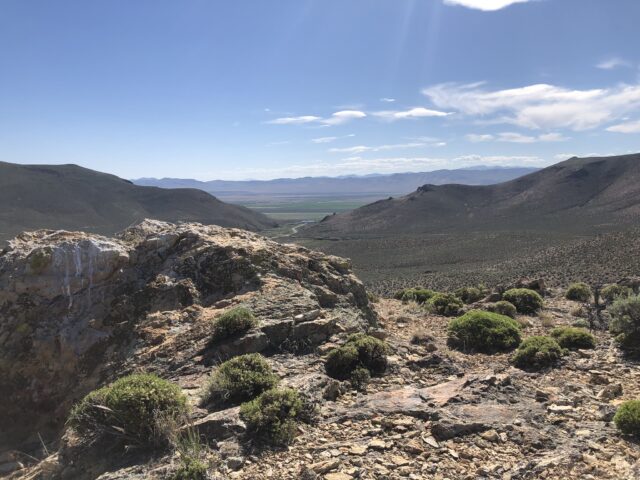
The report comes as the United States is intensifying efforts to secure domestic supplies of lithium, a mineral critical for electric vehicle batteries, renewable energy storage systems and growing artificial intelligence infrastructure. Nevada contains most of the country’s known lithium reserves and has become a focal point in the global race for so-called critical minerals.
Amnesty said more than 23,000 lithium mining claims have been registered across Nevada, transforming large areas of desert and mountain ecosystems into targets for extraction. The organization warned that mining operations could permanently damage fragile ecosystems that are already facing drought and water scarcity.
The report focuses heavily on the Thacker Pass lithium mine, operated by Lithium Americas. The project has faced years of opposition from Indigenous land defenders, environmental groups and local ranchers who say the mine threatens culturally significant land and burial sites tied to the massacre of Paiute people in the 19th century.
Amnesty argues that U.S. agencies relied on narrow consultation processes that failed to meet international standards outlined in the United Nations Declaration on the Rights of Indigenous Peoples (UNDRIP). The organization also noted that Lithium Americas is headquartered in Canada, where UNDRIP has been incorporated into federal law and into provincial law in British Columbia.
The report goes on to criticize the broader legal framework governing mining on U.S. public lands, arguing that many of the territories targeted for extraction overlap with lands historically stewarded by Indigenous Nations, particularly Western Shoshone communities.
“The classification of these lands as ‘public’ ignores the history of dispossession that made mining possible in the first place,” the report states.
Amnesty said the rapid expansion of lithium extraction reflects a growing contradiction within the global clean energy transition. While governments present electric vehicles and renewable technologies as climate solutions, Indigenous communities in mineral-rich regions are increasingly bearing the environmental and social costs of extraction.
Similar conflicts are unfolding across Indigenous territories in Mexico, Argentina, Chile and Bolivia, where communities have raised concerns about groundwater depletion, contamination and the industrialization of sacred landscapes.
“A just energy transition must respect Indigenous Peoples’ rights at every stage,” the report concludes. “Otherwise, the harms of the fossil fuel economy risk being repeated under a new green banner.”
Across the world right now, Indigenous peoples are facing a renewed assault on their lands, rights, and ways of life.
From extractive industries pushing deeper into ancestral territories, to governments rolling back hard-won protections,
the threat is global—and it is growing.
What makes this moment especially dangerous is how little attention it receives.
Stories like this are disappearing in real time. Mainstream media
barely covers it and the coverage is fragmented. The public is left without the context
needed to understand what is truly at stake.
That is exactly why IC Magazine exists..
For more than 20 years, IC has reported on Indigenous struggles worldwide — consistently, independently, and without compromise.
We don’t follow news cycles; we trace patterns. We don’t sensationalize; we provide context.
And when the world looks away, we stay focused.
But this work is increasingly difficult to sustain.
We refuse to lock our reporting behind a paywall. We don’t sell access through subscriptions.
And we don’t answer to advertisers. IC Magazine survives solely because readers like you choose to
support independent Indigenous journalism.
Please donate today if you can. Every contribution helps us to continue this crucial work.
Thank you,
John Ahni Schertow
Founder and Editor in Chief