Last Updated on May 16, 2026
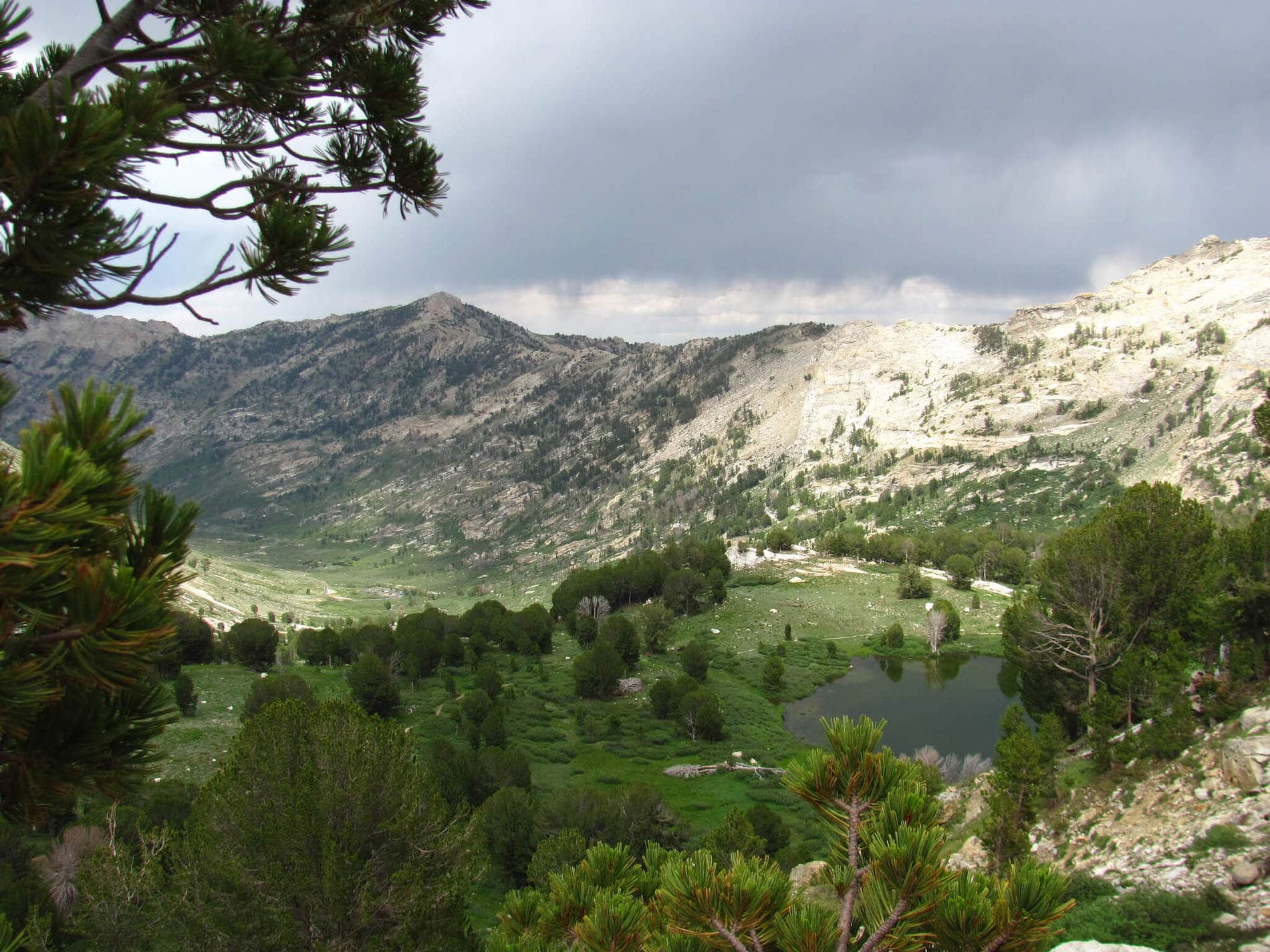
Construction tied to the expansion of U.S. President Donald Trump’s border wall is damaging a mountain that’s sacred to the Kumiai peoples in northern Mexico.
Heavy machinery and explosive blasts linked to wall construction near Tecate, Baja California, have cut into Cerro Cuchumá — also known as Kuchamaa or Tecate Peak — a mountain revered by the Kumiai, whose ancestral territory spans what is now the U.S.-Mexico border.
Community representatives say detonations began in recent weeks as contractors expanded sections of the border barrier through rugged terrain long left untouched because of the mountain’s cultural and ecological significance. Residents in nearby communities reported hearing repeated explosions without warning.
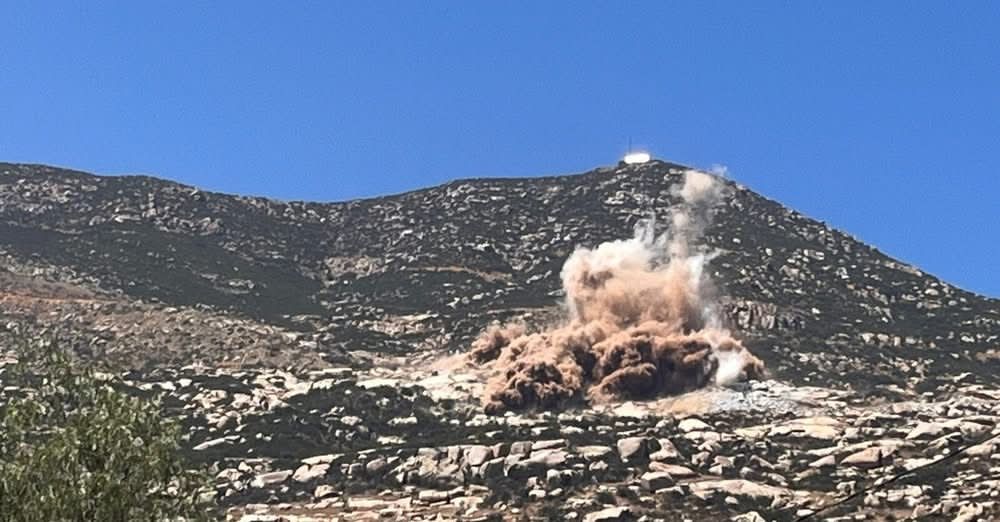
Detonation on Mount Cuchumá.
“For you, it’s just a mountain; for us, it’s our church,” Kumiai representative Norma Meza Calles told the Spanish news agency EFE.
The mountain holds deep ceremonial importance for the Kumiai, also known as the Kumeyaay in the United States. Oral histories and anthropological records describe Cuchumá as a place of spiritual training, ceremony and cultural transmission. Archaeological features, including cave paintings and monoliths, have also been documented in the area.
The site was added to the U.S. National Register of Historic Places in 1992 after years of advocacy by Kumiai spiritual leaders and preservation advocates. For decades, a stretch of the mountain remained free of border fencing under agreements intended to protect the sacred landscape. Indigenous residents now say that understanding was abandoned without consultation.
The conflict reflects a broader resurgence of border wall construction during Trump’s second administration. New federal funding approved in 2025 accelerated projects across the southern border, including in areas previously considered environmentally or culturally sensitive.
Advocates say the construction is proceeding under sweeping powers granted through the 2005 REAL ID Act, which allows the U.S. Department of Homeland Security to waive environmental and cultural protection laws for border barrier projects. Those waivers have previously overridden protections tied to the National Environmental Policy Act, the Endangered Species Act and federal historic preservation laws.
Kumiai leaders and residents say the damage extends beyond archaeology or landscape disruption. The mountain sits within a fragile ecological corridor home to native plants and wildlife adapted to the semi-arid Tecate region.
Community members also fear that restricted access to ceremonial areas will further sever cross-border cultural ties already strained by militarized border policies.
Officials in Baja California, including the state’s Secretariat of Culture, have called for an urgent review of the project, while Mexican President Claudia Sheinbaum said federal agencies were examining the potential impacts of the blasting on the sacred site.
Despite those appeals, construction has continued.
The destruction at Cuchumá is not an isolated case. Indigenous leaders and archaeologists across the border region say the accelerated expansion of Trump’s border wall has increasingly cut through culturally significant landscapes, sacred sites and ancient archaeological areas under the justification of national security.
In neighboring Arizona, contractors working on a new section of the border wall recently bulldozed part of the Las Playas Intaglio, a 1,000-year-old geoglyph in the Sonoran Desert sacred to the Hia-Ced O’odham and Tohono O’odham peoples.
The massive fish-shaped ground etching, located inside the Cabeza Prieta National Wildlife Refuge, was damaged after heavy machinery carved through roughly 60 feet of the site during wall construction.
Indigenous elders said federal officials and contractors had been warned about the site’s significance before construction began. Lorraine Marquez Eiler, a Hia-Ced O’odham elder, said the destruction represented not only the loss of an archaeological site but an attack on ancestral memory and ceremonial traditions.
Across the world right now, Indigenous peoples are facing a renewed assault on their lands, rights, and ways of life.
From extractive industries pushing deeper into ancestral territories, to governments rolling back hard-won protections,
the threat is global—and it is growing.
What makes this moment especially dangerous is how little attention it receives.
Stories like this are disappearing in real time. Mainstream media
barely covers it and the coverage is fragmented. The public is left without the context
needed to understand what is truly at stake.
That is exactly why IC Magazine exists..
For more than 20 years, IC has reported on Indigenous struggles worldwide — consistently, independently, and without compromise.
We don’t follow news cycles; we trace patterns. We don’t sensationalize; we provide context.
And when the world looks away, we stay focused.
But this work is increasingly difficult to sustain.
We refuse to lock our reporting behind a paywall. We don’t sell access through subscriptions.
And we don’t answer to advertisers. IC Magazine survives solely because readers like you choose to
support independent Indigenous journalism.
Please donate today if you can. Every contribution helps us to continue this crucial work.
Thank you,
John Ahni Schertow
Founder and Editor in Chief