Last Updated on June 16, 2014
By focusing on the Native American struggle for spiritual and cultural autonomy on disputed lands in the U.S. Southwest, “Trespassing” unpacks a deadly political and ethical controversy around land rights, uranium mining, nuclear testing and the disposal of nuclear waste, and examines the ability of a culture to bring itself to the brink of annihilation while simultaneously producing “gatekeepers” to combat that annihilation.
May 10, 2006 – ”Trespassing,” censored in more film festivals worldwide than it has been shown, reveals how the Colorado River Indian Tribes, Fort Mojave, Western Shoshone, Pueblo and Navajo were targeted by the nuclear industry.
Stewart Udall, former Interior Department secretary under presidents John Kennedy and Lyndon Johnson, appears in the film and calls for honesty from the United States regarding the mistakes of the Cold War and Atomic Age. Udall points out that Americans were told to trust those in power concerning radiation and uranium.
”Well, it turns out – and we’re learning more and more about it – that they made mistakes. And they lied. And now we have to confront this with the legacy of the Atomic Age. And that includes radiation, the waste, the dumps, the people that were harmed; and I think we have to demand the truth.”
Truth and censorship have become the key words in the making and distribution of ”Trespassing.”
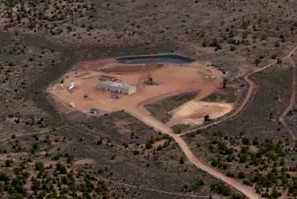
”Trespassing” documents the Colorado River Indian Tribes and Fort Mojave’s successful fight against the proposed Ward Valley nuclear dump and the ongoing Western Shoshone protest of nuclear testing at the Nevada Test Site and proposed nuclear dump at Yucca Mountain.
The film exposes the Cold War machinations of the nuclear industry, resulting in widespread cancer and respiratory diseases for Pueblos and Navajos working without protective clothing in Cold War uranium mines.
”Trespassing,” by Red Umbrella Productions, captured the Trustee Award at the 15th Arizona International Film Festival April 28, an award based on merit, which is not given out annually.
In the United States and worldwide, however, the film has been rejected by more film festivals than it has been accepted. (read the full review)
Across the world right now, Indigenous peoples are facing a renewed assault on their lands, rights, and ways of life.
From extractive industries pushing deeper into ancestral territories, to governments rolling back hard-won protections,
the threat is global—and it is growing.
What makes this moment especially dangerous is how little attention it receives.
Stories like this are disappearing in real time. Mainstream media
barely covers it and the coverage is fragmented. The public is left without the context
needed to understand what is truly at stake.
That is exactly why IC Magazine exists..
For more than 20 years, IC has reported on Indigenous struggles worldwide — consistently, independently, and without compromise.
We don’t follow news cycles; we trace patterns. We don’t sensationalize; we provide context.
And when the world looks away, we stay focused.
But this work is increasingly difficult to sustain.
We refuse to lock our reporting behind a paywall. We don’t sell access through subscriptions.
And we don’t answer to advertisers. IC Magazine survives solely because readers like you choose to
support independent Indigenous journalism.
Please donate today if you can. Every contribution helps us to continue this crucial work.
Thank you,
John Ahni Schertow
Founder and Editor in Chief