
Last Updated on August 3, 2018
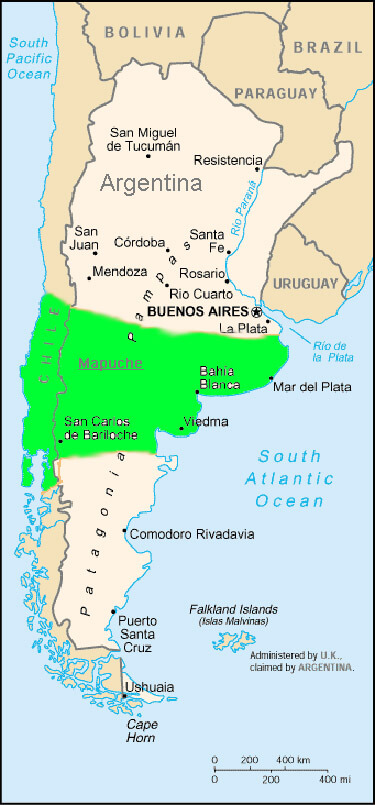
Here’s a few recent stories focusing on the current work of the Mapuche People…
On May 16, 2007, fourteen Mapuche activists temporarily occupied a property owned by Fernando Léniz, one of Chile’s most important forestry leaders…
From the Santiago Times – Mapuches entered Léniz’s property at 8 a.m. and left it at 5 p.m., after government officials assured that the National Corporation for Indigenous Development (Conadi) would meet with them to discuss their grievances. Juan Huichamán, spokesperson for the Mapuche community, explained that “the community mobilized because Conadi failed to respond to their demand for land.” (source)
Also recently, representatives from eleven Mapuche communities filed an appeal to protect the territory of the Lleu Lleu lake from mining exploitation. They say the mining activity threatens the Mapuche culture, and that it will change the natural balance by damaging places of cultural interest.
From Global Voices Online – “Another case [like this] is the construction of the Ralco dam by the Spanish company Endesa, where 381 indigenous families were relocated from an area that is now flooded. All of the cemeteries and ancestral ceremonial sites were lost.” (source)
Finally, just a couple days ago the Coordination of Mapuche Organizations (COM), an alliance representing some 35 Mapuche communites, temporarily broke off communications with the Chilean government after President Michelle Bachelet’s perceived failure to adequately address their demands.
From the Patagonia Times – “The government’s announcements were important, but we also need (the government) to clarify what procedures (it plans to follow), to clarify how it plans to advance on these issues that are so important for Mapuche rights…”
Continued participation, COM explained, would simply “support indigenous bureaucracy rather than our autonomous (political) participation.”
COM’s announcement came just one week after the highly influential human rights advocacy group Amnesty International (AI) released its latest annual report. Included in its rundown of human rights problems in Chile, AI drew attention to continued mistreatment of the country’s indigenous people (PT, March 23). (source)
Further Reading
Across the world right now, Indigenous peoples are facing a renewed assault on their lands, rights, and ways of life.
From extractive industries pushing deeper into ancestral territories, to governments rolling back hard-won protections,
the threat is global—and it is growing.
What makes this moment especially dangerous is how little attention it receives.
Stories like this are disappearing in real time. Mainstream media
barely covers it and the coverage is fragmented. The public is left without the context
needed to understand what is truly at stake.
That is exactly why IC Magazine exists..
For more than 20 years, IC has reported on Indigenous struggles worldwide — consistently, independently, and without compromise.
We don’t follow news cycles; we trace patterns. We don’t sensationalize; we provide context.
And when the world looks away, we stay focused.
But this work is increasingly difficult to sustain.
We refuse to lock our reporting behind a paywall. We don’t sell access through subscriptions.
And we don’t answer to advertisers. IC Magazine survives solely because readers like you choose to
support independent Indigenous journalism.
Please donate today if you can. Every contribution helps us to continue this crucial work.
Thank you,
John Ahni Schertow
Founder and Editor in Chief


