Last Updated on March 13, 2013
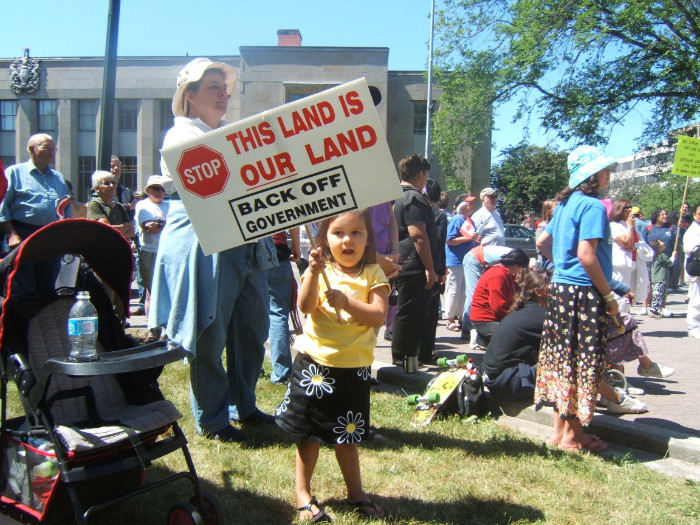
Today, April 17th, is the International Day of Peasant Struggle, as called for by la Via Campesina International — a day of action which commemorates the Massacre of Carajas on April 17, 1996 where 19 Peasants were killed and 69 injured while demanding land to live and work on.
In Switzerland, Spain, Sweden, Mozambique, Congo, Paraguay, Dominican Republic, Indonesia, Cameroon, Thailand, Colombia, Bangladesh, Germany, Brazil, Argentina, Canada , Bolivia, and France – Peasants and small farmers have organized events for this day.
From a Via Campesina Press Release:
This year, the African organisations will mainly protest against the EPAs (Economic Partnership Agreements) that are threatening their economies by pushing further trade liberalisation. As a result, cheap import of food products will keep destroying local livelihoods. Many African organisations will also join the global day of action against the EPAs on the 19th of April.
In Latin America, Agrarian Reform will be at the heart of the struggle this year. In Brazil for example, actions will be held in 14 states demanding President Lula to implement Genuine Agrarian Reform.
In Europe, peasants’ organisations are launching a call for the anti-G8 protests. Social movements from all over Europe will gather in Rostock, Germany in June to protest against the policies of the G8 governments benefiting transnational business instead of local communities! Meanwhile in Asia, peasants’ organisations will campaign for food sovereignty, farmer’s rights and against large dams destroying rural communities.
See here for a full list of the organized events.
Across the world right now, Indigenous peoples are facing a renewed assault on their lands, rights, and ways of life.
From extractive industries pushing deeper into ancestral territories, to governments rolling back hard-won protections,
the threat is global—and it is growing.
What makes this moment especially dangerous is how little attention it receives.
Stories like this are disappearing in real time. Mainstream media
barely covers it and the coverage is fragmented. The public is left without the context
needed to understand what is truly at stake.
That is exactly why IC Magazine exists..
For more than 20 years, IC has reported on Indigenous struggles worldwide — consistently, independently, and without compromise.
We don’t follow news cycles; we trace patterns. We don’t sensationalize; we provide context.
And when the world looks away, we stay focused.
But this work is increasingly difficult to sustain.
We refuse to lock our reporting behind a paywall. We don’t sell access through subscriptions.
And we don’t answer to advertisers. IC Magazine survives solely because readers like you choose to
support independent Indigenous journalism.
Please donate today if you can. Every contribution helps us to continue this crucial work.
Thank you,
John Ahni Schertow
Founder and Editor in Chief