Last Updated on July 28, 2014
The farmers of Daechuri and Doduri have long resisted the Korean government’s attempts to force their eviction in order to make way for the expansion of the “Camp Humphreys” (K-6) US Military Base. After years of legal battles, in December 2005, the Central Land Expropriation Committee approved a request for imminent domain acquisition of the two villages, instantly making the farmers criminals trespassing on federal property.
Three months later, the farmers marched to the local government office to declare that Daechuri and Doduri were autonomous from Korea. They renounced their citizenship and burned their residency cards. They had also began protesting on a daily basis.
One month after that, the government started a campaign of violence and intimidation against them. At first hundreds, then thousands of military riot police and plain-clothed thugs were sent in to force them off the land. But the determined communities only grew in strength, ultimately preventing every attempt to ruin and evict them. But n February, 2007, after “the destruction of their school, the demolition of vacant and re-occupied houses, dozens of politically motivated arrests (including of former village leader Kim Ji Tae), repeated police attacks, the fencing off of their fields with barbed wire, and arbitrary police checkpoints on the roads leading to the village,” the Daechuri struggle came to an end. The community was forced to sign a deal and accept their displacement..
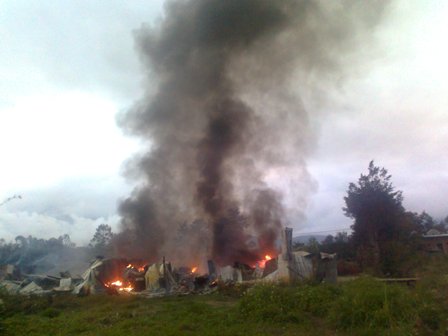
Shortly before leaving their land, a ceremony was held to mark the conclusion. “The residents who had left earlier, and those who had stayed until the end, came together to have the ceremony. The villagers set fire to the two bamboo guardian statues that stood at the entrance of the village. They wept as they watched the statues burn…”
While they were still burning “the residents left the field, carrying a symbolic peace boat, decorated with flowers. As they approached the Daechu Elementary School yard, someone said to Byeong Cheol, an elementary school student of the village, who was riding in the boat, “Byeong Cheol, when you grow up, you must take the village back.”
Produced by 5 students who sought to learn about Korean culture, “Daechuri” documents the struggles of the farmers in Pyeongtaek, South Korea.
Across the world right now, Indigenous peoples are facing a renewed assault on their lands, rights, and ways of life.
From extractive industries pushing deeper into ancestral territories, to governments rolling back hard-won protections,
the threat is global—and it is growing.
What makes this moment especially dangerous is how little attention it receives.
Stories like this are disappearing in real time. Mainstream media
barely covers it and the coverage is fragmented. The public is left without the context
needed to understand what is truly at stake.
That is exactly why IC Magazine exists..
For more than 20 years, IC has reported on Indigenous struggles worldwide — consistently, independently, and without compromise.
We don’t follow news cycles; we trace patterns. We don’t sensationalize; we provide context.
And when the world looks away, we stay focused.
But this work is increasingly difficult to sustain.
We refuse to lock our reporting behind a paywall. We don’t sell access through subscriptions.
And we don’t answer to advertisers. IC Magazine survives solely because readers like you choose to
support independent Indigenous journalism.
Please donate today if you can. Every contribution helps us to continue this crucial work.
Thank you,
John Ahni Schertow
Founder and Editor in Chief