Last Updated on December 22, 2025
Indigenous peoples achieved a historic shift in 2025. In October, Taiwan passed the Pingpu Indigenous People’s Identity Act, formally recognizing groups like the Siraya, Makatao, and Taivoan as Indigenous peoples. For the 980,000 people who identify as Pingpu, the moment is historic.
The law restores what Pingpu groups were long denied: constitutional protections and political representation. For communities the state once treated as nonexistent, that’s a seismic change.
For the first time, Pingpu groups can formally apply for legal recognition. That became possible after a 2022 Constitutional Court ruling cracked open the political space the state had long closed off. Under the Pingpu Indigenous People’s Identity Act, however, the power to define Indigeneity ultimately rests within state institutions.
The recognition process now relies on strict state criteria: language ability, cultural practice, genealogical proof, and household records. Taiwan’s Council of Indigenous Peoples evaluates applications using these benchmarks, deciding who officially “counts.”
The stakes are larger than one law or one island. Around the world, Indigenous rights exist on paper, yet states wield the power of definitional violence. It gets to decide who qualifies as Indigenous, when, and how.
Definitional violence is real, as states turn lived identities into checkboxes or exclude nations forcibly assimilated. Indigenous peoples have long resisted being defined by states, notably resisting any closed definitions by states at the United Nations, time and again.
Some see the Pingpu Indigenous Identity Act as a breakthrough; a long-overdue redress to centuries of erasure toward restoring rights to Taiwan’s Indigenous communities. But not all are convinced the Act will deliver real change. As activist Iban Nokan from the Atayal nation warns, “‘recognition’ without genuine autonomy risks reproducing colonial dynamics under a new label.”
The Pingpu peoples, including groups such as the Siraya, Taivoan, Makatao, Taukat, Kaxabu, Pazeh, Papora, Papulu, and Ketagalan, historically inhabited Taiwan’s lowland plains, coastal areas, and river valleys as Austronesian-speaking communities.
Pingpu communities endured successive foreign regimes, such as the Qing, Japanese colonial government, and later the Republic of China, which pressured or ‘incentivized’ them to adopt Han languages and classifications in more or less forced projects of assimilation. As a result, Pingpu descendants were often registered as “Han,” excluded from Indigenous-status protections, as their languages and customs started fading away.
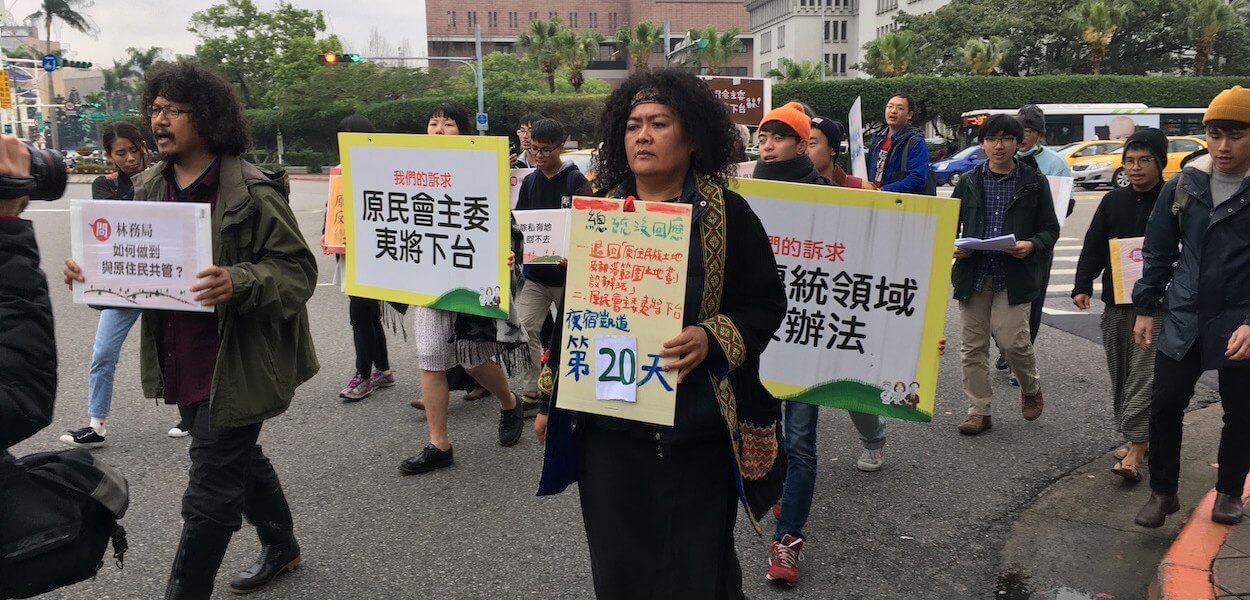
Over the last decade, Tsai Ing-wen’s government has laid the groundwork for major Indigenous reforms. This timing was not accidental; public pressure is also rising. In the weeks leading up to Tsai’s 2016 apology, Indigenous protesters camped outside the Presidential Office, calling for hunting rights, land protections, and concrete legal reforms, making inaction politically costly.
President Tsai (left) travels to Sandimen Township in Pingtung County to attend a harvest festival held by the Paiwan and Rukai people. (2016/08/15). Photo: Office of the President, Republic of China (Taiwan) (CC)
On August 1, 2016, Tsai issued a historic apology acknowledging “four centuries of pain and mistreatment” inflicted on Indigenous peoples. This apology wasn’t mere rhetoric; it came with a promise to address past harms by reforming discriminatory laws. This initial shift paved the way for the Pingpu Indigenous Identity Act.
For many Pingpu activists, the 2025 recognition law is not a sudden victory and much less a gift from the state. It is the culmination of decades of petitions, lawsuits, and cultural revival work.
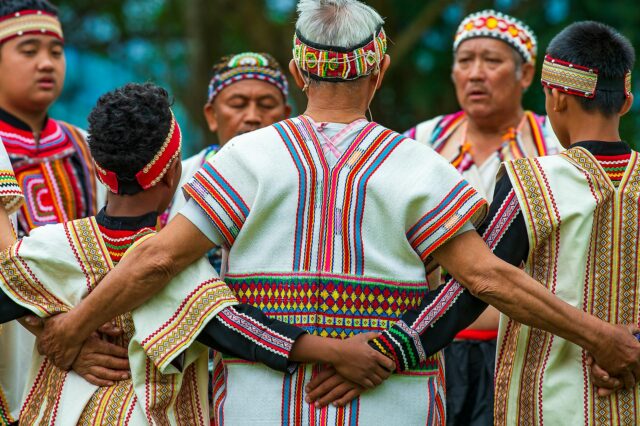
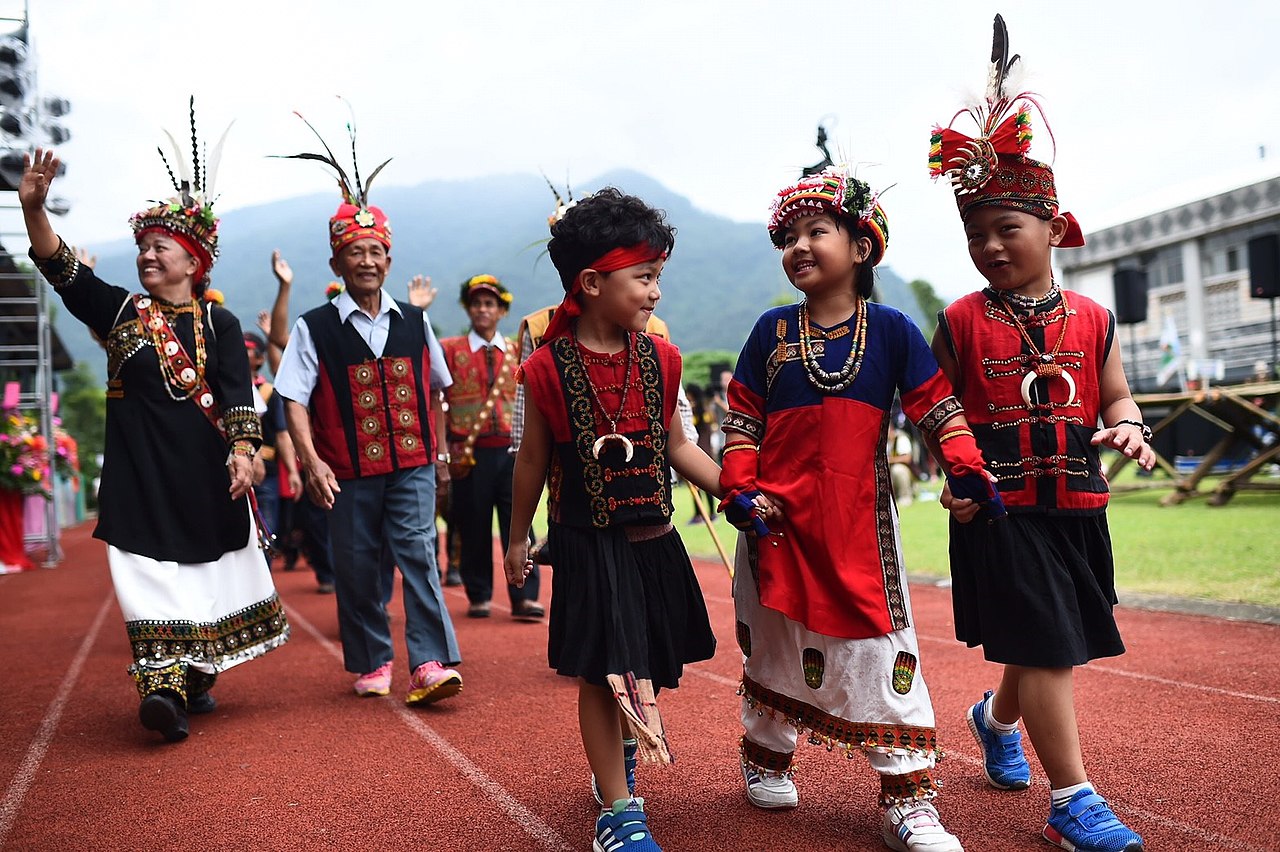
The Makatao community submitted a formal application for official Indigenous status in November 2024, following three decades of elder- and youth-led intergenerational activism. Then in May 2025, several Pingpu groups held a news conference outside the Legislative Yuan, wearing traditional clothing as they called for an end to “systematic exclusion.”
For decades, Pingpu peoples such as the Siraya, Taokas, and Pazeh were told they were “not Indigenous enough” to claim Indigenous belonging. They were denied self-identification for lacking state-approved markers such as household registration records, documented language use, or continuous cultural practice. This reinforced definitional violence exercised through state-designated classifications.
Definitional violence is the state power to define who counts as Indigenous. For Pingpu communities, it meant generations of families written out of history. It meant a legally enforced disappearance: an administrative form of erasure that made Indigenous histories invisible.
Pingpu belonging exists through song and story, not just documents. Siraya folk melodies are tied to specific villages and landscapes. Pazeh ancestral songs open with lines like “Oh! Ayan, my ancestor,” linking memory, kinship, and land across generations. These practices sustained belonging as official records erased it, preserving ties to place that outlasted colonial rule and state archives.
Settler colonialism still casts a long shadow across Taiwanese society. Indigenous communities experience disproportionately high unemployment, with an average household income 60 percent below the national level. They face striking educational and health-outcome gaps: only about 57.6 percent of Indigenous high-school graduates go on to collegiate education (versus 89.0 percent of non-Indigenous peers). Their age-standardized mortality rate (659.1 per 100,000) is far higher than the national norm of roughly 390 per 100,000.
Pingpu marginalization has shaped Taiwan’s political life. Scholar Sabrina Wong notes that “even if an Indigenous person runs for office, they hardly ever receive support from other Indigenous people.” A single definitional bill won’t fix all historical wrongs. Even if more people are formally recognized as Indigenous, these historical fractures will continue to shape voting patterns and alliances.
The electoral system reinforces these inequalities. There are dozens of Indigenous nations, but they are grouped in just two districts (“Mountains” and “Plains”) with only six reserved seats in the national legislature. Smaller or unrecognized nations are often marginalized, and representation tends to be shaped by major political parties rather than Indigenous peoples themselves.
While the Pingpu Indigenous People’s Identity Act opens doors to official status, community representative Kaisanan Ahuan warns it might remain “status recognition in name only,” if it fails to secure control over ancestral lands, self‑governance, or real institutional inclusion under the Council of Indigenous Peoples.
Even as debates over autonomy and implementation continue, the Pingpu Indigenous Identity Act has pushed Taiwan into a broader conversation that goes beyond bureaucracy or political rights.
For Pingpu activist Teyra Yudaw, recognition was never just about access to protections. It was also about challenging how the state and the public understand indigeneity in the first place. “A lot of average Taiwanese people would say to me, you’re Indigenous. You’re not Taiwanese.” Yudaw said. “I say, because I’m Indigenous, I am a real Taiwanese person.”
Yudaw points to a deeper struggle over who counts as “Taiwanese.” His claim flips a common assumption that treats Indigeneity as outside the nation, reframing Indigenous peoples as the foundational first members of Taiwan.
Nation-states often try to ‘fixate’ identity through official categories, while Indigenous communities assert identities rooted in history, belonging, and relationships that exceed bureaucratic labels. Recognition exposes the gap between legal status and material control over land, a divide that shapes Indigenous politics far beyond Taiwan.
Taiwan’s politics of Indigenous recognition may also be a message to its neighbors. China does not recognize “Indigenous peoples” as a separate legal category. Indigenous people are classified under broader “minority nationalities,” with policies that emphasize a unified “Chinese nation” and promote “ethnic unity,” which critics say increases assimilationist pressures and tightens ideological control. It is a politics of minoritization that denies self-determination as politics of elimination rage through nations such as the Uyghur.
Asia lacks a uniform approach to Indigenous recognition. Some countries grant distinct legal rights, while others refuse recognition. In that regional context, Taiwan’s approach, formally granting Indigenous legal status stands out as relatively progressive, even if deeply imperfect in practice.
The fact that Taiwan offers a politics of Indigenous recognition contrasts with China, indicating that the Pingpu Indigenous People’s Identity Act operates on the global stage. As pressure from mainland China intensifies, Taiwan has incentives to emphasize a democratic identity through Indigenous politics of recognition. Presenting itself internationally as a rights-respecting, pluralistic society helps strengthen its diplomatic position and widen its international alliances.
It also consolidates national support from the ground up: by formally recognizing Pingpu communities, the government signals inclusion seeking support from Indigenous and local domestic sectors. This reinforces national identity and public perception of Taiwan as a democratic society.
For Tsai Ing-wen’s Democratic Progressive Party, which maintains that Taiwan is a sovereign nation, Indigenous policies can function on two levels at once: they address real historical injustices while also signaling Taiwan’s autonomy to the world.
The Pingpu Indigenous Identity Act is both a domestic reform and a diplomatic message, strengthening Taiwan’s moral standing at a moment of rising cross-strait tension.
This isn’t to say the Act shouldn’t have been passed. Whether it was performative, aimed at gaining moral high ground on the global stage, or a politics of reconciliation, it can be an opportunity.
Still, the criteria for defining who counts as Indigenous shouldn’t come from the state that once suppressed these communities, but from Taiwan’s ancestral nations themselves.
This article is a part of Hotspots, a journalistic collaboration between IC, Professor Manuela Picq and her students at Amherst College.
Across the world right now, Indigenous peoples are facing a renewed assault on their lands, rights, and ways of life.
From extractive industries pushing deeper into ancestral territories, to governments rolling back hard-won protections,
the threat is global—and it is growing.
What makes this moment especially dangerous is how little attention it receives.
Stories like this are disappearing in real time. Mainstream media
barely covers it and the coverage is fragmented. The public is left without the context
needed to understand what is truly at stake.
That is exactly why IC Magazine exists..
For more than 20 years, IC has reported on Indigenous struggles worldwide — consistently, independently, and without compromise.
We don’t follow news cycles; we trace patterns. We don’t sensationalize; we provide context.
And when the world looks away, we stay focused.
But this work is increasingly difficult to sustain.
We refuse to lock our reporting behind a paywall. We don’t sell access through subscriptions.
And we don’t answer to advertisers. IC Magazine survives solely because readers like you choose to
support independent Indigenous journalism.
Please donate today if you can. Every contribution helps us to continue this crucial work.
Thank you,
John Ahni Schertow
Founder and Editor in Chief