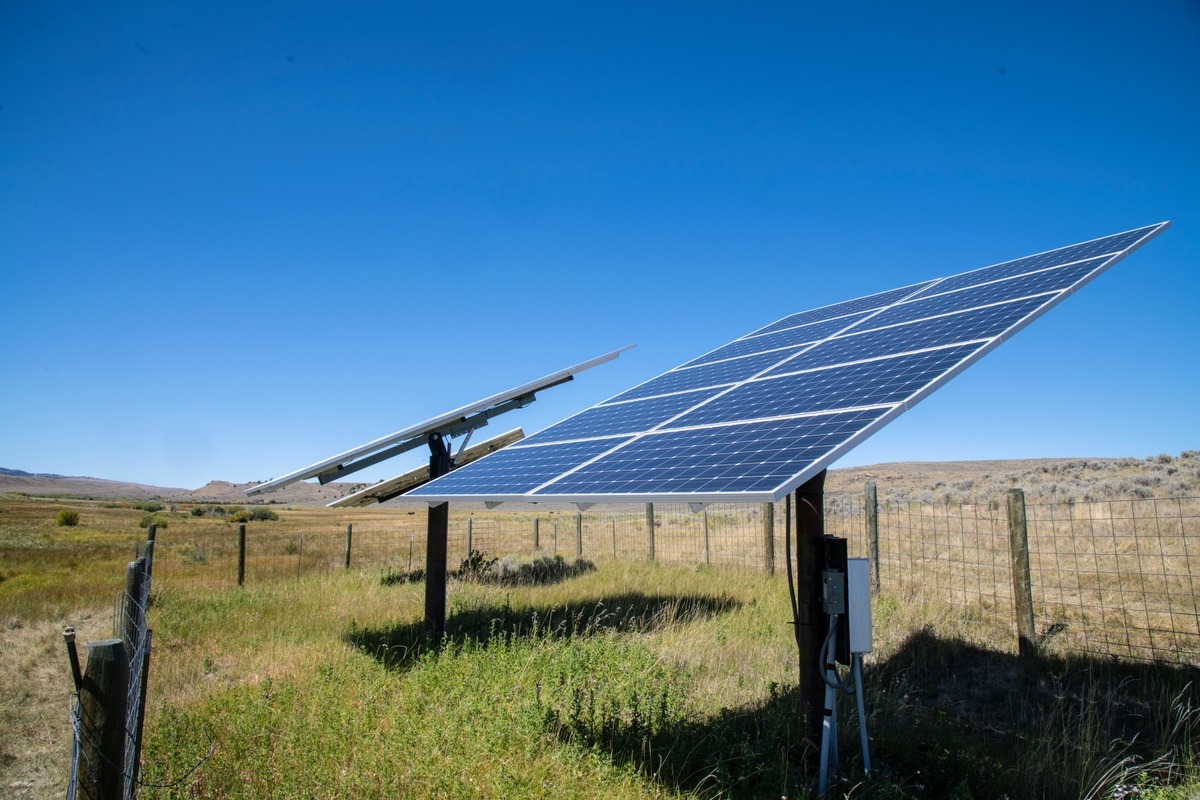

Last Updated on October 9, 2026
This literature review began with a broad search using the keywords “Indigenous, Solar Power” and “Solar Power, Indigenous Led,” examining academic journal articles from Google Scholar and PubMed before extending into some grey, non-academic journal articles.
At this juncture, solar ‘systems’ are emerging independently, semi-autonomously, and as an energy source which feeds directly into the power grid through centralized solar farms.
The impact each sub-sector has – or has the potential to have – must be analyzed and tracked for structural imbalances, incongruencies in systems, authoritarian control of all solar options in some possible cases, and the potential for coexistence with maximum efficiency outcomes which support individuals, communities, and businesses or institutions such as hospitals – both in times of crises and in sustained access to a larger grid.
As solar initiatives have the potential to curb extractive activity in vulnerable regions, a larger conversation must emerge which maintains a larger focus on environmental justice along with necessary fiscal opportunities and progress, and which celebrates the public / environmental health milestones along the way.
The following aggregated research reflects emerging issues that are gaining academic attention, while also revealing identifiable gaps in the existing literature. These gaps can, in some cases, be identified through deduction from the available research and point toward areas requiring further investigation.
“The ongoing history of setter colonialism is inextricable from the infrastructures of energy and extraction that provide its material foundation”.
“Ultimately, this article argues that Indigenous solarities Indigenous self-determination concerns relate to the nonuse of solar energy on the reservation, burgeoning energy security and poverty needs, and unmet investments in aging infrastructure on the CRIT reservation.”
Titled, ‘Design and analysis of nuclear and solar-based energy, food, fuel, and water production system for an indigenous community’ we hear:
“As a case study, the Saugeen First Nation Indigenous community in the Bruce Peninsula in Ontario, Canada, is selected for meeting the demands of useful commodities where an integration of a newly developed multigenerational system with an existing nuclear reactor is achieved in order to provide food security, supply the freshwater for drinking purposes, and meet the community’s electricity and heat demands. Moreover, to exploit the existing thermophysical properties of fluids in the nuclear system, a hydrogen generation unit is proposed. The novel integration is enhanced the current nuclear system and increased the variety of useful outputs.”
Scholars recently analyzed a decade-plus year old solar project in California and found rampant themes concerning: “the nonuse of solar energy” on the reservation as well as burgeoning issues at the intersectional points of poverty and energy security, as “unmet investments in aging infrastructure” on the affected reservation.
“Indigenous self-determination concerns relate to the nonuse of solar energy on the reservation, burgeoning energy security and poverty needs, and unmet investments in aging infrastructure on the CRIT reservation.”
It has been further documented that while solar and wind projects are ultimately expanding worldwide, poor or hasty planning can have devastating impacts on local biodiversity, while compounding variables further endanger Indigenous land rights.
One study concluded that solar had more potential to impact Indigenous livelihood than wind power. Intentional, long-sighted, development is crucial to mitigating both unintended risks and ongoing challenges.
“The share of wind and solar energy in global energy mix is rising rapidly. Despite their great potential for reducing carbon emissions, poorly planned wind and solar farms may encroach on socio-ecologically sensitive areas, threatening biodiversity and Indigenous people’s traditional land uses.
However, these potential risks associated with wind and solar farm development worldwide are poorly understood. Here, we evaluate the potential biodiversity and Indigenous risks from wind and solar energy development by examining the extent to which global wind and solar farms are situated within or adjacent to socio-ecologically sensitive areas.
Our analysis revealed that 13,699 wind and solar farms or 14.4 % of the farms’ total footprint area are within protected areas, critical habitats, and Indigenous people’s lands, occupying a total of 26,840 km2 of those socio-ecologically sensitive areas.
Wind and solar farms overlap with the distribution ranges of 2,310 threatened amphibians, birds, mammals, and reptiles, accounting for 36.3 % of the world’s 6,362 threatened vertebrate species.
The encroachment of solar and wind farms on sensitive areas mostly occurs in economically developed countries with substantial wind and solar energy facilities, while many developing countries in the tropics tend to have a higher proportion of such farms situated within sensitive areas.
Compared to wind farms, solar farms pose greater risks to biodiversity and Indigenous people’s lands. These findings provide valuable insights into the socio-ecological risks of wind and solar energy development and highlight the urgent need for strategic planning to mitigate the risks.”
Another important area explored catered to the needs of some of the more isolated Indigenous communities globally and measured outcomes such as technological success and aggregated community satisfaction reports.
“In remote Orang Asli communities, especially in Pahang, where the majority of these communities live, solar lighting is a practical way to address electricity shortages. Energy reliability is increased by incorporating solar lights into schools, which serve as important educational hubs and central gathering spaces for them.
The purpose of this study is to evaluate the effectiveness of solar lighting applications for a remote school with 40 school users, who represent a diverse group of staff, who will participate voluntarily. In a case study conducted in Jerantut, the effects of solar lights are assessed using field installations, observations, and questionnaire surveys. The study assesses community involvement, sustainability, and energy efficiency.
The findings show night illumination has significantly improved, going from 15 lux to 100 lux, and almost 90% of the respondents are satisfied. These results address important energy concerns in rural areas, foster a resilient learning environment, and add to the larger conversation on sustainable energy availability.”
A positive outcome for food production came from the following study which seemed to demonstrate that a solar panel-induced shading agrovoltaic synergistic system did not have an impact on pollinators.
“While panel-induced shading reduced flower unit densities while enlarging display areas of several native wildflowers, it did not significantly alter pollinator community composition. The findings demonstrate that ecological restoration at GPVs can potentially reconcile renewable energy production with biodiversity conservation in harsh, weed-prone environments.”
Further investigation revealed Indigenous-led solar projects emerging as a ‘force of nature’ in tribal reservations – with millions being invested in the wake of pipeline protests on Native lands.
Independent solar ownership could prove an important step forward for Native communities. In tribes like the Navajo, the people have watched in horror as isolated elders froze to death during harsh winters. Isolated and community bridged solar structures could easily address this ongoing, unacceptable state of affairs in terms of energy security, public health, and community level and individual health.
According to Felicity Barringer, “the Navajo Nation has the most capacity, but its troubled energy history and culture of livestock grazing make solar development fraught.”
Nevertheless, it’s unclear why there can’t be a transition to Agrovoltaics (solar panels designed to be synergistic with pastured livestock) to bring more energy, fiscal benefits, and diversity of investment for the Tribe.
In any event, shifts are happening across the world. Certain groups are financing individual and community level solar start-ups until they become self-sustaining and a part of the growing network of solar infrastructure. Unfortunately, these companies seem to be focused on urban areas in developed countries at this time.
“Although renewable energy could provide power to remote locations, its adoption is lagging, particularly in the most vulnerable countries. The consequences of this delay reflect the human impacts of an unjust transition. Globally, 745 million people still lack access to electricity and are facing the harms of energy poverty on health and wellbeing.”
There is great need for solar energy in remote regions but efforts to expand access are falling short of the greater need – as the harms of energy insecurity and lack of access manifest different impacts on public health and individual wellbeing.
Another study highlights how “More than 3 billion people do not have access to clean energy and primarily use solid fuels to cook. Use of solid fuels generates household air pollution, which was associated with more than 2 million deaths in 2019. Although local patterns in cooking vary systematically, subnational trends in use of solid fuels have yet to be comprehensively analysed. We estimated the prevalence of solid-fuel use with high spatial resolution to explore subnational inequalities, assess local progress, and assess the effects on health in low-income and middle-income countries (LMICs) without universal access to clean fuels.”
Beyond the public health and entrepreneurial opportunities, solar power can help households shift away from burning solid fuels indoors for cooking which has a terrible impact on environmental health within the family unit. More research is needed to assess and address universal access to clean fuels.
This leads to another highly controversial energy usage issue:
“Recent advancements in Artificial Intelligence (AI) and data center infrastructure have brought the global cloud computing market to the forefront of conversations about sustainability and energy use.
Current policy and infrastructure for data centers prioritize economic gain and resource extraction, inherently unsustainable models which generate massive amounts of energy and heat waste.”
One team “proposes the formation of policy around earth-friendly computation practices rooted in Indigenous models of circular systems of sustainability. By looking to alternative systems of sustainability rooted in Indigenous values of aloha ‘āina, or love for the land, we find examples of traditional ecological knowledge (TEK) that can be imagined alongside Solarpunk visions for a more sustainable future… One in which technology works with the environment, reusing electronic waste (e-waste) and improving data life cycles.”
Switching gears back to the circular reasoning around data centers and the debate about the impact on the environment, this is probably a gap in research which should be identified for further study. Let’s take a look at another study about combining ecology-driven, environmentally sound land usage concepts developed to offset negative impacts of power installations.
To optimize agrivoltaic systems for crop growth, energy pathways must be characterized. While the solar panels shade the crops, they also emit longwave radiation and partially block the ground from downwelling longwave radiation.
A deeper understanding of the spatial variation in incoming energy would enable controlled allocation of energy in the design of agrivoltaic systems. The model also demonstrates that longwave energy should not be neglected when considering a full energy balance on the soil under solar panels…
Growing demand for food and clean energy has led to competition between croplands and solar arrays for land. An estimated 6000 TWh of PV [photovoltaic] power will be generated in 2050, most of which can be met with building integrated PV and rooftop PV.
The remaining demand can be met with land-based solar farms. To mitigate competition, some land-based solar farms could be converted to agrivoltaic systems, in which crops are grown under solar panels. Agrivoltaics simply refers to land where both solar panels and agriculture are present. This can take many forms, including rows of crops grown in the space between panels, panels on top of a greenhouse, or even livestock grazing around the panels…
While there is high potential for agrivoltaics, maximizing its performance will require a deeper understanding of the underlying physical processes.
Models can be used to help predict the reduction in crop yield, to maximize crop yield, to minimize heterogeneity in soil moisture, or to optimize the system in other ways. There is still much to learn, including the best crop species for agrivoltaics, how to optimize solar panel configurations, and to what extent crop evapotranspiration cools off the panels. The heterogeneity of longwave radiation at the ground surface has not been widely explored…
The model predicts locations and intensities of microclimates based on array geometry and local climate. It could be manipulated to optimize parameters for a solar array. For example, the model could be reversed to output panel geometry based on the energy and water needs for a certain crop.”
“Growing demand for food and clean energy has led to competition between croplands and solar arrays for land.” As demand increases, all related industries and communities should familiarize themselves with agrovoltaic systems.
The term ‘agrovoltaics’ – or APV (agricultural photovoltaic) systems – grew from a 1982 publication by Goetzberger and Zastrow on the “coexistence of power generation and crop cultivation.” Please pay note to the citations within the cited article here:
“Solar photovoltaic (PV) infrastructure integrated with agricultural production has been considered specifically for effects on soil moisture, evapotranspiration, and plant water-use efficiency with potential (irrigation) water savings, from shading effects (Barron-Gafford et al., 2019).
However, ramifications of rainfall redistribution by PV infrastructure on Hortonian overland flow (infiltration excess) and subsequent soil erosion need to be considered to avoid potential catastrophic acceleration of soil degradation, for the following three reasons…
”Regions with the most PV energy potential overlap with regions of high soil erosivity and erodibility. Simply put, many agronomically productive regions where the PV energy generation potential is good, are the same regions where soils are most severely at risk of erosion because rainfall intensities are high and infiltration capacities are low.
Traditionally, the most affected regions are those with Mediterranean-like climates, mainly found in California, Chile, South Africa, Australia, southern Europe, northern Africa, and the Middle East. However, soil degradation extends beyond Mediterranean regions with 75 % of global agricultural soils being severely degraded (Scholes et al., 2018), mainly due to low soil organic matter contents as well as decreased soil structure and infiltration rates.
PV infrastructure redistributes rainfall, thereby worsening erosivity (Fig. 1). Although PV infrastructure reduces the kinetic energy of the rainfall in the rain-shaded part of the soil, by redistributing the rainfall to where the panels drain (Choi et al., 2020), the infiltration capacity of the soil at the panel discharge sites will be exceeded at lower rainfall intensities.
Therefore, PV infrastructure has a positive effect on erosion by reducing rainsplash erosion in the rain-shaded part of the soil, and may improve infiltration if vegetation cover is enhanced in the sun-shaded part of the soil. However, the trade-off is concentrated drainage of rainfall as panel discharge, which increases the occurrence of overland flow (at lower rainfall intensities) underneath and immediately downslope from panel discharge sites.
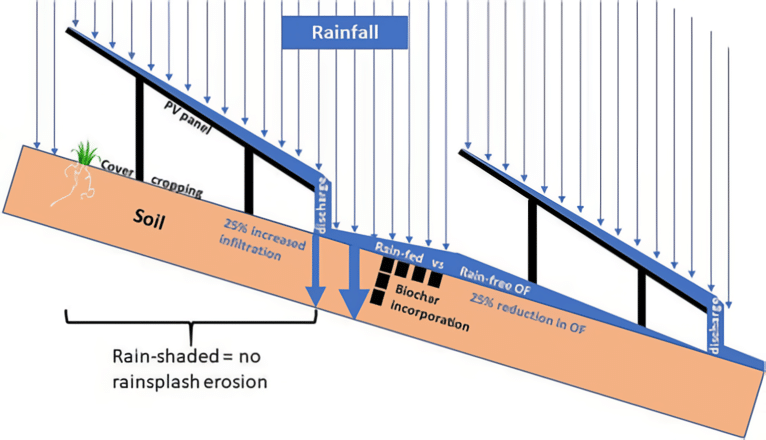
Fig. 1. Conceptual sketch of rainfall redistribution by a simple example of PV infrastructure. The width of the rainfall arrows is proportional to the width of the discharge and overland flow (OF). Rainsplash erosion is reduced by the PV panels, but rainfall is concentrated in panel discharge, leading to increased OF and erosion. Biochar incorporation can increase the soil sponge function by reducing OF – and increasing infiltration – by 25 % on average, according to meta-analyses.
For most regions, rainfall intensities are expected to increase this century. Global soil erosion by water is predicted to increase by 30–66 % by 2070 (Borrelli et al., 2020, Borrelli et al., 2022a). Recent projections are that 80–85 % of the global land surface will have an increasing trend in rainfall erosivity by, on average, around 30 % by 2050–2070 (Panagos et al., 2022), including also non-Mediterranean regions, such as central and northern Europe (Borrelli et al., 2022b).”
One team of scientists investigated the use of a foldable solar panel system equipped with a dynamic tracking algorithm for agrivoltaics system (AVS) applications. It aims to simultaneously meet the requirements for renewable energy and sustainable agriculture.
The design focuses on improving solar energy capture while facilitating crop growth through adjustable shading.
The results show that foldable panels, controlled by the tracking algorithm, significantly outperform fixed panels in energy efficiency, achieving up to a 15% gain in power generation and uniform power generation throughout the day.
Despite the presence of shadows of adjacent panels in the early morning and late evening, the system’s effectiveness in creating microclimates for diverse crops demonstrates its substantial value.
The foldable design not only protects crops from adverse climate conditions across different seasons but also generates energy efficiently. This demonstrates a step forward in sustainable land use and food security.
“We report for the first time that microclimate, growth, photochemistry and yield performances of mungbean were improved under APV system in a tropical environment. The improved performances of mungbean under EPV compared to WPV suggest that PV orientation is important and should not be overlooked in APV system designs.”
“This study investigates the use of a foldable solar panel system equipped with a dynamic tracking algorithm for agrivoltaics system (AVS) applications.
It aims to simultaneously meet the requirements for renewable energy and sustainable agriculture.
The design focuses on improving solar energy capture while facilitating crop growth through adjustable shading. The results show that foldable panels, controlled by the tracking algorithm, significantly outperform fixed panels in energy efficiency, achieving up to a 15% gain in power generation and uniform power generation throughout the day.
Despite the presence of shadows of adjacent panels in the early morning and late evening, the system’s effectiveness in creating microclimates for diverse crops demonstrates its substantial value. The foldable design not only protects crops from adverse climate conditions across different seasons but also generates energy efficiently.
This demonstrates a step forward in sustainable land use and food security.”
Space Based Solar Power (SBSP)
There is another crucial component that should be addressed as well:, which is the costly exploration into Space Based Solar Power (SBSP). The following is from NASA’s Office of Technology, Policy, and Strategy from 2024.
“This study evaluates the potential benefits, challenges, and options for NASA to engage with growing global interest in space based solar power (SBSP). Utilizing SBSP entails in-space collection of solar energy, transmission of that energy to one or more stations on Earth, conversion to electricity, and delivery to the grid or to batteries for storage. Experts in both the aerospace and energy sectors are debating the benefits of SBSP as more organizations globally begin SBSP technology development programs. Proponents claim SBSP could deliver large amounts of electricity at competitive prices and with fewer greenhouse gas (GHG) emissions than terrestrial renewable electricity technologies while accelerating development of the space economy. Skeptics say SBSP has no clear development path and would divert billions of dollars from known terrestrial solutions while damaging the environment. While it is generally understood that SBSP is cost prohibitive and technically infeasible today, this study assesses operating SBSP systems in 2050. Part of NASA’s mission is to innovate for the benefit of humanity – it is through this lens that the Agency weighs whether and how to support SBSP development…
Aerospace provided data and analysis, including rationales for their methodologies, to NASA OTPS. To address the two questions in this study, we (OTPS) leveraged the data provided by Aerospace and performed an analysis to independently validate ConOps elements (such as orbital transfer and assembly times) and cost outputs for each design reference system and to estimate the GHG emissions of developing and operating each system. We also gathered data from authoritative sources on other electricity production technologies for comparison with the two design reference systems, primarily from NREL. We conclude with sensitivity analyses to explore potential effects on SBSP system costs of modifying parameters which could reasonably vary.”
This is not the usual format for articles on IC but since solar power (and other clean energies) seems to be moving into another potential resource conflict on a global (and beyond) scale with implications on the environment, vulnerable populations, and potential fiscal disasters, it seems important to let the scientists studying and publishing let the data speak clearly with minimal yet subtly critical commentary.
For those who thought / hoped that clean energy would be a ‘clean’ transition, this seems to simply not be the case.Hopefully, this article can shine the light of day on some of the issues which have been unfolding in the dark.
Guaranteeing access to information, coupled with vigilance,strategy, and informed community health workers will be needed as well as cooperative efforts with an eye to the sky while grounded in what works best for each Indigenous Nation is both crucial and optimal to find freedom to create what works best and in demanding the resources which are obviously in supply.
Across the world right now, Indigenous peoples are facing a renewed assault on their lands, rights, and ways of life.
From extractive industries pushing deeper into ancestral territories, to governments rolling back hard-won protections,
the threat is global—and it is growing.
What makes this moment especially dangerous is how little attention it receives.
Stories like this are disappearing in real time. Mainstream media
barely covers it and the coverage is fragmented. The public is left without the context
needed to understand what is truly at stake.
That is exactly why IC Magazine exists..
For more than 20 years, IC has reported on Indigenous struggles worldwide — consistently, independently, and without compromise.
We don’t follow news cycles; we trace patterns. We don’t sensationalize; we provide context.
And when the world looks away, we stay focused.
But this work is increasingly difficult to sustain.
We refuse to lock our reporting behind a paywall. We don’t sell access through subscriptions.
And we don’t answer to advertisers. IC Magazine survives solely because readers like you choose to
support independent Indigenous journalism.
Please donate today if you can. Every contribution helps us to continue this crucial work.
Thank you,
John Ahni Schertow
Founder and Editor in Chief

