
Last Updated on April 10, 2025
North Dakota regulators approved the siting permit for a massive crude oil pipeline. The multibillion dollar pipeline that would transport thousands of barrels of Bakken crude is now one step closure to construction.
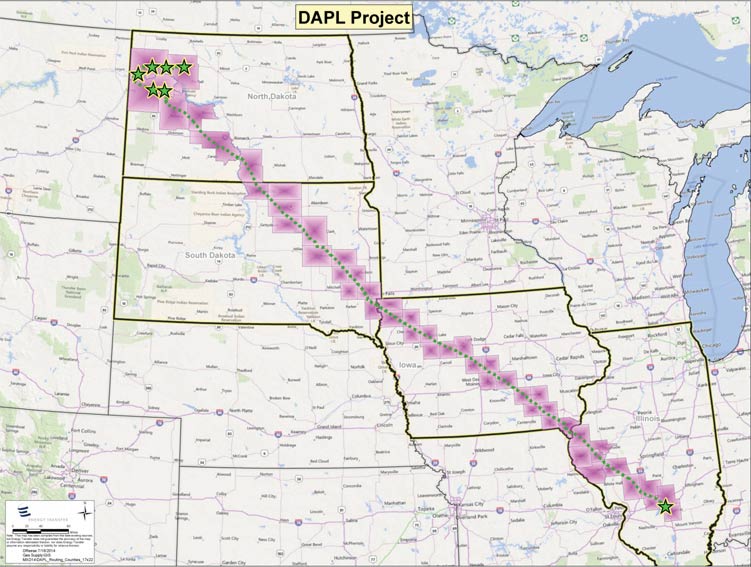
The Dakota Access Pipeline is a 1,168-mile, 30-inch diameter pipeline, backed by Texas based Energy Transfer Partners. If built the pipeline would begin in western North Dakota near Stanley and would end near Patoka, Ill.
The Dakota Access Pipeline would transport as much as 450,000 barrels of oil per day with a future capacity of 570,000 barrels per day. Its proposed route would also cross the Cannon Ball River on the Standing Rock Sioux reservation and over the Missouri River, posing a serious threat to water sources in the area.
Iowa is the only state left to approve its permit for construction
Last year an oil pipeline burst in North Dakota spilling over 3-million gallons of toxic waste into the Missouri River. It was the largest known spill in North Dakota state history.
Members of the Standing Rock Sioux Tribe oppose the construction of the pipeline. LaDonna Tamakawastewin Allard from Standing Rock provided the following history of the Cannon Ball area where the Dakota Access Pipeline would cross.
“The cannon ball ranch across the river from me was owned by Alma Parkin she was the daughter of Matilda Gaplin, Matilda Gaplin was the only Indian woman who signed the treaty, her daughter Louisa Degray Van Solen was the first school teacher on Standing Rock, Matilda’s other daughter Loulou Harmon established Miles City Montana, these were all Indian women, they are buried on the Cannon Ball ranch, which is a very historic ranch it was the stage coach stop, pony express, steamboat and mail carrier stops, and anyone who was anyone in that time stayed at the site.
Then in 1935 they held a Sundance in the area where the pipeline is going. The dance was held by a man named Wisespirit and Tatanka Ohitika, it is where our dance came from. Then there is a Mandan village, Cheyenne village and Arikara village there. Plus it is our old river crossing.
The place were the Mandan came into the world after the great flood is also in this area. The place where the Mandan had their Okipa, or Sundance is in the area.
Then we have the medicine rock that tells the future in the area. We have many burial there plus as you know my father Frank, my son Phil, my cousin JohnThunder Hawk and George Eagle and one nephew are buried there.
Plus it the place where I gather sage for the sun dance. There is so much history. I told those people [the pipeline company representatives] hey look at me I am the closest landowner. They will destroy my well. I am heartsick. This is heartbreaking! This is my home! They are pushing this pipeline so fast that no one knew about it.”
Across the world right now, Indigenous peoples are facing a renewed assault on their lands, rights, and ways of life.
From extractive industries pushing deeper into ancestral territories, to governments rolling back hard-won protections,
the threat is global—and it is growing.
What makes this moment especially dangerous is how little attention it receives.
Stories like this are disappearing in real time. Mainstream media
barely covers it and the coverage is fragmented. The public is left without the context
needed to understand what is truly at stake.
That is exactly why IC Magazine exists..
For more than 20 years, IC has reported on Indigenous struggles worldwide — consistently, independently, and without compromise.
We don’t follow news cycles; we trace patterns. We don’t sensationalize; we provide context.
And when the world looks away, we stay focused.
But this work is increasingly difficult to sustain.
We refuse to lock our reporting behind a paywall. We don’t sell access through subscriptions.
And we don’t answer to advertisers. IC Magazine survives solely because readers like you choose to
support independent Indigenous journalism.
Please donate today if you can. Every contribution helps us to continue this crucial work.
Thank you,
John Ahni Schertow
Founder and Editor in Chief