Last Updated on April 10, 2025
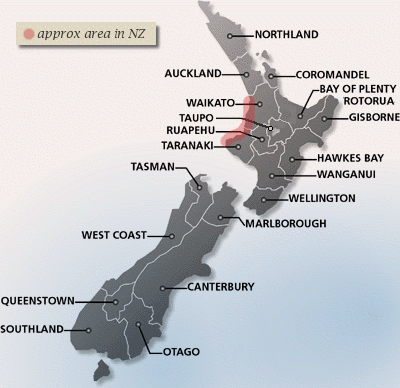
Rio Tinto, the multinational mining giant that grew out of former Australian and UK mining conglomerates, has recently begun an airborne survey of 1200sq km of mineral-rich iron-sand deposits along the west coast of the North Island. A recent study of the area found it may hold $33 billion worth of ‘untapped resources…’
From nzherald.co.nz – “The Rio Tinto company is managing the hunt for iron and other metals in a joint-venture with Iron Ore New Zealand, which won the prospecting permit from the Crown Minerals Group in the Ministry of Energy.”
As the survey aircraft yesterday flew low and slow over the permit area – at Mokau, north Taranaki and the west coast of south Auckland – iwi and environmental groups and the Auckland Regional Council scrambled for more information about the venture. Fears were expressed for the impact of any dredging on the maui’s dolphin, a species considered critically endangered, found only off the west coast from Northland to New Plymouth.
Ngati Te Ata environment manager Karl Flavell said he had scant information about the prospecting. “We have not been consulted although we are the tribal authority for the area from Manukau Heads to Maioro, the north side of Port Waikato Heads.”
ARC environment chairman Dianne Glenn said she raised three chief concerns about the prospecting at this week’s council meeting. “As a result the ARC will write to the Government’s conservation, economic development and fisheries ministers.
“One of our concerns is that the maui’s dolphin has a particularly strong presence in the permit area – the Waikato River mouth to Manukau Harbour.
“We are also concerned at extra erosion of the coast if there is extraction of sand.”
Mrs Glenn said another concern was any mining interference with the build up of the Auckland construction industry’s future sand supplies in the Kaipara Harbour. A further concern was the effect of sand extraction on Franklin’s surf beaches – Sunset Beach, at Port Waikato and Karioitahi.
Kiwis Against Sand Mining spokesman (Kasm) Bill McNatty said he felt the Rio Tinto joint venture was more “ominous” than previous seabed prospecting bids on the west coast because of the powerful company’s environmental record in its operations internationally.
Kasm raised 15,000 signatures for a petition calling for a blanket ban on ironsand mining of the seabed. The petition was presented to Parliament in February and is being considered by the Local Government and Environment Committee. (source)
From uriohau.blogspot.com, see Rio Tinto rape the Tai Tokerau.
Across the world right now, Indigenous peoples are facing a renewed assault on their lands, rights, and ways of life.
From extractive industries pushing deeper into ancestral territories, to governments rolling back hard-won protections,
the threat is global—and it is growing.
What makes this moment especially dangerous is how little attention it receives.
Stories like this are disappearing in real time. Mainstream media
barely covers it and the coverage is fragmented. The public is left without the context
needed to understand what is truly at stake.
That is exactly why IC Magazine exists..
For more than 20 years, IC has reported on Indigenous struggles worldwide — consistently, independently, and without compromise.
We don’t follow news cycles; we trace patterns. We don’t sensationalize; we provide context.
And when the world looks away, we stay focused.
But this work is increasingly difficult to sustain.
We refuse to lock our reporting behind a paywall. We don’t sell access through subscriptions.
And we don’t answer to advertisers. IC Magazine survives solely because readers like you choose to
support independent Indigenous journalism.
Please donate today if you can. Every contribution helps us to continue this crucial work.
Thank you,
John Ahni Schertow
Founder and Editor in Chief