

Last Updated on May 19, 2026
A suite of promising scientific initiatives presented recently at a landmark fossil fuel transition conference in Colombia intend to cut through the fog of climate denial by guiding the energy transitions of willing countries with authoritative science. But with Indigenous knowledge marginalized within these initiatives, science risks shaping forthcoming energy transitions that do not center on justice for Indigenous peoples.
Spearheading the First Conference on Transitioning Away from Fossil Fuels, Santa Marta’s art deco theatre played host in late April to the presentation of three bold scientific initiatives: a Science Panel for the Global Energy Transition (SPGET) led by climate scientists Johan Rockström and Carlos Nobre; a 24-strong international science team presented by constituent professors Frank Jotzo and Andrea Cardoso working to produce the Santa Marta Action Report (SMART); and a project led by University of Leeds professor Piers Forster to develop a preliminary fossil fuel phase-out roadmap for Colombia, intended as a demonstration of what science-driven energy transitions could look like.
Not all connected organizationally but certainly in purpose, the initiatives position science no longer simply as a method for planetary diagnosis but as an authoritative tool of political guidance for governments grappling with the turbulent task of disentangling their economies from oil, gas and coal dependencies in the context of rampant climate denial and intense fossil-fuelled geopolitical instability.
Conversations with participants and leaders of these initiatives revealed, however, a strong Global North bias and a failure to meaningfully incorporate Indigenous knowledge, leading to scientific outcomes that favoured a framing of the transition as a matter of technocratic adjustment, rather than one of systemic change.
“I can list so many things that went bad with this”, said one academic, who wished to remain anonymous, participating in a two-day academic dialogue with hundreds of academics at the conference intended to inform the SMART initiative, work on which had begun months prior. “There was an overwhelming participation of Global North institutions, partly because they were the ones who could quickly move the money and had the capacity to get involved – flexibility is a privilege of the rich.”
“But also it started from a very white academic bubble” she added, “and then when they invited the people that they knew, it was still a bubble.”
Cardoso emphasized during SMART’s presentation that each of the initiative’s 16 ‘workstreams’ had facilitators from both the Global North and Global South and that Indigenous academics were involved “in order to include different epistemologies”. But the participating academic’s frustrations about the way in which the initiative had become structurally dominated by Global North academics were later echoed in an open letter authored by four more participants, writing:
“The work of hundreds of academics from multiple disciplines, countries, experiences, and regions who gathered in Santa Marta over two days was rendered largely invisible. […] Inclusivity and dialogue among different positions, schools of thought, and types of knowledge are not matters of statistics or numbers. […] including an Indigenous person in a panel does not ensure that Indigenous epistemologies will be represented. This depends on a methodological design with a decolonizing intent, as well as on the representativeness and legitimacy of the invited voices.”
SMART’s outcome is a carefully-worded ‘menu’ of 12 ‘action insights’ directed towards governments, ranging from carbon pricing to the inclusion of diverse forms of knowledge. It’s a detailed document that also makes reference to principles of Free, Prior and Informed Consent (FPIC) and halting all new fossil fuel extraction projects, but participants say these are not at the core of the report. Instead, the outcome was criticized for reflecting the initiative’s structure: “The problem with scientific exercises generally, and specifically this one” said Peter Newell, professor of International Relations at the University of Sussex, “is it isolates out complicated things, saying just tweak the technology or mobilize a different source of finance and everything can carry on as usual. It reproduces the problem that the system doesn’t need to change, just technologies or finance do.”
In contrast, Indigenous representatives from across the world organizing in the same room of the city’s University of Magdalena the following day, issued a declaration summarizing their collective position that places transitions firmly within the context of an extractive global economic system: “resource colonization is really at the heart of what we’re discussing here”, said Janene Yazzie, a representative of the Dine (Navajo) communities, “despite our diversity, we can clearly and quickly come to agreement about what needs to be done to move away from fossil fuels.”
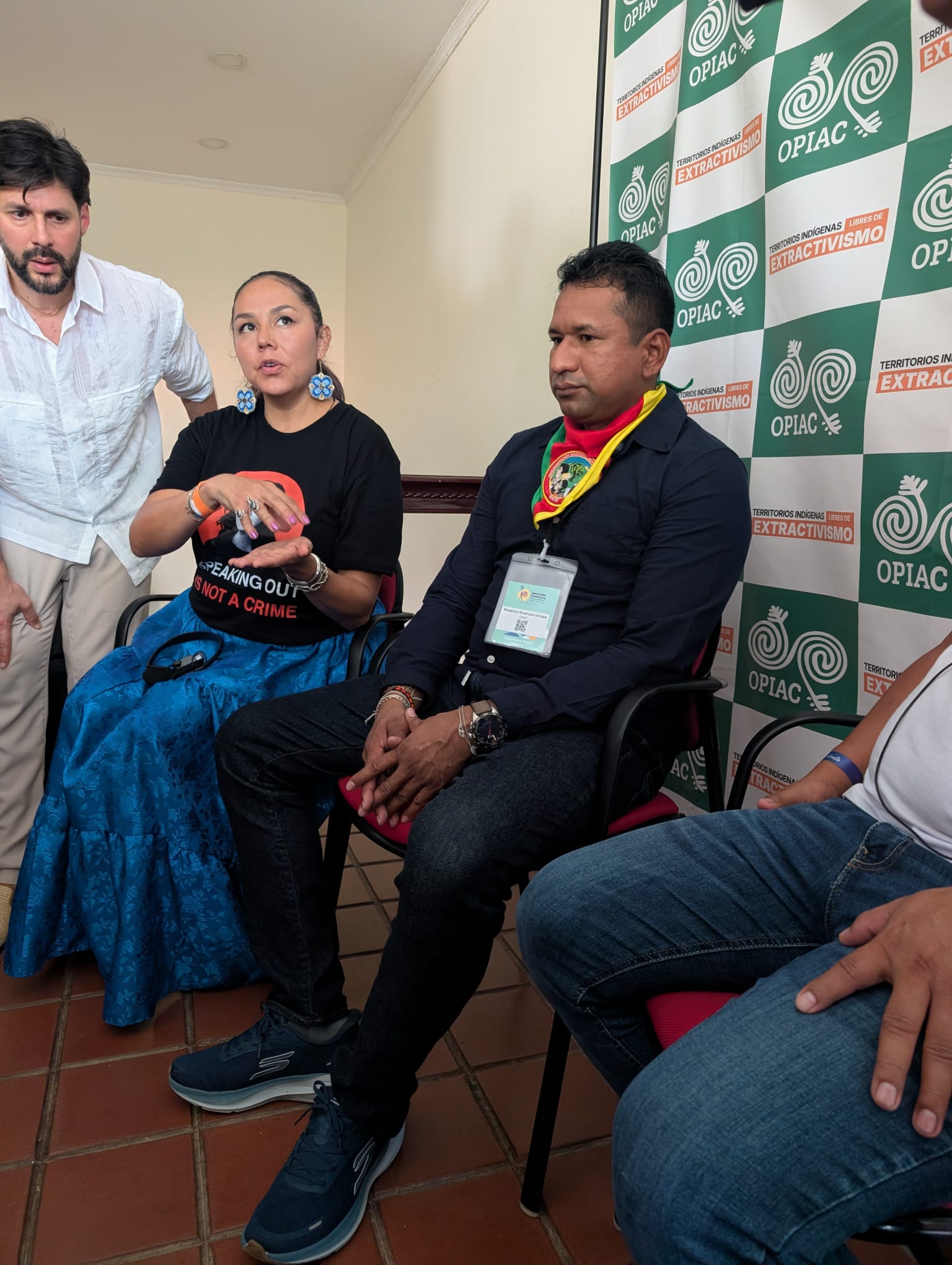
Janene Yazzie talks outside Indigenous peoples’ declaration. Credit: Adam Termote
These measures, listed in the declaration, include guaranteeing rights to territories and self-determination for Indigenous peoples, as well as the contribution of Indigenous knowledge systems and sciences. The declaration further emphasizes that the transition “must not become a new form of colonial extractivism that perpetuates models that exploit our territories”, such as “the imposition of mineral extraction activities.”
Another of the scientific initiatives, the Colombian phase-out roadmap led by climate scientist Piers Forster, was developed by a multi-national team which consulted Colombian ministries, but did not involve Indigenous groups in Colombia. The roadmap builds upon a framework developed by the UK Climate Change Committee (CCC), and makes suggestions for Colombia that include generating upfront investment “much of [which] is expected to come from the private sector”, and securing ongoing revenue “through rapidly expanding the export of critical minerals such as copper”.
With a 2023 study finding that 54% of the mineral deposits needed for the global energy transition (65% for copper) are located in or near Indigenous territories, such solutions pose potentially devastating environmental consequences for Indigenous communities. In response to the scientific initiatives presented, Yblin Román Escobar (Kolla descent), facilitator for the Securing Indigenous Peoples’ Rights in the Green Economy (SIRGE), said: “We want to first acknowledge the contributions of conventional science; Professor Rockström and his colleagues’ work on planetary boundaries for example, gives us a clear indication that, as humanity, we are approaching a tipping point and this is important and fundamental information.
“However, it is also important at this point to acknowledge the significant contribution and value of Indigenous knowledge and science, which is based in our deep interaction with our natural environment, and through which we have built up a millennia-old body of knowledge. We possess science, methodology and sustainable knowledge—truly sustainable knowledge. That is important because it is linked to real solutions – not mercantilist or commercial ones.”
Responding directly to these comments, Forster said: “That’s a really profound response”, adding: “In an ideal world, you would call in all the evidence from different communities and make the right choices. But it’s true, we have the funding and the clout and the other things, to inadvertently trample over other important knowledges.”
Forster said the report is only intended as a starting point for discussions and that the point about market-driven solutions had been made to him previously. Going forward, he said: “If our report could be better, it would be clear about the framing and assumptions, say what is robust and where we’ve stepped over the line into choices where we’re not so expert”. He later ran an open space at the conference where people could challenge the report’s results in order to change it collaboratively.
But Indigenous peoples caution the effect of scientific initiatives whose recommendations carry political power and the authority of objectivity, yet are not co-produced with Indigenous knowledge: “Without the active participation of Indigenous peoples, there is a huge risk that the colonial system, the extractivist system, will go on under a clean label, and that policies will remain narrowly focussed on emissions reduction and technology deployment without looking at the cultural survival of the communities where these resources are coming from or where the technologies are deployed”, said Escobar.
Carlos Nobre, co-chair of the SPGET initiative launched at Santa Marta but not yet active, clarified in an interview that the panel is seeking 40 scientists “of all types” to fill its ranks, and Forster acknowledged that “where we must not be blinkered as scientists is to really do this co-design thing well and not to do it in any performative way, to let ourselves be challenged and to ask where our prejudices are”. Friedrich Bohn, one of the 24 principle authors in the international science team working on SMART, said he supports proposals made in the open letter criticising the initiative’s Global North bias and is committed to its improvement:
“In the spirit of cooperation and fairness that prevailed at Santa Marta, I hope that academia from all regions will work together to create an improved system. I have already had many constructive discussions, and communication between different regions of the world has improved considerably. Together, we have the chance to create a system that is more inclusive, effective and efficient, and which addresses the points raised in the letter and beyond. This next system will also teach us how to develop it further and it hopefully will help us to achieve evidence-based, actionable and fair outcomes to support the process started in Santa Marta.”
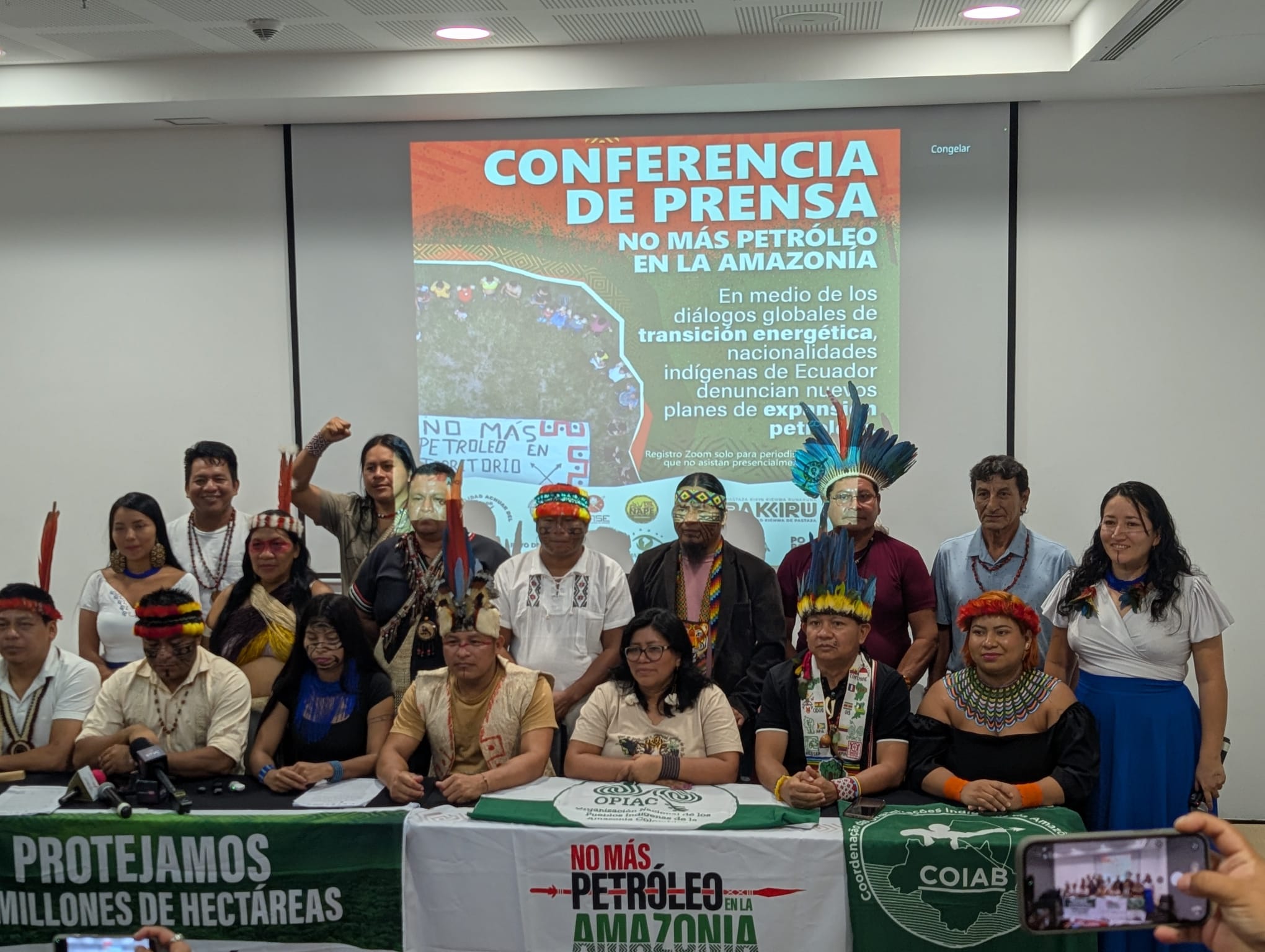
Amazonian Indigenous groups at a panel event denouncing new fossil fuel projects in Ecuador. Credit: Adam Termote
Learning to incorporate varied forms of knowledge is an urgent challenge for mainstream science, but for Indigenous communities on the frontlines of fossil fuel extraction, this is already a lived reality: “We have a science which is based in the knowledge of the communities, as well as western science”, said Ana Nango (Andwa), representing the seven nationalities of Pastaza of Ecuador (Kichwa, Shuar, Shiwiar, Sapara, Andwa, Achuar, Waorani).
“To fight against what is happening now it’s good to unite these two forms of science, and in this way be able to achieve something. It’s something that we, as Indigenous peoples, are constantly learning. I keep walking with these two feet, the science of our territories and western science, in that way uniting both sciences.”
Across the world right now, Indigenous peoples are facing a renewed assault on their lands, rights, and ways of life.
From extractive industries pushing deeper into ancestral territories, to governments rolling back hard-won protections,
the threat is global—and it is growing.
What makes this moment especially dangerous is how little attention it receives.
Stories like this are disappearing in real time. Mainstream media
barely covers it and the coverage is fragmented. The public is left without the context
needed to understand what is truly at stake.
That is exactly why IC Magazine exists..
For more than 20 years, IC has reported on Indigenous struggles worldwide — consistently, independently, and without compromise.
We don’t follow news cycles; we trace patterns. We don’t sensationalize; we provide context.
And when the world looks away, we stay focused.
But this work is increasingly difficult to sustain.
We refuse to lock our reporting behind a paywall. We don’t sell access through subscriptions.
And we don’t answer to advertisers. IC Magazine survives solely because readers like you choose to
support independent Indigenous journalism.
Please donate today if you can. Every contribution helps us to continue this crucial work.
Thank you,
John Ahni Schertow
Founder and Editor in Chief


