Last Updated on July 30, 2006
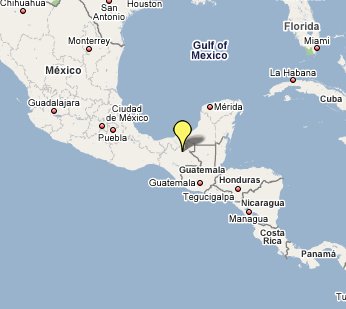
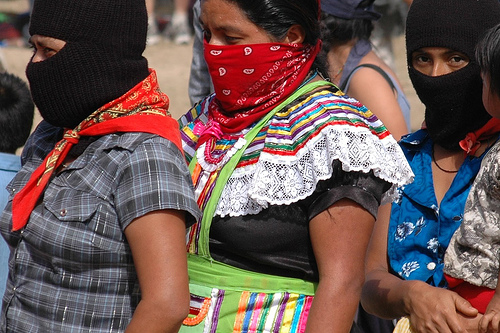
The Zapatista National Liberation Army (EZLN) and the narco-traffic in Chiapas “are factors that affect the national security,” says an internal document of Superior Center of Naval Studies (CESNAV) of the Secretary of the Navy. Developed for students of national security, high command and officers of the Navy of Mexico with the participation of officials with the rank of captain of the Navy, colonels of the Army and high-level functionaries of the secretariats of Exterior Relations, Government, Communications and Transport and the Center for Investigation and National Security (CISEN) the paper warned that the state of Chiapas confronts “threats and weaknesses” that affect not only that entity but the entire country.
Contrasting the frequent assurances from President Vicente Fox that “the issue of the EZLN is practically a thing of the past” and that stability and the rule of law have been secured, the course participants were told, “the isolation of the EZLN is a factor of tension and violence.” The material, developed last May is the result of a visit to Chiapas, at the beginning of this year, where the governor of the entity, Pablo Salazar Mendiguchia, the commanders of the military zones and region, as well as the commanders of the Naval bases in the state, were all interviewed.
[T] he document, obtained by La Jornada, outlines several threats to the “social filed,” such as: “The absence of a solution to the problem of the EZLN could give rise to a new conflict; the possibility exists that the EZLN intends to obtain resources via its links to organized crime, and the recognition that the foreign factor influences in great or small part the rest of the indigenous communities.”
With respect to the “military field”, the analysis affirms that the operations of the armed forces in the terrain has been characterized “by the exercise of the rule of law and cooperation with national institutions in the struggle against new threats to the national security particularly the narcotraffic, organized crime and illegal migration) and support of the civil population in cases of disaster.” Nonetheless, the document takes note of “weaknesses” to the military.
It notes that the equipment of the armed forces “is insufficient and inadequate” due to lack of resources to obtain equipment of the quality and quantity needed “in comparison to that available to the narco-traffickers.” It states “the majority of the operations that have been realized in support of the Prosecutor General of the Republic (PGR), the National Institute of Migration (INM) and the Public Security” have caused a “diminution of personnel en operations stipulated to the armed forces by the Constitution.”
It asserts that while “the EZLN and the narcotraffic in the region are factors that affect that national security, so are meteorological phenomena which are periodically presented and cause damages to the civil population, such as occurred with Hurricane Stan.” Taking stock of the fundamental themes underlying the social problems, the text indicates that “the inequality between indigenous and urban populations; the increased in organized delinquency thanks to the growing presence of Maras Salvatrucha (gangs made up largely of Central American immigrants), as well as the impacts of meteorological phenomena,” generate particular problems.
In this context, the future commanders of the Navy of Mexico and the civil functionaries of the federal government are forewarned that “foreign groups could use the violation of human rights in the state of Chiapas as an argument for interference.”
Source: La Jornada: 07/24 c/o ww4report.com
Across the world right now, Indigenous peoples are facing a renewed assault on their lands, rights, and ways of life.
From extractive industries pushing deeper into ancestral territories, to governments rolling back hard-won protections,
the threat is global—and it is growing.
What makes this moment especially dangerous is how little attention it receives.
Stories like this are disappearing in real time. Mainstream media
barely covers it and the coverage is fragmented. The public is left without the context
needed to understand what is truly at stake.
That is exactly why IC Magazine exists..
For more than 20 years, IC has reported on Indigenous struggles worldwide — consistently, independently, and without compromise.
We don’t follow news cycles; we trace patterns. We don’t sensationalize; we provide context.
And when the world looks away, we stay focused.
But this work is increasingly difficult to sustain.
We refuse to lock our reporting behind a paywall. We don’t sell access through subscriptions.
And we don’t answer to advertisers. IC Magazine survives solely because readers like you choose to
support independent Indigenous journalism.
Please donate today if you can. Every contribution helps us to continue this crucial work.
Thank you,
John Ahni Schertow
Founder and Editor in Chief