Last Updated on August 14, 2026
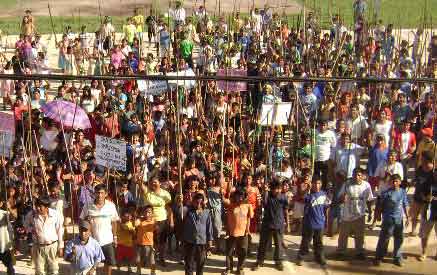
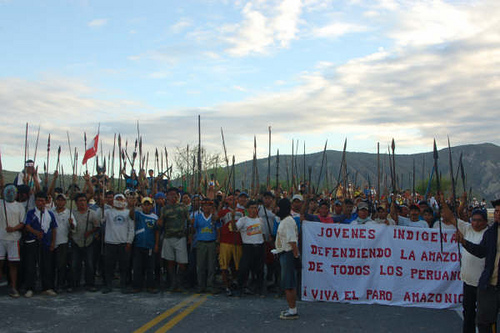
Indigenous groups in Peru are claiming victory after more than a week of protests throughout the state.
A day after the government declared martial law in three of the provinces affected by the protests, on August 19 a congressional commission voted to overturn the controversial law known as Decree 1015, which the indigenous groups were challenging.
They say the law “makes it easier for mining and energy companies to buy communally owned land, will lead to a foreign land grab, especially in the Amazon rain forest,” Reuters explains. “Garcia passed the law by decree earlier this year under special powers Congress granted him to bring Peruvian law into compliance with a new free-trade deal with the United States.”
The Congressional Commission said Garcia ‘went too far’ with the decree, and “agreed in principle to bring any new land law into compliance with Convention 169 of the International Labor Organization. The Commission also issued an official document to the Executive calling for the overturn of Supreme Decree 058-2008-PCM, imposing the states of emergency,” adds Bill Weinberg of the WW4Report.
The head of Peru’s legislature followed the announcement by saying it may go to a floor vote on Friday.
Garcia, on the other hand, thinks revoking the decree is a “huge mistake,” and that it will condemn Peru’s indigenous and rural communities to “another century of backwardness and misery.”
It’s not all that far off from the truth. However, it is in fact Garcia’s decree that would be condemning them to more “backwardness and misery.”
That’s why Sixty-five indigenous communities rose up and threatened a violent confrontation with the state. And it’s why those same communities are now celebrating.
Across the world right now, Indigenous peoples are facing a renewed assault on their lands, rights, and ways of life.
From extractive industries pushing deeper into ancestral territories, to governments rolling back hard-won protections,
the threat is global—and it is growing.
What makes this moment especially dangerous is how little attention it receives.
Stories like this are disappearing in real time. Mainstream media
barely covers it and the coverage is fragmented. The public is left without the context
needed to understand what is truly at stake.
That is exactly why IC Magazine exists..
For more than 20 years, IC has reported on Indigenous struggles worldwide — consistently, independently, and without compromise.
We don’t follow news cycles; we trace patterns. We don’t sensationalize; we provide context.
And when the world looks away, we stay focused.
But this work is increasingly difficult to sustain.
We refuse to lock our reporting behind a paywall. We don’t sell access through subscriptions.
And we don’t answer to advertisers. IC Magazine survives solely because readers like you choose to
support independent Indigenous journalism.
Please donate today if you can. Every contribution helps us to continue this crucial work.
Thank you,
John Ahni Schertow
Founder and Editor in Chief