Last Updated on August 13, 2026
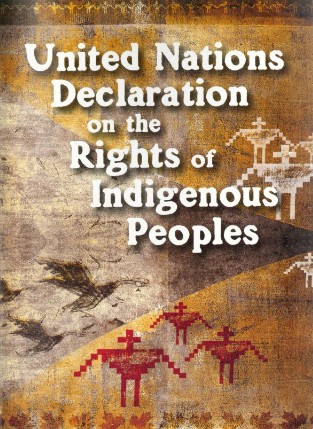
To my astonisment, the UN Declaration on Indigenous Rights has been approved. The 192-member assembly voted 143 in favor and four against, with 11 abstentions. Can you guess who opposed it? Australia, Canada, New Zealand and the United States.
Despite looking at the concerns recently and previously expressed, I still don’t know what the big deal is. The Declaration is still non-binding…. But at least the 25 year effort wasn’t for nothing.
The question now is, what’s next? Do we sit back and wait for the magic?
Some NGO’s have had an idea—but like the declaration itself, it seems more like a token gesture than anything, like leading ourselves to believe we can take down a brick wall with a toothpick.
All the toothpicks in the world could never hope to accomplish what one simple tree could do with ease.
From Survival International – Indigenous peoples around the world are today celebrating the UN General Assembly’s approval of the Declaration on the Rights of Indigenous Peoples. The declaration was approved by an overwhelming majority in an historic vote in New York today.
The vote is the climax of 22 years of intensive debate and negotiation. Australia, New Zealand, Canada and the United States voted against the declaration, whilst 143 nations voted in favour and eleven abstained.
Botswana Bushman Jumanda Gakelebone of First People of the Kalahari said today, ‘We would like to say that we are really very happy and thrilled to hear about the adoption of the declaration. It recognises that governments can no longer treat us as second-class citizens, and it gives protection to tribal peoples so that they will not be thrown off their lands like we were.’
Kiplangat Cheruiyot of Kenya’s Ogiek tribe said today, ‘With the adoption of the declaration, the lives of indigenous peoples will be improved on an equal footing with the rest of world citizens.’
Survival’s director Stephen Corry said today, ‘The declaration on indigenous peoples, with its recognition of collective rights, will raise international standards in the same way as the universal declaration on human rights did nearly 60 years ago. It sets a benchmark by which the treatment of tribal and indigenous peoples can be judged, and we hope it will usher in an era in which abuse of their rights is no longer tolerated.’
The declaration recognises the rights of indigenous peoples to ownership of their land and to live as they wish. It also affirms that they should not be moved from their lands without their free and informed consent. (source)
Across the world right now, Indigenous peoples are facing a renewed assault on their lands, rights, and ways of life.
From extractive industries pushing deeper into ancestral territories, to governments rolling back hard-won protections,
the threat is global—and it is growing.
What makes this moment especially dangerous is how little attention it receives.
Stories like this are disappearing in real time. Mainstream media
barely covers it and the coverage is fragmented. The public is left without the context
needed to understand what is truly at stake.
That is exactly why IC Magazine exists..
For more than 20 years, IC has reported on Indigenous struggles worldwide — consistently, independently, and without compromise.
We don’t follow news cycles; we trace patterns. We don’t sensationalize; we provide context.
And when the world looks away, we stay focused.
But this work is increasingly difficult to sustain.
We refuse to lock our reporting behind a paywall. We don’t sell access through subscriptions.
And we don’t answer to advertisers. IC Magazine survives solely because readers like you choose to
support independent Indigenous journalism.
Please donate today if you can. Every contribution helps us to continue this crucial work.
Thank you,
John Ahni Schertow
Founder and Editor in Chief