Last Updated on April 10, 2025
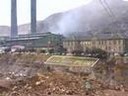
The following video is a look at the situation in La Oroya, Peru, which in 2006 was identified as one of the ten most polluted places in the world. Populated by some 35,000 people, La Oroya is a mining town that suffers from numerous health and developmental problems caused by the neighboring metallurgical smelter that’s been operating since 1922.
Today the smelter is owned by the US company Doe Run Peru. The main chimney emits on average of 1.5 tonnes of lead and 810 tonnes of sulphur dioxide every 24 hours – more than four times the maximum allowed under Peruvian legislation.
This has caused a sickening 91 percent of children in La Oroya to suffer from acute Lead Poisoning– which causes neurological, gastrointestinal, kidney and reproductive problems.
In addition to Lead, they are also exposed to arsenic and cadmium, among other metals/toxins.
Currently, there is an ongoing campaign headed by the Inter-American Association for Environmental Defense (AIDA), the Peruvian Environmental Law Society (SPDA), Earthjustice, and the Center for Human Rights and Environment to bring a reasonable end to this horrendous situation.
Just a few weeks ago they successfully petitioned the Inter-American Commission on Human Rights, who has since asked the government of Peru to immediately take steps to protect the health of the inhabitants of La Oroya. The government has been aware of the situation since at least 1999, and has since done almost nothing, besides issue a few orders and fine Doe Run a few times.
As for the company itself, well… noting that it just so happens to be owned by one Mr. Ira Rennert (the billionaire who also owns Hummer) they assert the toxic emissions are now well within legal limits and so there’s just no need for them to pay the fines layed against them. Everything’s been resolved, they say.
Considering the legacy of pollution that sits beneath Ira Rennert, obviously that needs to be independently proved. The most recent independent study (as far as I can tell) was done in May of this year, which showed that nothing has changed.
Across the world right now, Indigenous peoples are facing a renewed assault on their lands, rights, and ways of life.
From extractive industries pushing deeper into ancestral territories, to governments rolling back hard-won protections,
the threat is global—and it is growing.
What makes this moment especially dangerous is how little attention it receives.
Stories like this are disappearing in real time. Mainstream media
barely covers it and the coverage is fragmented. The public is left without the context
needed to understand what is truly at stake.
That is exactly why IC Magazine exists..
For more than 20 years, IC has reported on Indigenous struggles worldwide — consistently, independently, and without compromise.
We don’t follow news cycles; we trace patterns. We don’t sensationalize; we provide context.
And when the world looks away, we stay focused.
But this work is increasingly difficult to sustain.
We refuse to lock our reporting behind a paywall. We don’t sell access through subscriptions.
And we don’t answer to advertisers. IC Magazine survives solely because readers like you choose to
support independent Indigenous journalism.
Please donate today if you can. Every contribution helps us to continue this crucial work.
Thank you,
John Ahni Schertow
Founder and Editor in Chief