
Last Updated on June 16, 2014
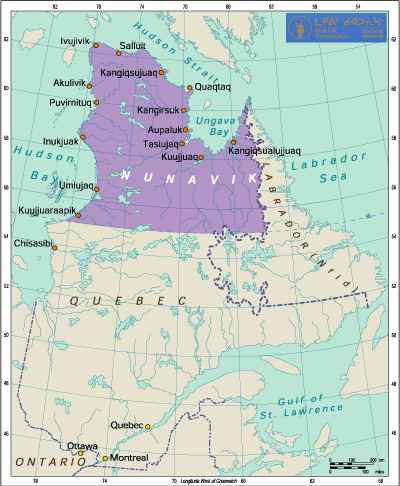
An agreement in principle was signed on Wednesday between the governments of Canada and Quebec, the Makivik Corporation and indigenous representatives for a new “semi-autonomous Inuit government” (or perhaps more accurately, “experimental municipal government”) in Northern Quebec..
Basically, the plan is to enjoin the existing Kativik regional government, the area school board and regional health authority into one body that will be comprised of an Assembly made of 21 members, and a five-member executive council to be elected by the 11,000 mostly Inuit residents of the region.
The responsibilities of this new Assembly will be the same as those normally covered by a municipal government, though it will also take care of education and health matters in the region.
The assembly will, however, “remain part of Quebec and would be subordinate to the province’s legislature and the federal House of Commons,” said Quebec’s native affairs minister, adding the “new powers still stop short of a full land claim settlement” (which obviously leaves the door open for development.)
Noting that, I find it strange how Indian Affairs Minister Chuck Strahl can claim that this deal means the Inuit will “be able to make their own decisions about matters related to the preservation and development of their distinctive culture” seeing as how Inuit culture, like all traditional indigenous culture, is inherently connected to the land.
How exactly are the Inuit supposed to have such authority over their culture when Quebec and Canada reserves the right to infringe on the land however they want? I’m sure it’s not so black and white, but considering Canada’s new-found love affair with unbridled development, it is a valid concern, and a serious one. Are the Inuit just supposed to rest on the faith that Canada will not undermine their culture (pun intended) because they love the Inuit so much?
In any event, at least this “semi-autonomous Inuit government”is giving some hope to the Inuit in Nunavik, who have been deeply struggling with violence, suicides and narcotics abuse in their communities. With my love and respect to the them, I prey it is not false hope, and that it will provide them with what they need to bring healing to their People.
The agreement is expected to be in place by 2009.
Across the world right now, Indigenous peoples are facing a renewed assault on their lands, rights, and ways of life.
From extractive industries pushing deeper into ancestral territories, to governments rolling back hard-won protections,
the threat is global—and it is growing.
What makes this moment especially dangerous is how little attention it receives.
Stories like this are disappearing in real time. Mainstream media
barely covers it and the coverage is fragmented. The public is left without the context
needed to understand what is truly at stake.
That is exactly why IC Magazine exists..
For more than 20 years, IC has reported on Indigenous struggles worldwide — consistently, independently, and without compromise.
We don’t follow news cycles; we trace patterns. We don’t sensationalize; we provide context.
And when the world looks away, we stay focused.
But this work is increasingly difficult to sustain.
We refuse to lock our reporting behind a paywall. We don’t sell access through subscriptions.
And we don’t answer to advertisers. IC Magazine survives solely because readers like you choose to
support independent Indigenous journalism.
Please donate today if you can. Every contribution helps us to continue this crucial work.
Thank you,
John Ahni Schertow
Founder and Editor in Chief