
Last Updated on August 4, 2018
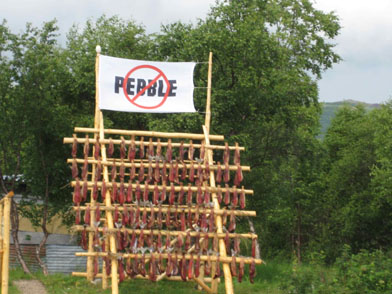
Last week, five of America’s leading jewellery retailers announced their support for the protection of Alaska’s Bristol Bay from large-scale mining; particularly against the proposed Pebble gold-copper mine.
Featured in the report, Golden Rules: Making the Case for More Responsible Mining (pdf), the proposed Pebble mine would come to be “the largest mine in North America, covering over 15 square miles (39 square kilometres) of land and generating more than 3 billion tons of mine waste over its life. The waste [would] be impounded in a seismically active area behind a number of dams. If built to the proposed dimensions, two of these dams will be the largest in the world—far bigger than the giant Three Gorges Dam in China.
The project world utterly devastate the Bristol Bay watershed, and with it a wealth of natural resources:
The subsistence way of life for the many region’s indigenous communities would also be profoundly impacted, possibly lost for future generations.
The recent pledge by the 5 retailers — Tiffany & Co., Ben Bridge Jeweller, Helzberg Diamonds, Fortunoff, and Leber Jeweller, Inc. — brings the number of businesses around the world supporting clean gold up to 28—a number backed by no less than 100,000 consumers from over 100 countries who have signed on to support ‘the Golden Rules—‘ which are social, human rights, and environmental criteria for more responsible mining of gold and other precious metals.
The rules call on mining companies to meet the following basic standards:
To learn more about the No Dirty gold campaign, or to sign the pledge yourself, please head over to www.nodirtygold.org
Across the world right now, Indigenous peoples are facing a renewed assault on their lands, rights, and ways of life.
From extractive industries pushing deeper into ancestral territories, to governments rolling back hard-won protections,
the threat is global—and it is growing.
What makes this moment especially dangerous is how little attention it receives.
Stories like this are disappearing in real time. Mainstream media
barely covers it and the coverage is fragmented. The public is left without the context
needed to understand what is truly at stake.
That is exactly why IC Magazine exists..
For more than 20 years, IC has reported on Indigenous struggles worldwide — consistently, independently, and without compromise.
We don’t follow news cycles; we trace patterns. We don’t sensationalize; we provide context.
And when the world looks away, we stay focused.
But this work is increasingly difficult to sustain.
We refuse to lock our reporting behind a paywall. We don’t sell access through subscriptions.
And we don’t answer to advertisers. IC Magazine survives solely because readers like you choose to
support independent Indigenous journalism.
Please donate today if you can. Every contribution helps us to continue this crucial work.
Thank you,
John Ahni Schertow
Founder and Editor in Chief


