
Last Updated on June 18, 2014
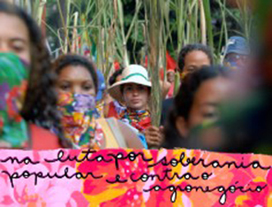
Following up the story published last week about Via Campesina’s “week of mobilization for Agrarian Reform and against the violence of big land-owners”, the women of Via Campesina and the Landless Workers Movement of Brazil organized several other actions to report—most notably, against the transnational companies Monsanto, and Syngenta.
On Friday, hundreds of women entered a research plant near Brazil’s capital of Sao Paolo, destroying a greenhouse and an experimentation field for the MON810 strain of GM corn. Patended by Monstanto, the strain was recently banned in France over concerns that it harms the ecosystem. Brazil recently cleared MON810 and one other GM strain for commercial use.
A spokesperson for Via Campesina told Reuters that “the authorization of these varieties shows once more that (President Luiz Inacio Lula da Silva’s) government favors agribusiness and big foreign companies, abandoning land reform and family farming.”
The Oread Daily reports that Via Campesina also “said the companies behind the engineered corn had presented studies that were “completely inadequate and insufficient to guarantee the safety of these products in terms of human health.”
Via Campesina left the Monstanto farm before the police arrived. “Meanwhile,” Real World Radio explains,
[…] in the cities of Londrina, Campo Mourão, Santa Tereza do Oeste and Ponta Grossa – there were rallies outside Syngenta’s heaquarters that gather nearly 1,500 women. Chasque news agency reports that the members of Via Campesina recalled that Syngenta acted above the law in Brazil, since it planted GM corn and soy less than 10 kilometers from Iguazu National Park, something which was banned by the country’s environmental laws. As a result of the enforcement of the law, the Brazilian Institute of Environment and Renewable Natural Resources (IBAMA) fined Syngenta for 500,000 dollars. The company has not paid the fine yet.
The peasants also demanded punishment for the murder of farmer Valmir Mota in October of 2007. He was a member of La Via Campesina. Mota was murdered in cold blood by an employee of NF security company in a Syngenta experimentation field in Santa Tereza do Oeste, where nearly 150 Brazilian farmers were settled.
Vía Campesina claims the NF was hired by Syngenta, so it demands the Swiss company should be blamed for the murder. A police investigation determined that nine private security guards and the owner of NF, Nerci Freitas, were responsible for October’s armed attack. But Syngenta was not charged with any crimes.
During the week of mobilization there were over a dozen other actions, including a rally at the square of Santana do Livramento, in Rio Grande do Sul state which gathered nearly 900 People; a march to an estate held by Aracruz in the municipality of Encruzilhada do Sul; another march in Porto Alegre, which demanded updates on the investigations regarding Stora Enso illegal purchase of land near the Uruguay border; and, as previously noted on IC, the eight-road blockade in Rio Grande do Sul that came after police arrested and injured dozens of women a couple days earlier. Real World Radio has reports on all of these actions.
I believe this marks the end of the week-long campaign, however Via Campesina is continuing to mobilize itself. Just today they blocked a railway owned by Vale to protest a hydroelectric dam the company helped build, which led to the displacement of more than 2000 people. Vale is reported to be the second largest mining company in the the world. Another railway blockade was set up yesterday; and on Sunday, Via Campesina entered and ‘vandalized’ a forestry and charcoal plant owned by the same company.
Across the world right now, Indigenous peoples are facing a renewed assault on their lands, rights, and ways of life.
From extractive industries pushing deeper into ancestral territories, to governments rolling back hard-won protections,
the threat is global—and it is growing.
What makes this moment especially dangerous is how little attention it receives.
Stories like this are disappearing in real time. Mainstream media
barely covers it and the coverage is fragmented. The public is left without the context
needed to understand what is truly at stake.
That is exactly why IC Magazine exists..
For more than 20 years, IC has reported on Indigenous struggles worldwide — consistently, independently, and without compromise.
We don’t follow news cycles; we trace patterns. We don’t sensationalize; we provide context.
And when the world looks away, we stay focused.
But this work is increasingly difficult to sustain.
We refuse to lock our reporting behind a paywall. We don’t sell access through subscriptions.
And we don’t answer to advertisers. IC Magazine survives solely because readers like you choose to
support independent Indigenous journalism.
Please donate today if you can. Every contribution helps us to continue this crucial work.
Thank you,
John Ahni Schertow
Founder and Editor in Chief


