Last Updated on May 18, 2019
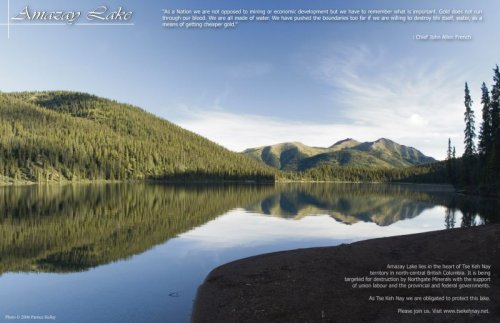
The Canadian Government along with the Province of British Columbia announced on Friday that they will accept the recommendations made by the Kemess North Mine Joint Review Panel.
Last September, the Panel rejected Northgate Minerals’ mine expansion proposal because they felt ‘the benefits of the project outweigh the risks of significant adverse environmental, social and cultural effects.’ If Northgate was allowed to proceed, they would have turned Amazay Lake, held Sacred by the Tse Keh Nay Peoples, into a toxic waste dump.
In a Press Release dated March 7, Leaders from the Union of B.C.Indian Chiefs, the B.C. Assembly of First Nations, and the First Nation Summit expressed relief over the Government’s decision:
“It should have been an easy decision for both governments. No government should as a matter of public policy authorize the destruction of lakes,” Grand Chief Edward John of the First Nation Summit said. “Nevertheless, the decision was made for the right reason. In that respect, this decision can be a catalyst for First Nations, governments, and the mining industry in B.C. to establish working relationships so we can start down the path of true sustainable development, where everyone’s interests are met.”
“We trust that industry and the governments of BC and Canada have learned an invaluable lesson from this long and frustrating experience. They must change their attitudes, approaches and policies concerning the essential need to recognize our Aboriginal Title and Rights,” said Grand Chief Stewart Phillip of the Union of B.C.Indian Chiefs. ‘I hope they have the vision and intelligence to understand the need to commit to these changes.”
“Today’s announcement should bring immense relief to the Tse Keh Nay and Gitxsan peoples who were directly affected by this mine proposal,” Regional Chief Shawn Atleo of the B.C. Assembly of First Nations said. “Over the years, their leadership, staff, and various supporters worked diligently to publicize the message that destroying Amazay Lake was just too high of a price to pay, no matter the short-term benefits promised. So now, finally, it can be said with certainty that they will not have to pay that price. For this reason, and remarkably enough that this matter didn’t end up in court, we can all be thankful.”
Unfortunately, Amazay Lake is far from being safe for good. In making their decision, both governments left the door open for Northgate to walk right back in with a new proposal.
On top of that, it would seem the (BC) government took the opportunity to show just how willing they are to harm—and so deny the rights, needs, and interests of indigenous People.
In a March 7 letter to Ken Stowe, chief executive officer of Northgate Minerals Cooperation, B.C. minister of environment Barry Penner wrote:
In reaching this conclusion we note that the proposed Project would have considerable implications for environmental and cultural values. These include the loss of Duncan Lake (also known as Amazay Lake), impacts on First Nations interests in the Project area, and certain long-term environmental risks…
However, Penner’s letter, which was sent also on behalf of B.C.’s minister of energy, mines and petroleum resources, Richard Neufeld, continues in a more cordial tone [hint, hint, nudge, nudge]:
[The government’s] overarching recommendation is not applicable to every possible proposal respecting mine activity in this area. More specifically, we wish to note that nothing in this decision prevents Northgate from seeking to reconfigure any aspect of the Project or the factors considered by the Panel.…
More specifically, we wish to make clear that we are not holding that a mine project can never receive approval in circumstances where a lake is used to manage tailings for a long term into the future, as use of a lake for such purposes may be appropriate. Similarly, we are not holding that a mine can never proceed in circumstances where there is some degree of opposition by, or an adverse impact on, First Nations, although the interests of First Nations will be seriously considered.
In light of this, one can’t help but wonder why the Federal and Provincial Government even bothered saying no to the expansion. Morally and legally speaking, the reason is obvious enough: It would have been a molestation on the People.
However, the above (highlighted) statement makes it clear the government doesn’t care about that. So then what, are they just putting on a good show? Maybe trying to instill a false sense of hope that may ripped from them at any given moment? Maybe not. Maybe they were just trying to console Northgate for getting kicked in the shins.
Whatever the reason, at least we are reminded of how British Columbia views Indigenous People—-as suppressible and disposable.
Across the world right now, Indigenous peoples are facing a renewed assault on their lands, rights, and ways of life.
From extractive industries pushing deeper into ancestral territories, to governments rolling back hard-won protections,
the threat is global—and it is growing.
What makes this moment especially dangerous is how little attention it receives.
Stories like this are disappearing in real time. Mainstream media
barely covers it and the coverage is fragmented. The public is left without the context
needed to understand what is truly at stake.
That is exactly why IC Magazine exists..
For more than 20 years, IC has reported on Indigenous struggles worldwide — consistently, independently, and without compromise.
We don’t follow news cycles; we trace patterns. We don’t sensationalize; we provide context.
And when the world looks away, we stay focused.
But this work is increasingly difficult to sustain.
We refuse to lock our reporting behind a paywall. We don’t sell access through subscriptions.
And we don’t answer to advertisers. IC Magazine survives solely because readers like you choose to
support independent Indigenous journalism.
Please donate today if you can. Every contribution helps us to continue this crucial work.
Thank you,
John Ahni Schertow
Founder and Editor in Chief