

Last Updated on March 13, 2013
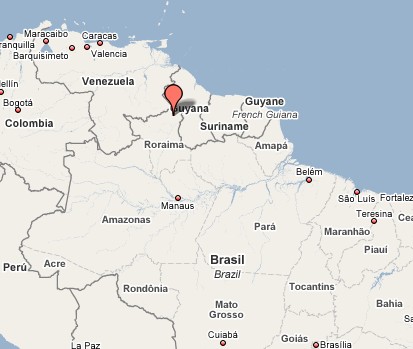
A small group of rice farmers illegally occupying indigenous lands in the Brazilian state of Roraima have recently turned violent in an effort to resist their eviction.
Survival International explains in a recent release that at least one person has been injured, a local Indigenous Leader in the community of Barro, after the farmers threw a home-made bomb into his home. The farmers have also set up roadblocks and burned at least three bridges leading into Raposa Serra do Sol indigenous territory.
Home to the the Makuxi, Wapixana, Ingarikó and Taurepang, the People have been struggling for the last 30 years to reclaim their land from the farmers, an effort that’s repeatedly turned violent. But in April 2005, as noted here last January, Brazil’s President signed a law ordering the removal of all non-indigenous people from Raposa Serra do Sol. However, the government never actually took any action — that is, until now.
According to Survival, “most of the illegal occupants have already left Raposa Serra do Sol and have been resettled and compensated,” but this group of rice farmers refuse to move. “Their violent actions of the past week are in response to an operation launched by the Brazilian Federal Police, Operation Upatakon 3, to finally remove them from the area.”
The Indigenous Council of Roraima (CIR), while applauding the government for finally taking action after three years, calls for “the urgent removal of the farmers,” who have, ontop of the violence and destruction, announced (eng. translation) a “shedding of blood… the communities fear the worst.”
CIMI (Indigenist Missionary Council) has also spoken out against the farmer violence. (eng.) “[They] are ignoring the Federal Constitution, ignoring the laws, ignoring the demarcation and ratification of the indigenous territory; they are ignoring every decision that does not interest them, be it by the President of the Republic or the Supreme Federal Tribunal.”
According to the Herald Sun, the police are preparing to remove the farmers.
Across the world right now, Indigenous peoples are facing a renewed assault on their lands, rights, and ways of life.
From extractive industries pushing deeper into ancestral territories, to governments rolling back hard-won protections,
the threat is global—and it is growing.
What makes this moment especially dangerous is how little attention it receives.
Stories like this are disappearing in real time. Mainstream media
barely covers it and the coverage is fragmented. The public is left without the context
needed to understand what is truly at stake.
That is exactly why IC Magazine exists..
For more than 20 years, IC has reported on Indigenous struggles worldwide — consistently, independently, and without compromise.
We don’t follow news cycles; we trace patterns. We don’t sensationalize; we provide context.
And when the world looks away, we stay focused.
But this work is increasingly difficult to sustain.
We refuse to lock our reporting behind a paywall. We don’t sell access through subscriptions.
And we don’t answer to advertisers. IC Magazine survives solely because readers like you choose to
support independent Indigenous journalism.
Please donate today if you can. Every contribution helps us to continue this crucial work.
Thank you,
John Ahni Schertow
Founder and Editor in Chief


