Last Updated on August 14, 2026
Presna Latina reports that the Bolivian government has “ratified its recognition of indigenous autonomies, in accordance with a November 2007 ruling and the United Nations Declaration on the Rights of Indigenous Peoples.”
Making the announcement on Saturday, Vice president Alvaro Garcia explained that “the country’s new political Constitution guarantees Bolivian native people the right to free determination, self-governing and to manage their own financial resources.”
He also “questioned the autonomy referendums being promoted by authorities from the departments of Benu, Pando, Santa cruz and Tarija,” saying they are unnecessary because autonomies are already legal. “They just need to be implemented”.
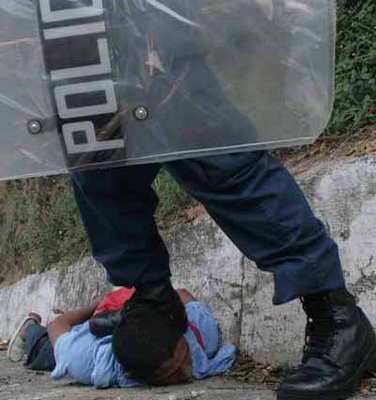
According to Inside South America, “the move promises to raise already-high tensions in advance of the May 4 vote, which Santa Cruz leaders have sworn will not be put off. A militant indigenous group known as the Red Ponchos allied to Morales has promised to march in Santa Cruz against the referendum. Militant youth in the province have meanwhile promised to defend their autonomy by force if necessary.”
“While Morales has pledged not to send troops into the province to stop the autonomy referendum, the possibility of violence breaking out is growing. The Organization of American States as well as neighboring Brazil have all sent diplomats into Bolivia to try to mediate between the two sides, so far to no avail. Read about those efforts here;“ and you can learn more about the referendum over at Bolivia Rising.
Photo by C Maranon,
republished here under a Creative Commons License
Across the world right now, Indigenous peoples are facing a renewed assault on their lands, rights, and ways of life.
From extractive industries pushing deeper into ancestral territories, to governments rolling back hard-won protections,
the threat is global—and it is growing.
What makes this moment especially dangerous is how little attention it receives.
Stories like this are disappearing in real time. Mainstream media
barely covers it and the coverage is fragmented. The public is left without the context
needed to understand what is truly at stake.
That is exactly why IC Magazine exists..
For more than 20 years, IC has reported on Indigenous struggles worldwide — consistently, independently, and without compromise.
We don’t follow news cycles; we trace patterns. We don’t sensationalize; we provide context.
And when the world looks away, we stay focused.
But this work is increasingly difficult to sustain.
We refuse to lock our reporting behind a paywall. We don’t sell access through subscriptions.
And we don’t answer to advertisers. IC Magazine survives solely because readers like you choose to
support independent Indigenous journalism.
Please donate today if you can. Every contribution helps us to continue this crucial work.
Thank you,
John Ahni Schertow
Founder and Editor in Chief