Last Updated on April 7, 2025
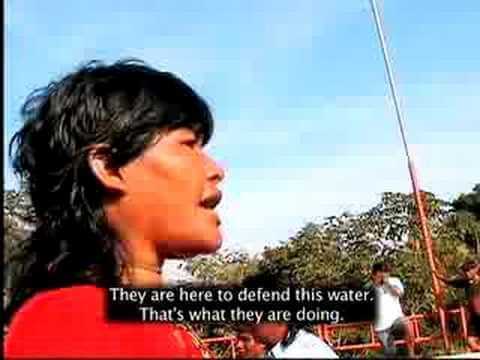
Nobodies from the Rainforest (Anonimato) is a short documentary about the Hupda indigenous People from Alto Rio Negro, northwest Amazon (Brazil).
Produced last year by Orlando Lemos, the film reveals a precarious health situation among the Hupda — one that’s been caused by outsider contact and a lack of access to clean water — as they struggle day to day with little resources, assistance, or even hope.
As for the health problem, the film primarily looks at Trachoma, which is a leading cause of infectious blindness in the world (8 million people, mostly in so-called developing countries, are visually impaired every year by Trachoma). There are however, numerous other health problems facing the Hupda.
Underlying this “modern life” is a story of one Hupda Woman, Lucia, who, mistakenly stepped on a poisonous snake after going almost blind from Trachoma.
After being bitten, Lucia wasn’t sure what to do, so she hid away. With her leg untreated though, it got infected and eventually developed into a necrosis. Lucia knew that if she went to a hospital the Doctors would want to take her leg away. She could not accept this.
Eventually however, she was sent to a city hospital. With her husband at her side, the doctors told her what she already knew. She escaped before they had the chance to take her leg.
After returning home, she was encouraged to see a western doctor working in the region. The doctor asked for the help of a traditional medicine man—and together they cured the necrosis without having to remove her leg.
Throughout all this, Lucia lost touch with her husband, who she lost touch with after she ran from the hospital. For months she thought the worst, that she would never again see the love her life.
Fortunately, it turned out he just got lost in the city. Lucia and her husband are together again, reminding them — and now even us, that even in the worst of situations, good things still happen. We just have to trust our hearts, take care of ourselves, and never ever give up.
Learn more about the Hupda at Wikipedia
Across the world right now, Indigenous peoples are facing a renewed assault on their lands, rights, and ways of life.
From extractive industries pushing deeper into ancestral territories, to governments rolling back hard-won protections,
the threat is global—and it is growing.
What makes this moment especially dangerous is how little attention it receives.
Stories like this are disappearing in real time. Mainstream media
barely covers it and the coverage is fragmented. The public is left without the context
needed to understand what is truly at stake.
That is exactly why IC Magazine exists..
For more than 20 years, IC has reported on Indigenous struggles worldwide — consistently, independently, and without compromise.
We don’t follow news cycles; we trace patterns. We don’t sensationalize; we provide context.
And when the world looks away, we stay focused.
But this work is increasingly difficult to sustain.
We refuse to lock our reporting behind a paywall. We don’t sell access through subscriptions.
And we don’t answer to advertisers. IC Magazine survives solely because readers like you choose to
support independent Indigenous journalism.
Please donate today if you can. Every contribution helps us to continue this crucial work.
Thank you,
John Ahni Schertow
Founder and Editor in Chief