Last Updated on August 3, 2018
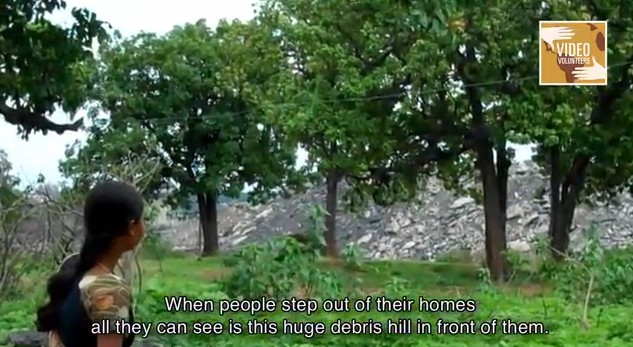
In this short video, IndiaUnheard Correspondent Mohan Bhuiyan documents the impacts of dumping coal mine debris on his village in Ramgarh District, Jharkhand, India.
Mohan writes that his village has actually been wedged in by two mining companies:
“300mts to the west of my village are the blackened coal mines of Central Coalfields Limited. Less than 300mts to the east are mining pits belonging to [Tata]. When the mining companies first arrived in my village, they came with promises of water, education, health, work and development. In 1984, they fooled us into acquiring the land on which we had our homes and our fields. But because the compensation and rehabilitation were never given, we refused to move.”
“For the last 20 years, we have been living in the most miserable conditions. The mining has destroyed our land. Our ponds and fields have dried up and become unusable. The air is polluted with dust and ash. It is unfit for breathing. The companies couldn’t care less. They were mining crores (tens of millions of dollars) worth of coal from our land and gave us nothing in return. From a self-sufficient agricultural village, we have been pushed into destitution. But at least we had our homes.”
Following this video report, which was published on October 25, 2012, Tata covered up an important road that village relies on, making it difficult for people to get access to the jungle and the river, both of which they depend on.
The villagers have asked company officials to clear out the massive piles of rock. When that didn’t work they tried to blockade the mine.
Now the officials are saying that they will clean up the road when they get the machinery, but who knows if they will keep their word.
Call to Action: Mohan requests you to call the Director of the West Bokaro Coal Mine, Mr Rajoria on 06545262486 and demand that:
“The road is cleared and repaired so that people of Ghatotand can access the forest and rover once again.”
Across the world right now, Indigenous peoples are facing a renewed assault on their lands, rights, and ways of life.
From extractive industries pushing deeper into ancestral territories, to governments rolling back hard-won protections,
the threat is global—and it is growing.
What makes this moment especially dangerous is how little attention it receives.
Stories like this are disappearing in real time. Mainstream media
barely covers it and the coverage is fragmented. The public is left without the context
needed to understand what is truly at stake.
That is exactly why IC Magazine exists..
For more than 20 years, IC has reported on Indigenous struggles worldwide — consistently, independently, and without compromise.
We don’t follow news cycles; we trace patterns. We don’t sensationalize; we provide context.
And when the world looks away, we stay focused.
But this work is increasingly difficult to sustain.
We refuse to lock our reporting behind a paywall. We don’t sell access through subscriptions.
And we don’t answer to advertisers. IC Magazine survives solely because readers like you choose to
support independent Indigenous journalism.
Please donate today if you can. Every contribution helps us to continue this crucial work.
Thank you,
John Ahni Schertow
Founder and Editor in Chief