Last Updated on June 18, 2014
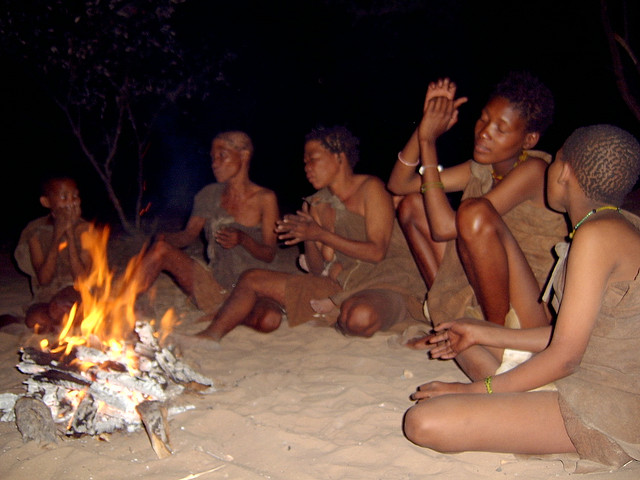
As First Nations in Saskatchewan and Chiapas made unscheduled appearances in world media this last week, the notion of Indigenous People as economic obstacles to the modern corporate state is again a hot topic of discussion. Stepping outside North America and traveling back in time four years, Friends of Peoples Close to Nature interviewed San activist Roy Sesana about the displacement of Bushmen from the Kalahari by the Botswana government.
As a partner with DeBeers, and dependent for half its revenue on diamonds, Botswana in 1997 began the process of ethnic cleansing in the Central Kalahari Game Reserve established in 1965 by the British Protectorate for the traditional economy of the Bushmen. With the discovery of diamonds, Botswana, in one generation, turned the inheritors of the 20,000-year culture of the Kalahari into despondent, impoverished residents of urban ghettos.
As Sesana — recipient of the 2005 Alternative Nobel Prize — remarks, thanks to diamonds, the Bushmen have now become wanderers between two cultures.
Across the world right now, Indigenous peoples are facing a renewed assault on their lands, rights, and ways of life.
From extractive industries pushing deeper into ancestral territories, to governments rolling back hard-won protections,
the threat is global—and it is growing.
What makes this moment especially dangerous is how little attention it receives.
Stories like this are disappearing in real time. Mainstream media
barely covers it and the coverage is fragmented. The public is left without the context
needed to understand what is truly at stake.
That is exactly why IC Magazine exists..
For more than 20 years, IC has reported on Indigenous struggles worldwide — consistently, independently, and without compromise.
We don’t follow news cycles; we trace patterns. We don’t sensationalize; we provide context.
And when the world looks away, we stay focused.
But this work is increasingly difficult to sustain.
We refuse to lock our reporting behind a paywall. We don’t sell access through subscriptions.
And we don’t answer to advertisers. IC Magazine survives solely because readers like you choose to
support independent Indigenous journalism.
Please donate today if you can. Every contribution helps us to continue this crucial work.
Thank you,
John Ahni Schertow
Founder and Editor in Chief