Last Updated on April 10, 2025
“Mirage of El Dorado” leads us into the mountains of northern Chile, where the devastating operations of Canadian mining companies threaten a fragile ecosystem in one of the driest parts of the globe.
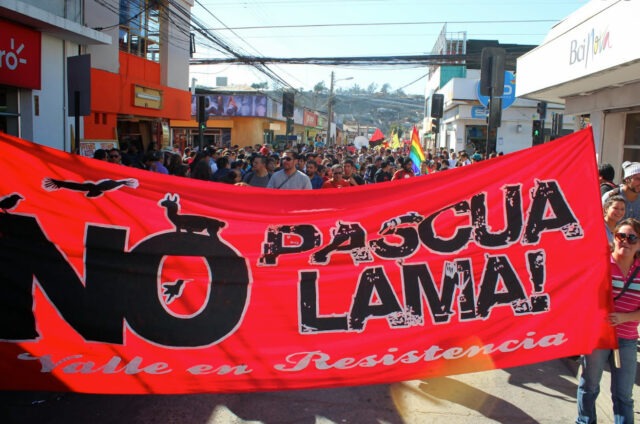
In northern Chile, Environmental groups and indigenous Diaguita communities are celebrating an April 10th court decision to suspend construction of the controversial Pascua Lama mine owned by the world’s largest gold mining company, Barrick gold. The court suspension was in response to a legal action that was brought forward by affected indigenous communities who have long maintained that the mining project threatens to severely deplete their water supply and pollute sensitive glaciers near the site where the mine is located.
Pascua Lama is in close proximity to three Andean glaciers which are vital water sources for the Huasco Valley, located in Chile’s Atacama desert region. Any impact on the glaciers, even from simple dust emissions, would have a devastating effect on the water supply and indeed, the entire ecosystem. In addition, the mining project would release cyanide, sulfuric acid and mercury into the valley’s rivers, a problem that the company tried to get around by offering farmers “social assistance” and promises of infrastructure.
To the surprise of absolutely no one, Barrick quickly bounced back with an appeal to reverse the court ordered suspension ; however, a Chilean appeals court on April 23rd rejected the appeal. It now looks like Barrick will be forced to walk away from the project.
It’s welcomed news, to say the least. As the award-winning documentary film Mirage of El Dorado shows, the Pascua Lama project has been mired in controversy ever since the infamous mining company started making its move in the 1990s.
Across the world right now, Indigenous peoples are facing a renewed assault on their lands, rights, and ways of life.
From extractive industries pushing deeper into ancestral territories, to governments rolling back hard-won protections,
the threat is global—and it is growing.
What makes this moment especially dangerous is how little attention it receives.
Stories like this are disappearing in real time. Mainstream media
barely covers it and the coverage is fragmented. The public is left without the context
needed to understand what is truly at stake.
That is exactly why IC Magazine exists..
For more than 20 years, IC has reported on Indigenous struggles worldwide — consistently, independently, and without compromise.
We don’t follow news cycles; we trace patterns. We don’t sensationalize; we provide context.
And when the world looks away, we stay focused.
But this work is increasingly difficult to sustain.
We refuse to lock our reporting behind a paywall. We don’t sell access through subscriptions.
And we don’t answer to advertisers. IC Magazine survives solely because readers like you choose to
support independent Indigenous journalism.
Please donate today if you can. Every contribution helps us to continue this crucial work.
Thank you,
John Ahni Schertow
Founder and Editor in Chief