Last Updated on October 3, 2013
On Tuesday May 28, 72 Indian nations in the United States and 10 Indian and Hawaiian Native organizations — speaking at the UN Permanent Forum on Indigenous Issues — jointly proposed action be taken to give indigenous peoples, especially indigenous constitutional and customary governments, a dignified and appropriate status for participating regularly in UN activities. As a problem that has already been studied and examined within the UN system, they noted, “it is time to take action at last so that indigenous peoples do not have to call themselves NGOs or depend upon ad hoc resolutions to be able to participate in UN meetings, processes, and events.”
Given the persistent marginalization of indigenous governing authorities by the UN and its member states since the Declaration on the Rights of Indigenous Peoples was passed by the UN General Assembly in 2007, this call for the full participation of indigenous peoples and indigenous governments in implementing the Declaration is long overdue. As governing authorities, the Indian nations made it clear that this action must be taken in order to stem the increasing worldwide violations of indigenous rights and violence inflicted on indigenous communities as a result of competition for natural resources in indigenous territories.
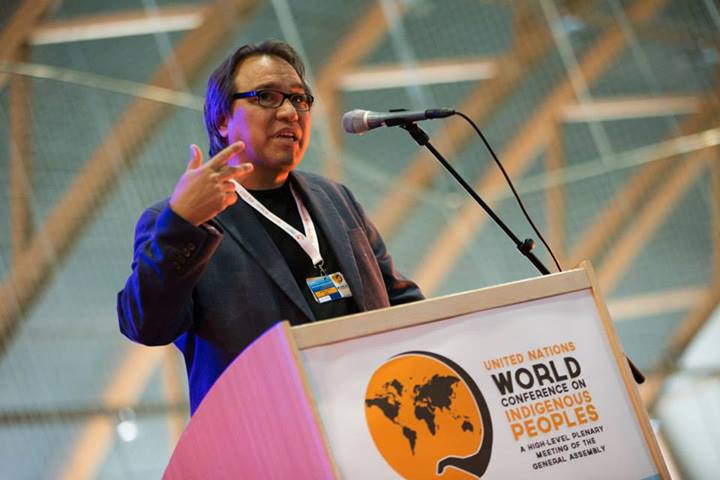
As they observed, “Sadly, we cannot yet say that the Declaration has reduced the attempts to destroy indigenous cultures and societies, or the taking of indigenous homelands and resources, or the economic marginalization of indigenous peoples. Without effective implementing measures and without international monitoring of indigenous peoples’ rights, the purposes of the Declaration cannot be achieved.” In proposing action to be taken at the 2014 World Conference on Indigenous Peoples, the Indian nations observed that indigenous parliaments, assemblies and councils are not NGOs, and recommended the UN World Conference give appropriate recognition to Indigenous Peoples represented by their own governments.
Across the world right now, Indigenous peoples are facing a renewed assault on their lands, rights, and ways of life.
From extractive industries pushing deeper into ancestral territories, to governments rolling back hard-won protections,
the threat is global—and it is growing.
What makes this moment especially dangerous is how little attention it receives.
Stories like this are disappearing in real time. Mainstream media
barely covers it and the coverage is fragmented. The public is left without the context
needed to understand what is truly at stake.
That is exactly why IC Magazine exists..
For more than 20 years, IC has reported on Indigenous struggles worldwide — consistently, independently, and without compromise.
We don’t follow news cycles; we trace patterns. We don’t sensationalize; we provide context.
And when the world looks away, we stay focused.
But this work is increasingly difficult to sustain.
We refuse to lock our reporting behind a paywall. We don’t sell access through subscriptions.
And we don’t answer to advertisers. IC Magazine survives solely because readers like you choose to
support independent Indigenous journalism.
Please donate today if you can. Every contribution helps us to continue this crucial work.
Thank you,
John Ahni Schertow
Founder and Editor in Chief