
Last Updated on August 3, 2018
While consultations between indigenous nations and modern states worldwide — mostly over resource extraction and development proposals — are in the news, little has been said about conditions for consultations. Since states and corporations are seeking to lend the appearance of meeting the free, prior and informed consent standard set by the UN Declaration on the Rights of Indigenous Peoples, it might seem reasonable that indigenous nations place conditions on how these consultations are conducted.
In Peru, indigenous peoples recently withdrew from a consultation until the state addressed longstanding items of neglect, the logic being that if the state cannot resolve existing grievances over health, education and the environment, then why should indigenous nations meet to discuss allowing corporations additional access to resources in their territories. One of the indigenous proposals in Peru is to establish state institutions designed to interact inclusively with indigenous nations, so that grievances and proposals can be discussed and resolved.
In the follow-up to the international conference of indigenous nations in Alta, Norway last week, Quinault Indian Nation president Fawn Sharp called for a similar protocol at the UN, in which indigenous nations would have a seat at the table. As Sharp noted, “Indigenous nations and each U.N. member now have clearly focused issues on which to base government-to-government negotiations. These negotiations can help eliminate violence against indigenous nations caused by rampant development which pollute lands and waters and force Indigenous Peoples out of their territories.”
As Quinault and 71 other American Indian nations proposed at the UN Permanent Forum on Indigenous Issues in May, indigenous governments must have a dignified and appropriate status at the UN in order to end violation of indigenous rights by its member states. Until indigenous nations are fully participating members of the UN, violations and violence inflicted on indigenous communities will likely continue to increase. As the 72 nations stated, “Without effective implementing measures and without international monitoring of indigenous peoples’ rights, the purposes of the Declaration cannot be achieved.”
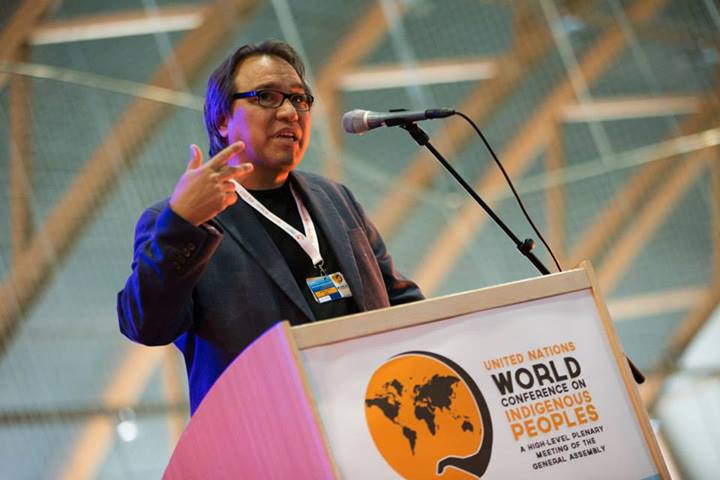
As indigenous nations and modern states seek a path to establishing constructive solutions to long festering conflicts, national and international institutions will need to be invented and reinvented. With the UN World Conference on Indigenous Peoples scheduled for September 2014, it is perhaps not too soon to begin.
Across the world right now, Indigenous peoples are facing a renewed assault on their lands, rights, and ways of life.
From extractive industries pushing deeper into ancestral territories, to governments rolling back hard-won protections,
the threat is global—and it is growing.
What makes this moment especially dangerous is how little attention it receives.
Stories like this are disappearing in real time. Mainstream media
barely covers it and the coverage is fragmented. The public is left without the context
needed to understand what is truly at stake.
That is exactly why IC Magazine exists..
For more than 20 years, IC has reported on Indigenous struggles worldwide — consistently, independently, and without compromise.
We don’t follow news cycles; we trace patterns. We don’t sensationalize; we provide context.
And when the world looks away, we stay focused.
But this work is increasingly difficult to sustain.
We refuse to lock our reporting behind a paywall. We don’t sell access through subscriptions.
And we don’t answer to advertisers. IC Magazine survives solely because readers like you choose to
support independent Indigenous journalism.
Please donate today if you can. Every contribution helps us to continue this crucial work.
Thank you,
John Ahni Schertow
Founder and Editor in Chief