

Last Updated on April 10, 2025
“Effective netwar, as demonstrated by the Zapatista, relies on the strategic use of all available forms of communication, including street art, public gestures, signage, text and audio/visual expressions, all of which relate to an overall theme that is apparent and memorable. Effective mobilization of netwar, on the other hand, is more complex. It relies on time and place, the kinds of resources we have, and the challenges in front of us.”
–John Ahniwanika Schertow, editor & publisher, Intercontinental Cry Magazine
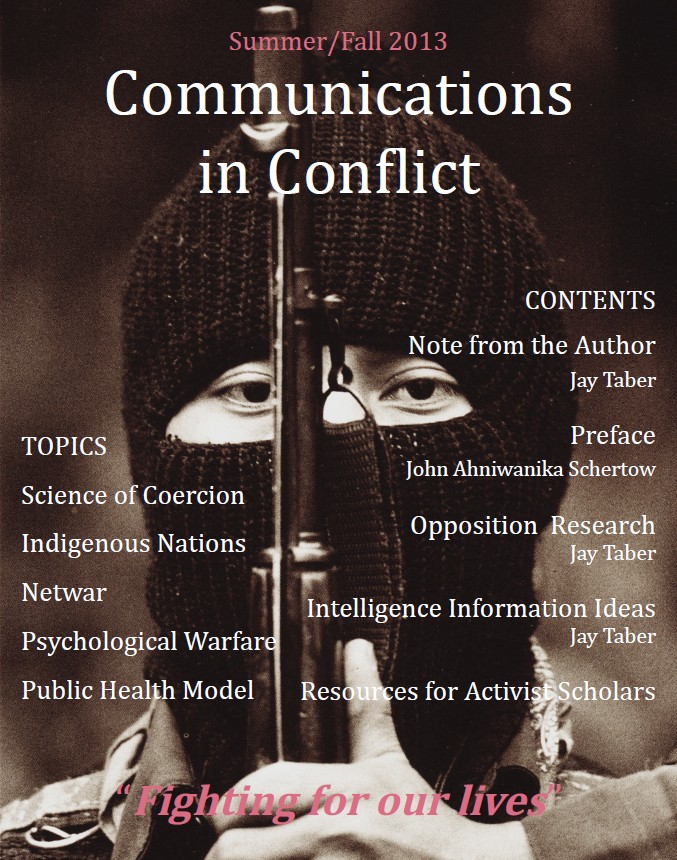
Intercontinental Cry today released its third major publication — Communications in Conflict — a collaboration with Public Good Project under the creative direction of Wrong Kind of Green.
In Communications in Conflict, IC Editorial Advisor and Columnist Jay Taber describes the effective communications devices used in netwar, revealing a communications strategy that works. Through interviews, research and analysis over the course of two decades, he conveys lessons from which anyone committed to human rights and the Indigenous Peoples Movement, can benefit.
As an introduction to the topic of netwar, Communications in Conflict is uniquely suited to serve as a touchstone for those who, like the Zapatista of Chiapas, Mexico, realize the connection between intelligent communications and networked power.
FOR ORDERING INFORMATION, CLICK HERE
Across the world right now, Indigenous peoples are facing a renewed assault on their lands, rights, and ways of life.
From extractive industries pushing deeper into ancestral territories, to governments rolling back hard-won protections,
the threat is global—and it is growing.
What makes this moment especially dangerous is how little attention it receives.
Stories like this are disappearing in real time. Mainstream media
barely covers it and the coverage is fragmented. The public is left without the context
needed to understand what is truly at stake.
That is exactly why IC Magazine exists..
For more than 20 years, IC has reported on Indigenous struggles worldwide — consistently, independently, and without compromise.
We don’t follow news cycles; we trace patterns. We don’t sensationalize; we provide context.
And when the world looks away, we stay focused.
But this work is increasingly difficult to sustain.
We refuse to lock our reporting behind a paywall. We don’t sell access through subscriptions.
And we don’t answer to advertisers. IC Magazine survives solely because readers like you choose to
support independent Indigenous journalism.
Please donate today if you can. Every contribution helps us to continue this crucial work.
Thank you,
John Ahni Schertow
Founder and Editor in Chief

