Last Updated on April 10, 2025
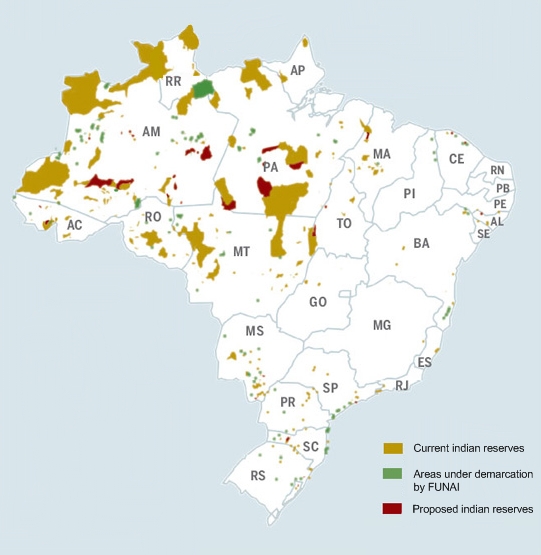
Brazilian President Luiz Inacio Lula da Silva signed a decree last week to permanently station the military on every indigenous reserve along the border.
The move is an apparent response to concerns over “possible incursions by guerrilla fighters, drug traffickers and others,” notes a recent report by Reuters. However, it more so appears to be a follow-up to statements issued by General Augusto Heleno this past April.
During a seminar in Rio de Janeiro, General Heleno said the United Nations (UN) Declaration on the Rights of Indigenous Peoples gives room for indigenous people to cede from the state and adopt another nationality. That makes it a threat to ‘National Sovereignty.’
One month later, following a ceremony to commemorate the end of WW2, Brazil’s Defense Minister Nelson Jobim stated the military should be deployed because the State’s “territorial sovereignty is at risk,” says another report by Reuters.
“We want to be clear on something fundamental — Indian lands are Brazilian lands,” Jobim said. “There are no nations or Indian peoples, there are Brazilians who are Indians.”
Pointing to the ongoing land conflict between Indigenous Peoples and vigilante farmers in the northern state of Roraima, Reuters added that “at least one former Venezuelan army official entered the Roraima reservation to train gunmen, and a Venezuelan flag was raised on one farm, Indian leaders and media reported.”
Curiously, however, President da Silva dismissed this concern. Instead, he chose to praise indigenous people for their loyalty to the state. “Much of the Brazilian army is made up of Indians,” the President said. “How often have the Indians defended our borders?”
According to Saturino Xavante, a secretary with the Amazon umbrella group COIAB, indigenous people have been doing so for a long time. “In all these years we kept intruders out — and now we are a risk to national security?”
Then there’s the legality of occupying indigenous lands. Not only is it a violation of international agreements, but according to Claudio Luiz Beirao, a legal consultant to the Catholic Church’s Indigenous rights group, CIMI, it’s also against the law. “The constitution says only Indians can occupy indigenous lands unless Congress passes special legislation,” says Beirao — “and it didn’t.”
The worst past of all, however, is the fact that this occupation lays the groundwork for the indigenous peoples’ worst fear to become a reality: that the military will start taking their lands, influencing their cultures, terrifying them with surprise maneuvers, and raping their women — none of which is unprecedented.
Across the world right now, Indigenous peoples are facing a renewed assault on their lands, rights, and ways of life.
From extractive industries pushing deeper into ancestral territories, to governments rolling back hard-won protections,
the threat is global—and it is growing.
What makes this moment especially dangerous is how little attention it receives.
Stories like this are disappearing in real time. Mainstream media
barely covers it and the coverage is fragmented. The public is left without the context
needed to understand what is truly at stake.
That is exactly why IC Magazine exists..
For more than 20 years, IC has reported on Indigenous struggles worldwide — consistently, independently, and without compromise.
We don’t follow news cycles; we trace patterns. We don’t sensationalize; we provide context.
And when the world looks away, we stay focused.
But this work is increasingly difficult to sustain.
We refuse to lock our reporting behind a paywall. We don’t sell access through subscriptions.
And we don’t answer to advertisers. IC Magazine survives solely because readers like you choose to
support independent Indigenous journalism.
Please donate today if you can. Every contribution helps us to continue this crucial work.
Thank you,
John Ahni Schertow
Founder and Editor in Chief