Last Updated on June 18, 2014
Bengali settlers have attacked 5 Jumma villages in Matiranga Upozila, a sub district of Khagrachari in south-eastern Bangladesh.
On August 3, 2013, a group of Bengali settlers wielding sharp knives and machetes began to gather at the Taindong Bazar area in Matiranga Upozila, claiming that ‘indigenous miscreants’ had kidnapped a Bengali man named Kamal Hossain.
“The Bengali settlers asked us to go to Taindong Bazar area to help [find] Kamal Hossain. We went there to help them,” said Amrito Ranjon Chakma, village head of Bondorsingh Para (area), and Fonibhushon Chakma UP member from Ward No. 1 of Taindong, in an interview with CHT News Update. “At one [point], all of a sudden, they started beating us. They were shouting ‘attack the indigenous villages’. Out of nowhere, hundreds of Bengali settlers joined the attack.”
Both Fonibhushon Chakma and Amriton Ranjon Chakma were among the first victims of the attack. They were undergoing medical treatment when CHT News Update spoke to them.
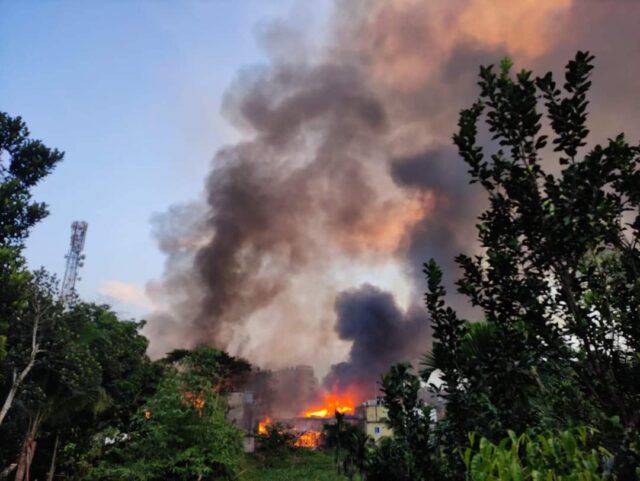
For hours-on-end, the enraged Bengali settlers looted and ransacked as many as 400 Jumma houses. They also set fire to about 40 homes, and, according to local sources, Buddhist temples in Sorbewor Para, Bondorsingh Para, Boga Para, Monudas Para and Talukdar Para of Taindong.
At least 50 Jumma were wounded and 6 Jumma were also reported missing. Out of the missing Jummas, reports CHT News Update, “3 are feared to be dead based on information from eye witnesses. They have been identified as Arun Mohon Chakma, resident of Monudas Para; Suresh Talukdar and his old mother from Talukdar Para.”
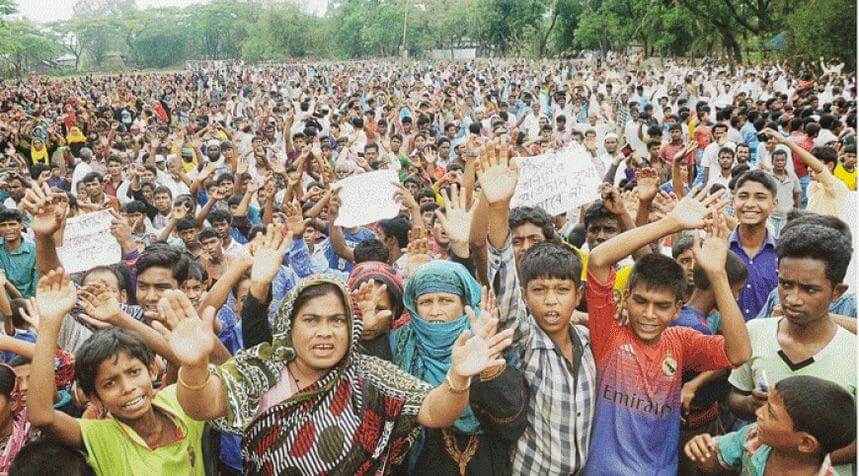
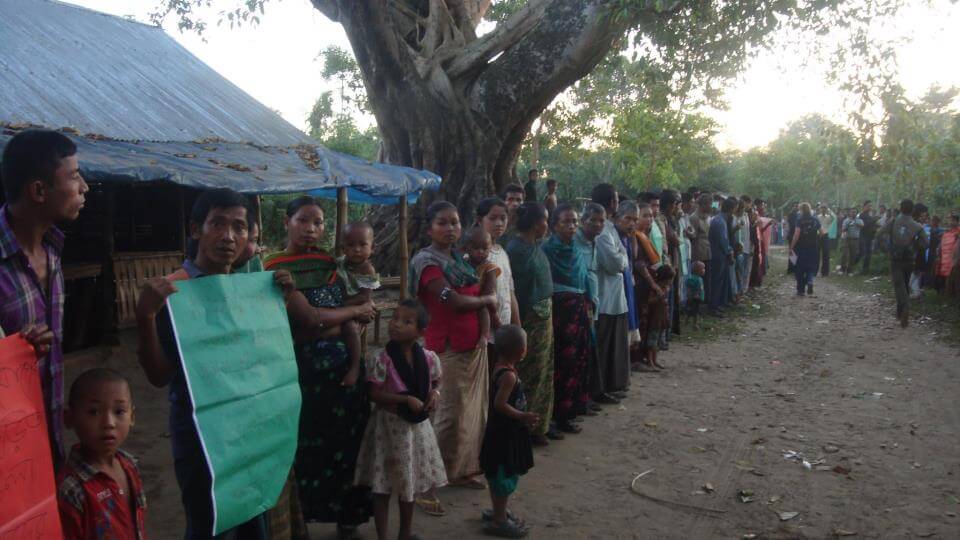
Seeking refuge from the attackers, more than 1,500 men, women and children from the Chakma and Tripuri tribes fled to the India-Bangladesh border. They were, however, denied entry into India by the Border Security Force (BSF). BSF deputy inspector general Bhaskar Rawat told the Times of India that the BSF is providing the villagers with food and other assistance.
In the days that followed the attack, it was confirmed that the supposed kidnapping of Kamal Hossain was completely staged. On Aug. 6, Prothom Alo, a leading Bangladesh Newspaper, quoted the Assistant Police Superintendent of Ramgarh Circle as saying, “This was not kidnapping, the whole thing was a staged drama.” Police found Hossain about two hours after the hate-fueled attack began. Fonibhushon Chakma also commented, “They master-planned the incident to evict the indigenous peoples and to make them financially vulnerable.”
Police have since arrested four people in connected to the attack, the allegedly-kidnapped Kamal Hossain as we all as Qamrul Hasan, Abu Taher and local Awami League leader M Abid Ali.
Rights activists are now demanding a high level investigation into the attack. India’s ruling party, Congress, and main opposition Bharatiya Janata Party (BJP) also asked the Bangladesh government for permanent rehabilitation and security for the displaced Jumma.
The International Chittagong Hill Tracts Commission (CHTC) expressed further alarm, describing in a press statement a pattern of arson attacks on Jumma villages following rumours of Bengali settlers being held hostage or attacked. The CHTC went on to criticize Bangladesh security forces for tacitly supporting the settlers rather than protecting the indigenous villagers, adding that the military, police and border guards must also be held accountable “for their role in allowing these attacks to take place.”
Across the world right now, Indigenous peoples are facing a renewed assault on their lands, rights, and ways of life.
From extractive industries pushing deeper into ancestral territories, to governments rolling back hard-won protections,
the threat is global—and it is growing.
What makes this moment especially dangerous is how little attention it receives.
Stories like this are disappearing in real time. Mainstream media
barely covers it and the coverage is fragmented. The public is left without the context
needed to understand what is truly at stake.
That is exactly why IC Magazine exists..
For more than 20 years, IC has reported on Indigenous struggles worldwide — consistently, independently, and without compromise.
We don’t follow news cycles; we trace patterns. We don’t sensationalize; we provide context.
And when the world looks away, we stay focused.
But this work is increasingly difficult to sustain.
We refuse to lock our reporting behind a paywall. We don’t sell access through subscriptions.
And we don’t answer to advertisers. IC Magazine survives solely because readers like you choose to
support independent Indigenous journalism.
Please donate today if you can. Every contribution helps us to continue this crucial work.
Thank you,
John Ahni Schertow
Founder and Editor in Chief