Last Updated on April 10, 2025
Indigenous Taino People of Puerto Rico, and residing on the U.S. mainland, are over 30,000 strong, according to current census reports. This official data victoriously and ‘officially’ trumps the propaganda spread by other mainstream sources, such as Wikipedia, that the culture went “extinct” after Spanish colonization. Affirmation of Taino identity is gathering momentum towards achieving inherently deserved recognition as part of the larger trajectory of re-claiming explicit community and individual rights to self-determination and sovereignty within national and international affairs.
The Taino People are Pre-Columbian occupants of an extended area that includes present day Puerto Rico, Cuba (‘Havana’ is actually a Taino word), Jamaica, the Bahamas, the Cayman Islands, the northern Lesser Antilles, the Dominican Republic, and Haiti. Their traditional territory extended even further outwards, on into the southern tip of Florida. Historically, this extended network of island and continental tribal populations maintained a strong sense of community. Tribal elders sustained their affiliation through a cohesive foundation of nonviolent family-expansion maintained through constant networking by ‘canoa’ (a Taino word for canoe that has been adopted into the Spanish vernacular.) The first step in Taino Peoples’ journey to reclaiming the sovereign powers of their birthright begins with overcoming a state of ‘guimasoa’, which is the Taino word for ‘invisibility’. This term is strongly synchronous with their current status in the context of international affairs.
Roberto Múkaro Borrero, a Borikén Taino community leader, and the President of the United Confederation of Taino People, recently spoke at the U.S. Human Rights Network’s Biannual Conference in Atlanta, Georgia. Borrero issued a demand of the United States for full accountability in complying with human rights standards and obligations towards not only the Taino People, but to all Indigenous Peoples residing in such called ‘insular areas’ within current U.S. jurisdiction. This network of insular areas includes nations and territories such as Guam, American Samoa, the U.S. Virgin Islands and the Northern Mariana Islands. Borrero also issued a call for coalition building that involved Indigenous Peoples of Insular Areas within the broader network of the international human rights community. Such alliances would serve to remedy the current state of affairs where there remains a significant blind spot in these regards.

Roberto Mukaro Borrero and Ban ki Moon (Source: Roberto Mukaro Borrero)
Borrero stressed that the Indigenous route to Sovereignty and Self-determination was not embedded within other politics of nationalism in Puerto Rico, including the independence movement. Indigenous Peoples there, as elsewhere, are operating within a different paradigm as they have never actually given up their autochthonous claim to sovereignty. Therefore their route to, and rights to, self-determination constitute a different political arena almost entirely. In fact, Taino identity within the context of the nation of Puerto Rico, is still recovering from a broad national assault of what Borrero termed as, ‘paper genocide’. There was a point in time–the year 1800 to be exact–when the indigenous identity was effectively erased from the census data, becoming instead enmeshed in the broader category of ‘free colored people’. This highly political move, for all intents and purposes, wiped out the existence of Taino communities ‘on paper’ within the national framework of Puerto Rico. Since the Indigenous identity has been resurrected in more recent census data reports, the communities have, again, emerged over 12,000 strong on the island with about 22,000 residing on the U.S. mainland.
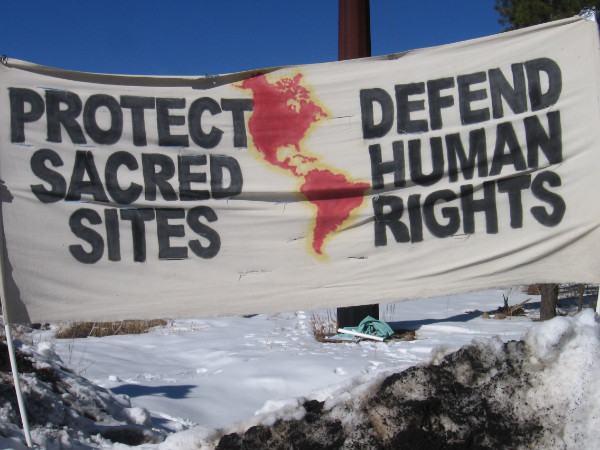
Other current issues facing the Taino People in their homeland of Puerto Rico will likely resonate with Indigenous communities all over the world. Among these, are access to Burial Sites, Sacred Areas, Funerary Objects, Ceremonial Centers, and Ancestral Remains; Tainos in Puerto Rico are currently engaged in a huge battle over what should be considered inalienable rights concerning these issues, and protected rights in the context of the Native American Grave Protection and Repatriation Act, 25 U.S.C. §§ 3001-3013. Indigenous Peoples across the world may identify with the difficulty encountered by the Taino People when, as Borrero recounted, they have to explain to their youth why their ancestors are the only ones put on display in museums behind ‘prison walls of glass’. Such displays of course would otherwise be deemed unthinkable, irreverent, and even sacrilegious within the value matrix of the settler populations that put them there. These issues stand as unfortunate beacons of international solidarity, and are set against the backdrop of the unique struggle of the Taino People to overcome the consecutive eras of physical, cultural, and ‘paper’ genocide within the landscape of Puerto Rico.
Notes
Many thanks to Roberto Mukaro Borrero for his integral collaboration on this piece and much respect for his tireless leadership in this movement.
To keep up with and learn more about current Taino movements and culture visit: www.uctp.org
…and check out this video for a deeper look on the census issues…
http://www.youtube.com/watch?v=As01jVTvLVI
Certain pieces of information for this article were sourced from, and are expanded on, here.
Across the world right now, Indigenous peoples are facing a renewed assault on their lands, rights, and ways of life.
From extractive industries pushing deeper into ancestral territories, to governments rolling back hard-won protections,
the threat is global—and it is growing.
What makes this moment especially dangerous is how little attention it receives.
Stories like this are disappearing in real time. Mainstream media
barely covers it and the coverage is fragmented. The public is left without the context
needed to understand what is truly at stake.
That is exactly why IC Magazine exists..
For more than 20 years, IC has reported on Indigenous struggles worldwide — consistently, independently, and without compromise.
We don’t follow news cycles; we trace patterns. We don’t sensationalize; we provide context.
And when the world looks away, we stay focused.
But this work is increasingly difficult to sustain.
We refuse to lock our reporting behind a paywall. We don’t sell access through subscriptions.
And we don’t answer to advertisers. IC Magazine survives solely because readers like you choose to
support independent Indigenous journalism.
Please donate today if you can. Every contribution helps us to continue this crucial work.
Thank you,
John Ahni Schertow
Founder and Editor in Chief