Last Updated on April 10, 2025

Pipes carrying uranium tailings in the eastern state of Jharkhand, India, burst on the 16th of August, “spewing the village of Dungridih with radioactive waste,” according to a recent report by Sanhati
It’s the latest in a series of uranium spills that have taken place over the last two years:
Incident 1: December 2006
In the first instance of tailing pipe leakage in Dec 2006, the radioactive waste contaminated the local water canal in Dungridih, killing all acquatic life in the channel. UCIL officials only reached the site after the villages blockaded the road, after the waste had been spilling for 9-10 hours. A report of this incident is available here: http://www.jadugoda.net/Accidents/index.htmlIncident 2: April 2007
In the second instance, 4 months later, we know that 1.5 tonnes of solid radioactive waste and 20,000 liters of liquid radioactive waste was leaked (this is the smallest of the recorded leaks) but more information is lacking.Incident 3: February 2008
In Feb 2008, tailing pipes burst again in Dungridih and radioactive sludge entered the streets and houses of the local villagers. After a sustained campaign by local activists, the UCIL CMD, Mr Ramendra Gupta informed villagers that they would be relocated to safer places and all protective measures will be taken to ensure that no further leakages happen from the tailing pipes. However, no such steps have been taken so far.Incident 4: July 2008
In July 2008, Jadugoda received record rainfall, which caused tailing ponds at Turamdih to spill over into the village ponds and lakes. UCIL acknowledged this spill but claimed that there was nothing they could do to prevent it. (”Radioactive waste flows into village” http://www.hindustantimes.com/StoryPage/StoryPage.aspx?id=9dcc11cc-d424-4900-95a1-41310e6daffe )Incident 5: August 2008
In August 2008, the tailing pipes have burst again in Dungridih, and the radioactive sludge flowing through them at high pressure has been sprayed over 10-12 houses.
UCIL readily admits that the previous incidents were caused by ‘poor maintenance and negligence’, however, the company is claiming that the most recent leak is a result of sabotage by the villagers.
It’s an insult to a community that’s greatly suffering because of UCIL’s incompetence — and moreso because of their refusal to respect the community’s land rights. The company displaced the village when they were building two of their three tailing ponds.
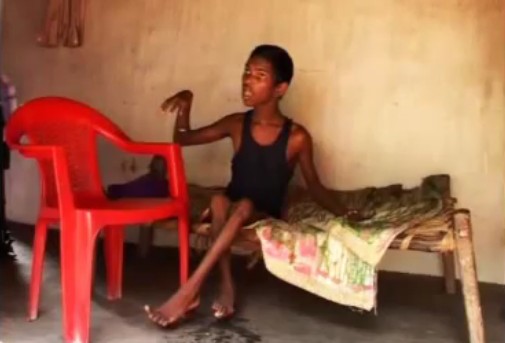
With nowhere to go, or otherwise refusing to leave their land, the villagers now report high levels of fatigue, lack of appetite, respiratory ailments, miscarriages, impotency, infant mortality, Down’s syndrome, skeletal deformities and thalassemia (a blood disorder).
It looks as if the uranium company has never given any compensation or aid to the village, however they now seem poised to relocate them. “Technically ‘illegal’ settlers on UCIL land,” explains Sanhati, “the UCIL [maintains] that it is under no compulsion to resettle these villagers–but will do so out of compassion. Having thus systematically illegitimized these original inhabitants of the land and put their lives and livelihoods at danger, the UCIL is now conferring a favor on these communities by now displacing them once more and resettling them at safer locations.”
Picture from www.nuclear-free.com
Across the world right now, Indigenous peoples are facing a renewed assault on their lands, rights, and ways of life.
From extractive industries pushing deeper into ancestral territories, to governments rolling back hard-won protections,
the threat is global—and it is growing.
What makes this moment especially dangerous is how little attention it receives.
Stories like this are disappearing in real time. Mainstream media
barely covers it and the coverage is fragmented. The public is left without the context
needed to understand what is truly at stake.
That is exactly why IC Magazine exists..
For more than 20 years, IC has reported on Indigenous struggles worldwide — consistently, independently, and without compromise.
We don’t follow news cycles; we trace patterns. We don’t sensationalize; we provide context.
And when the world looks away, we stay focused.
But this work is increasingly difficult to sustain.
We refuse to lock our reporting behind a paywall. We don’t sell access through subscriptions.
And we don’t answer to advertisers. IC Magazine survives solely because readers like you choose to
support independent Indigenous journalism.
Please donate today if you can. Every contribution helps us to continue this crucial work.
Thank you,
John Ahni Schertow
Founder and Editor in Chief