
Last Updated on April 10, 2025
Sovereignty or rather co-management? Atikamekw First Nation leaders have raised their voices before the Canadian and Quebec governments in relation to the rights to their ancestral lands. Headed by Great Chief Constant Awashish, Atikamekw leaders released on Monday a declaration of sovereignty over their ancestral territory of Nitaskinan, and urged the Quebec government to resume negotiations with them.
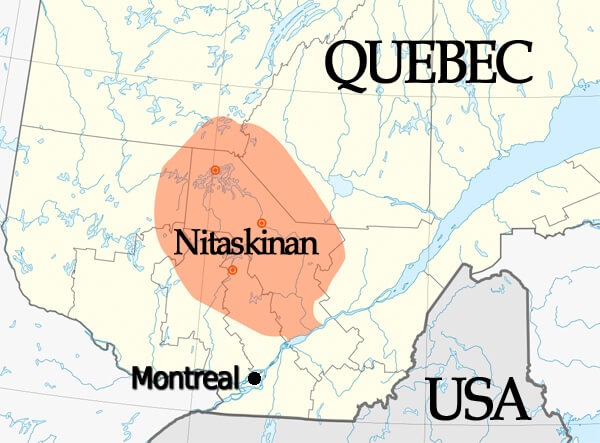
Nitaskinan spans over 80,000 square kilometers north to Quebec’s capital Montreal. the Atikamekw are organized into three communities (Manawan, Wemotaci and Opticiwan), which total some 7,000 people. Most of them still speak their own Algonquian language.
Great Chief Awashish says that, since a recent judgment of the Supreme Court of Canada regarding indigenous ancestral rights, “gone are the days of negotiating the rights of the Atikametw, which have not been surrendered.”
However, the Atikamekw have not presented a program for secession. They rather say that are willing to negotiate a “nation-to-nation” agreement with the government of Quebec under a clear premise: any development in the Nitaskinan territory must be focused on Atikamekw benefit and on the protection of their culture.
Quebec Premier sees will for “co-management”
The Premier of Quebec, Philippe Couillard, believes the declaration of sovereignty rather points towards a desire to “co-management, collaboration [and] consultations, which anyway we also want to do.” Couillard also recalls that Quebec and the Atikamekw leadership reached an agreement in 2013 on land management. He admits that an Atikamekw community rejected the deal, but argues this does not mean both delegations cannot go back to the negotiating table and reach a final agreement.
Across the world right now, Indigenous peoples are facing a renewed assault on their lands, rights, and ways of life.
From extractive industries pushing deeper into ancestral territories, to governments rolling back hard-won protections,
the threat is global—and it is growing.
What makes this moment especially dangerous is how little attention it receives.
Stories like this are disappearing in real time. Mainstream media
barely covers it and the coverage is fragmented. The public is left without the context
needed to understand what is truly at stake.
That is exactly why IC Magazine exists..
For more than 20 years, IC has reported on Indigenous struggles worldwide — consistently, independently, and without compromise.
We don’t follow news cycles; we trace patterns. We don’t sensationalize; we provide context.
And when the world looks away, we stay focused.
But this work is increasingly difficult to sustain.
We refuse to lock our reporting behind a paywall. We don’t sell access through subscriptions.
And we don’t answer to advertisers. IC Magazine survives solely because readers like you choose to
support independent Indigenous journalism.
Please donate today if you can. Every contribution helps us to continue this crucial work.
Thank you,
John Ahni Schertow
Founder and Editor in Chief

