Last Updated on August 14, 2026
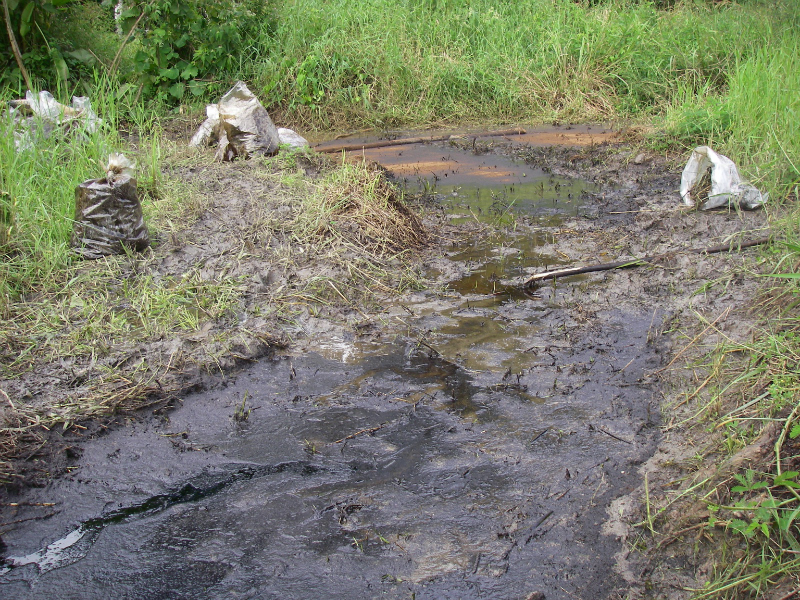
The Matanza-Riachuelo river basin, the most polluted region in Argentina, is getting some desperately needed relief thanks to a landmark decision by the National Supreme Court of Justice.
On September 10th, a caravan of inspectors from Argentina’s National Environmental Authority, the SAYDS, accompanied by 100 national guardsman and a busload of federal and local police, carried out a surprise raid on 34 companies said to be contaminating the Matanza-Riachuelo river basin in northeastern Buenos Aires.
“The crackdown, which included leather tanneries, food packing plants, vehicle junk-yards, and chemical producers, was accompanied by a court order from Federal Circuit Judge Luis Armella, and follows a recent verdict by the Supreme Court in which the River Basin Authority, a multi-jurisdictional body headed by the SAYDS and tasked with the river clean-up program, must inspect the totality of companies contaminating the basin,” explains a recent report from the Center for Human Rights and Environment (CEDHA).
“Of the 34 inspections, two companies, a meat packing facility and a leather tannery, were immediately ordered shut due to findings of infraganti violations of the environmental code, including direct toxic spillages into water ways, and improper citing of facilities in floodlands, placing the lives and health of workers and the community in danger,” the report continues.
“Judge Armella extended the court order to the Environment Secretary, Romina Picolotti, to intercede in 6 municipalities of the basin, following her request to intervene a list of renegade companies that refused to allow SAYDS inspectors on their premises. The SAYDS recently informed the court that they had identified at least 4,103 companies that released toxins into the river system with absolutely no treatment. Judge Armella accompanied the task force in the raid.”
The Matanza-Riachuelo watershed has been polluted since the 19th century, but the level of contamination has turned critical over the last few decades.
In 2004 a group of local residents took action, by filing a lawsuit against the national, provincial and city governments, and 44 companies for their contamination of the region.
Regarded as a landmark decision in the history of Latin American Environmental law, the Supreme court resolved to protect “the collective good,” stating, “The improvement or degradation of the environment benefits or harms the entire population because it is a good that belongs to society […] From this derives the particular energy with which judges should act to make effective the constitutional mandate to guarantee the right to a healthy environment.”
Across the world right now, Indigenous peoples are facing a renewed assault on their lands, rights, and ways of life.
From extractive industries pushing deeper into ancestral territories, to governments rolling back hard-won protections,
the threat is global—and it is growing.
What makes this moment especially dangerous is how little attention it receives.
Stories like this are disappearing in real time. Mainstream media
barely covers it and the coverage is fragmented. The public is left without the context
needed to understand what is truly at stake.
That is exactly why IC Magazine exists..
For more than 20 years, IC has reported on Indigenous struggles worldwide — consistently, independently, and without compromise.
We don’t follow news cycles; we trace patterns. We don’t sensationalize; we provide context.
And when the world looks away, we stay focused.
But this work is increasingly difficult to sustain.
We refuse to lock our reporting behind a paywall. We don’t sell access through subscriptions.
And we don’t answer to advertisers. IC Magazine survives solely because readers like you choose to
support independent Indigenous journalism.
Please donate today if you can. Every contribution helps us to continue this crucial work.
Thank you,
John Ahni Schertow
Founder and Editor in Chief