
Last Updated on April 20, 2026
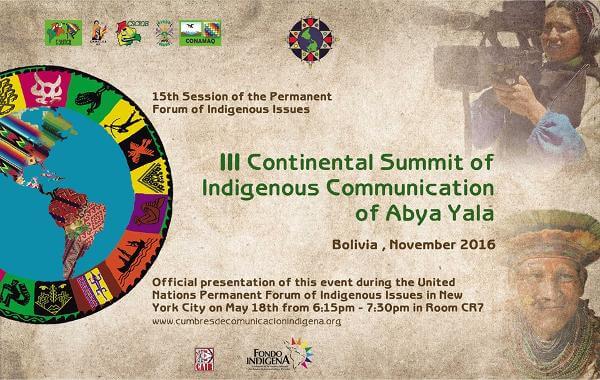
The III Continental Summit of Indigenous Communication of Abya Yala will be officially presented at this year’s session of the UN Permanent Forum on Indigenous Issues. The event will take place on Wednesday, May 18th from 6:15 to 7:30 PM at the CR7 room in the United Nations building in New York, in an event organized by a delegation from Bolivia, as well as by delegates from other member countries of the International Commission of the Summit.
The III Continental Summit of Indigenous Communication of Abya Yala will take place in the city of Tiquipaya, Department of Cochabamba, in the Plurinational State of Bolivia, from November 14-18, 2016, and some 1500 delegates are expected to attend. The event is organized by the five rural and indigenous confederations of Bolivia: Confederación Sindical Única de Trabajadores Campesinos de Bolivia (CSUTCB), Confederación Sindical de Comunidades Interculturales Originarias de Bolivia (CSCIOB), Confederación Nacional de Mujeres Campesinas Indígenas Originarias de Bolivia “Bartolina Sisa” (CNMCIOB-BS), Confederación de Pueblos Indígenas de Bolivia (CIDOB), and the Consejo de Ayllus y Markas del Qullasuyo (CONAMAQ). These confederations make up the National Organizing Committee of the Summit.
The official presentation at the UN will count with the presence of important delegates from indigenous organizations from around the continent, such as Myrna Cunningham Kain | Miskitu, Nicaragua | First Vice-President of the Indigenous Fund/ President of the Centre for the Autonomy and Development of Indigenous Peoples; Tarcila Rivera Zea | Quechua, Peru | Member of the Permanent Forum for Indigenous Issues of the United Nations/ President of Chirapaq – Indigenous Cultural Centers of Peru; Sandra Cossio Colque | Quechua, Bolivia | Representative of the Indigenous Audivisual Coordinator of Bolivia (CAIB) / Communicator of the Departmental Federation of Indigenous and Rural Women of Santa Cruz – Bartolina Sisa; David Hernández Palmar | Wayuu, Venezuela | Political Advisor of the Latin American Council of Film and Communication of Indigenous Peoples (CLACPI) / Director of the International Indigenous Film Showcase of Venezuela (MICIV); among others.
The representatives of the International Commission of the Summit are looking forward to meet with the UN Special Rapporteur on the Rights of Indigenous Peoples, Mrs. Victoria Tauli-Corpuz, in order to formally invite her to participate in the Summit.
The III Continental Summit in Bolivia
For Bolivia, the III Summit has strategic implications, as it seeks to integrate the experiences of indigenous and rural communicators within the philosophical framework that shapes the transformative movement currently underway in the country. This framework is based on the transformational concepts of decolonization, de-patriarchalization, and of Living Well. On the continental scale, the Summit also seeks to create a concrete road map that will guide the process of indigenous communication throughout the continent.
This III Summit will provide an ideal platform to present the important advances of this political process and confirm Bolivia’s leading role in the field of indigenous and rural communications.
For more information please check our web site: www.cumbresdecomunicacionindigena.org
Across the world right now, Indigenous peoples are facing a renewed assault on their lands, rights, and ways of life.
From extractive industries pushing deeper into ancestral territories, to governments rolling back hard-won protections,
the threat is global—and it is growing.
What makes this moment especially dangerous is how little attention it receives.
Stories like this are disappearing in real time. Mainstream media
barely covers it and the coverage is fragmented. The public is left without the context
needed to understand what is truly at stake.
That is exactly why IC Magazine exists..
For more than 20 years, IC has reported on Indigenous struggles worldwide — consistently, independently, and without compromise.
We don’t follow news cycles; we trace patterns. We don’t sensationalize; we provide context.
And when the world looks away, we stay focused.
But this work is increasingly difficult to sustain.
We refuse to lock our reporting behind a paywall. We don’t sell access through subscriptions.
And we don’t answer to advertisers. IC Magazine survives solely because readers like you choose to
support independent Indigenous journalism.
Please donate today if you can. Every contribution helps us to continue this crucial work.
Thank you,
John Ahni Schertow
Founder and Editor in Chief