Last Updated on May 19, 2019
Despite Attacks, Another Popular Assembly Emerges By Nancy Davies; Commentary from Oaxaca. January 28, 2007
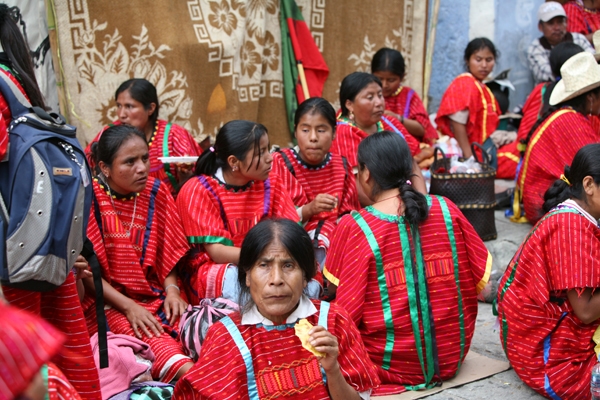
The Triqui indigenous community of Oaxaca declared its autonomy on January 21, 2007 after the election of its municipal authorities. The election process required two months to complete. The new municipal president is José Ramírez Flores with vice-president Leonardo Merino, constitutional mayor Severo Sánchez and secretary Macario Merino. Six others were named to the new Council of Elders (Concejo de Ancianos).
The chosen new government will employ the traditional indigenous practice of usos y costumbres used among the Triqui, with a council of elders and decisions made openly in assemblies. The authorities will meet with the leaders of the 20 communities which form San Juan Copala, as well as with the Council of Elders, so that decisions can be made.
The autonomous government has formed despite death threats against Ramirez and other leaders of the Triqui community who formed the autonomous municipality. In a January 21 interview with the daily La Jornada, Ramirez specifically cited the deception and oppression practiced by local political bosses (known as caciques) in the nearby towns of Santiago Juxtlahuaca, Putla de Guerrero and Constancia del Rosario, which have stayed outside the new autonomous municipality. One day before the new authorities assumed office, paramilitary groups burst into town and shot up the place. Worse, they ambushed Roberto García Flores, assassinating him on route to San Juan to participate in the new municipality.
Many consider the grip of the caciques as the greatest obstacle to peaceful development in Oaxaca. The United Popular Party, (PUP, in its Spanish initials) and the leaders of the Unified Independent Movement for the Triqui Liberation (MULT, in its Spanish initials) control the greater part of the local treasury in the area. Ramírez claims that more than half of received government funds go into their pockets and that MULT and its chief leader Heriberto Pazos are mentioned as stealing resources which should have gone into the relief of poverty for the Triquis.
Therefore, many people support the autonomous community as an act of rebellion against the caciques and their hired gun, identified as the deputy Rufino Maximino Zaragoza, who is accused by representative Edilberto Hernandez Cárdenas, of the Unified Independent Movement for the Triqui Liberation Independiente (MULTI, in its Spanish initials), of being responsible for the killing of more than ten people since March of 2006, the majority of them children between the ages of six and fifteen. Shootings among indigenous and campesino populations have been ignored by state authorities who declare virtually all deaths to be internal, or land boundary, disputes.
Autonomy is a complicated matter anywhere; it’s even more complicated given that the Triqui peoples split off a smaller group, a division fought against by the ruling Institutional Revolutionary Party (PRI, in its Spanish initials), which believed itself in complete control of Triqui areas. The PRI has been repressing the autonomists ever since.
The autonomous group MULTI dominates five of the municipalities within the new autonomous community of twenty. The MULTI came into existence on April 20 of 2006, and affiliated with the Popular Assembly of the Peoples of Oaxaca (APPO, in its Spanish initials). MULTI leaders and activists of the region documented the death or disappearance of 20 of their members, assigning responsibility to paramilitary groups sponsored by the governor Ulises Ruiz.
The other fifteen member towns are non-MULTI. Those remaining entirely outside the new autonomous entity remain predominantly in the control of the original MULT.
As a political entity, the new autonomous community of San Juan Cópala thus far exists only in the determination of the MULTI and united Triqui to maintain it. Its principal objective “is to achieve that our people, countrymen, brother Triquis, may continue struggling for our liberty and thus demand that the state authorities recognize our autonomous government and award us the economic resources that belong to us.”
That statement was given by the new president, José Ramírez Flores, in an interview given to La Jornada and published on January 22, 2007. Ramirez went on to say his challenges are to maintain the unity among the Triquis of the Mixteca region and to combat the daily violence in the community.
Historically, in the 1970s an organization formed to unite the Triqui around social issues. From that “Club,” the MULT emerged. In 2003 it opted for the formation of a political party to run for office and won at the ballot box. The PRI then threw all its power into infiltrating and corrupting the MULT, which was absorbed into the Popular Unity Party (PUP, Partido Unidad Popular). The consequent split between Triqui groups resulted in MULT and MULTI. I was taken aback during the spring of 2006 when I realized that the deaths of three Triquis were not counted among the death toll of the APPO which stood at 11 at that time, apparently because the murders were not directly attributed to the same paramilitary or plainclothes police who were shooting known APPO members. But according to reports, these Triquis (two adults and a young boy) had just left an APPO meeting. That is, one can assume they were MULTI adherents, killed for affiliating with the APPO. But they were not counted as “victims” of the government repression because they were supposedly shot by fellow Triquis, the MULT-PRIistas.
The majority of recent attacks against the residents of San Juan Copala have been against a secondary school, the municipal market, and the Catholic church. As in past “land disputes,” no state assistance to apprehend the criminals has been forthcoming. Abandonment and extreme misery and poverty, accompanied by repression against the Triqui, are the normal state of affairs, according to Edilberto Hernández Cárdenas, spokesperson for the new municipality.
With this declaration of autonomy by the twenty united communities, Edilberto Hernandez explained, they will reclaim the category of “free municipality” which they held in 1826 and which in 1948 was grabbed by the PRI government. MULT, originally formed as an alternative, betrayed the communities when it entered alliance with the PRI, and the rift is yet to be healed.
The state of Oaxaca refuses to recognize the newly constituted municipality, which raises the question of how San Juan Copola can negotiate for its share of state funding. The obvious issue is that the new entity wants all the legal funding to which it is entitled to get down to the base, without it being siphoned off by PRI operatives. One might wonder how that could take place under the current PRI governor, who is fighting for his political life. Nevertheless, Ramírez speaks of negotiating.
“If the state government does not want to recognize us, we will have to resort to another type of action. We want to negotiate, but if it’s not possible, we will carry out marches, meetings, and encampments, until they give us recognition.”
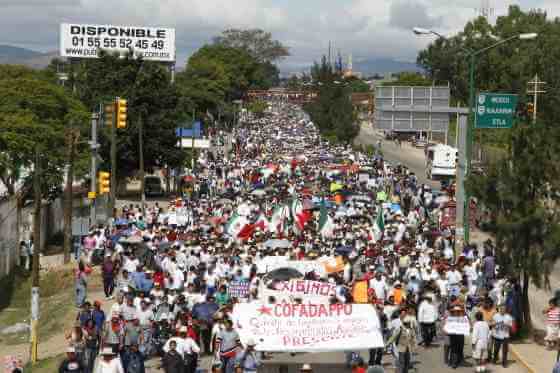
The APPO has congratulated the autonomous municipality. In that context, the attempt to achieve working unity among the twenty (of the thirty-six) Triqui communities of the Mixteca region, who have chosen to constitute the new municipality, is now paramount. Internal unity is placed above any political party, as modeled by the APPO. In other words, in the new municipal body they will act only as Triquis. According to La Jornada, Ramírez Flores was chosen president of the new municipality after three months of discussions among the leaders of the twenty participating Triqui communities, a month more than the “election” timeframe.
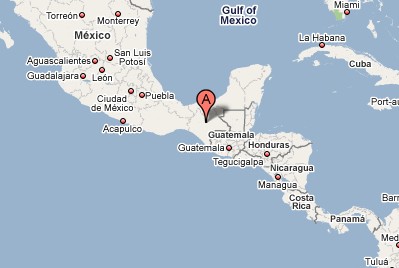
The San Juan Copala municipality unifies San Juan Copala, Yoxoyuzi, Santa Cruz Tilaza, Guadalupe Tilaza, Tierra Blanca, Paraje Pérez, El Carrizal, Sabana, Yerba Santa, San Miguel Copala, Yutazani, Unión de los Angeles, Río Metates, Río Lagarto, Cerro Pájaro and Cerro Cabeza, among others, for a total of about 15,000 indigenous people. Including the sixteen communities that remain with MULT, the total Triqui population is about 24,000.
The twenty unified communities placed a paid advertisement in Las Noticias when the autonomy was announced (and it was posted on Narco News). In it, the language affirmed solidarity with all Triquis. The implicit plea is to quit fighting among themselves for the scraps and crumbs that the PRI has shared out. The majority of the Triqui now want to start looking in a new direction. The sixteen non-participant communities that remain in the PRI can be wooed.
The swearing-in ceremony was celebrated by state and national guests, including the Indigenous Front of Binational Organizations, the National Unit Against Neoliberalism, The Peoples Popular Assembly of Oaxaca, the Francisco Villa Popular Independent Front, Section 22 of the National Teacher’s Union, the Extended Front of the Popular Struggle, the Popular Revolutionary Front and dozens more.
It is interesting to note that in Oaxaca, unlike Chiapas, the movement to “autonomy” does not mean withdrawal from contact with the official government, but rather a conquest of that government, in particular as equal members of the APPO. Joining the APPO reflects the demographics of Oaxaca where not only does the majority of the population have indigenous roots, but the majority of the population, in all its ethnicities, is in open revolt against the PRI, as we saw in the voting of July 2, 2006.
(source)
Across the world right now, Indigenous peoples are facing a renewed assault on their lands, rights, and ways of life.
From extractive industries pushing deeper into ancestral territories, to governments rolling back hard-won protections,
the threat is global—and it is growing.
What makes this moment especially dangerous is how little attention it receives.
Stories like this are disappearing in real time. Mainstream media
barely covers it and the coverage is fragmented. The public is left without the context
needed to understand what is truly at stake.
That is exactly why IC Magazine exists..
For more than 20 years, IC has reported on Indigenous struggles worldwide — consistently, independently, and without compromise.
We don’t follow news cycles; we trace patterns. We don’t sensationalize; we provide context.
And when the world looks away, we stay focused.
But this work is increasingly difficult to sustain.
We refuse to lock our reporting behind a paywall. We don’t sell access through subscriptions.
And we don’t answer to advertisers. IC Magazine survives solely because readers like you choose to
support independent Indigenous journalism.
Please donate today if you can. Every contribution helps us to continue this crucial work.
Thank you,
John Ahni Schertow
Founder and Editor in Chief