Last Updated on April 10, 2025
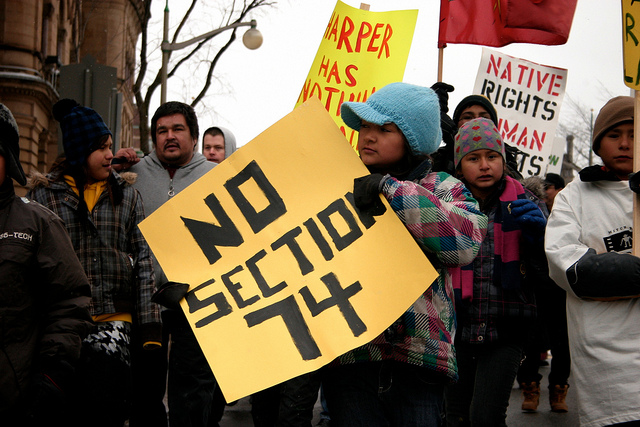
Earlier this month, a Federal Court Judge ruled in favour of the Barriere Lake Algonquins, calling into question Indian and Northern Affairs (INAC) 2008 decision to replace the First Nation’s traditionally-elected Chief and Council with a ‘minority faction.’
The leadership dispute is still far from over, however the ruling outlines a set of points that affirm Barriere Lake’s standing list of Demands.
Please see the press release below for more information.
On March 25 2008, the Elders Council of Barriere Lake filed a judicial review (JR) application of INAC’s decision to recognize Casey Ratt’s dissident faction over customary chief Benjamin Nottaway and his council (Wawatie et al v Indian and Northern Affairs Canada). At the time, the Minister had received applications from two different groups claiming to form the legitimate government of Barriere Lake. Why had Ratt’s council been recognized over Benjamin Nottaway’s?
The INAC Minister brought a motion to dismiss the case for JR in the Federal Court, claiming that no “decision” had been taken; it was simply a mechanical act that had led the Minister’s office to process one application over the other. In late August of 2008, the case was heard before a Prothonotary (the principal clerk of a court), who decided in favour of the Crown. The Elders requested that their council appeal the Prothonotary’s decision.
The appeal was heard on November 24 2008 in a Toronto court room, with several supporters in attendance. Last week we learned that Judge Zinn overturned the decision of the Prothonotary, and according to their council, affirming three crucial principles:
It goes without saying that this is excellent news. The Elders Council’s legal representatives, David Nahwegahbow and Nicole Richmond, are commended for their hard work and impressive summations for the Court of a complicated case.
Please see the attached document for Mr. Justice Zinn’s reasoning in the case: January 6, 2009 – Reasons for Order and Order (pdf)
Across the world right now, Indigenous peoples are facing a renewed assault on their lands, rights, and ways of life.
From extractive industries pushing deeper into ancestral territories, to governments rolling back hard-won protections,
the threat is global—and it is growing.
What makes this moment especially dangerous is how little attention it receives.
Stories like this are disappearing in real time. Mainstream media
barely covers it and the coverage is fragmented. The public is left without the context
needed to understand what is truly at stake.
That is exactly why IC Magazine exists..
For more than 20 years, IC has reported on Indigenous struggles worldwide — consistently, independently, and without compromise.
We don’t follow news cycles; we trace patterns. We don’t sensationalize; we provide context.
And when the world looks away, we stay focused.
But this work is increasingly difficult to sustain.
We refuse to lock our reporting behind a paywall. We don’t sell access through subscriptions.
And we don’t answer to advertisers. IC Magazine survives solely because readers like you choose to
support independent Indigenous journalism.
Please donate today if you can. Every contribution helps us to continue this crucial work.
Thank you,
John Ahni Schertow
Founder and Editor in Chief