Last Updated on June 18, 2014
Indigenous people in Peru are celebrating a major victory in their long-time struggle to protect the land from outsiders hoping to exploit it.
On January 14, the Regional Government of Cusco enacted a law that bans the practice of biopiracy, or “the appropriation and monopolization of traditional population’s knowledge and biological resources.”
“Worldwide, national governments and international bodies such as the World Trade Organization and the World Intellectual Property Organization have failed to protect indigenous people’s traditional knowledge and associated genetic resources from biopirates,” says Alejandro Argumedo, the Director of Asociacion ANDES, an Indigenous group based in Cusco.
“The new law enacted by the regional government of Cusco is a good example of how local governments can create the appropriate legal and institutional framework, as well as the mechanisms to implement it, to ensure that biopiracy does not prey on the creativity of indigenous peoples and local communities,” he adds.
Of particular note, “[the law includes] provisions for prior informed consent from indigenous and local communities, benefit-sharing with communities, and limitations upon the creation of patent rights over genetic resources,” says Johanna Gibson, the Director of Queen Mary Intellectual Property Research Institute (QMIPRI).
“[It is also] based on the understanding that such communities have sustained and protected the species for centuries through their traditions and practices, and acknowledge this guardianship in the duties to those communities, as recognised in the law, as well as providing for communities to rely on customary laws to develop and implement registers for genetic resources and protocols and procedures for the access to those resources,” says Gibson.
This is indeed a major victory, since the law (O.R. Nº048-2008-CR/GRC) creates an “equal playing field” in a country, or at least a region of it, that “has long been a hot spot for biopirates seeking easy prey,” says Dr Michel Pimbert, from the International Institute for Environment and Development.
“It strengthens community institutions and their capacity to manage access to their cultural and biological assets and to inform local authorities of any transgressions so that they can play a critical role in controlling biopiracy.”
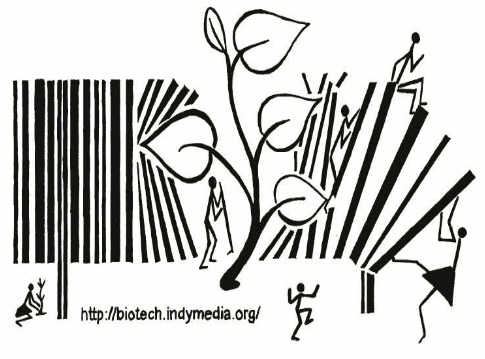
For more news and background on biopiracy, also known as bioprospecting, visit biotech.indymedia.org, ipcb.org, and ibin.org
Across the world right now, Indigenous peoples are facing a renewed assault on their lands, rights, and ways of life.
From extractive industries pushing deeper into ancestral territories, to governments rolling back hard-won protections,
the threat is global—and it is growing.
What makes this moment especially dangerous is how little attention it receives.
Stories like this are disappearing in real time. Mainstream media
barely covers it and the coverage is fragmented. The public is left without the context
needed to understand what is truly at stake.
That is exactly why IC Magazine exists..
For more than 20 years, IC has reported on Indigenous struggles worldwide — consistently, independently, and without compromise.
We don’t follow news cycles; we trace patterns. We don’t sensationalize; we provide context.
And when the world looks away, we stay focused.
But this work is increasingly difficult to sustain.
We refuse to lock our reporting behind a paywall. We don’t sell access through subscriptions.
And we don’t answer to advertisers. IC Magazine survives solely because readers like you choose to
support independent Indigenous journalism.
Please donate today if you can. Every contribution helps us to continue this crucial work.
Thank you,
John Ahni Schertow
Founder and Editor in Chief