Last Updated on May 20, 2019
SHINGAL, Nineveh, Iraq – In an official statement from Prime Minister Waheed Mandoo Hammo, the Provisional Government of Ezidikhan has flatly rejected a political deal cut between Baghdad and Irbil that hands military and political control over Ezidikhan and its people to the Kurdish Regional Government.
The official statement from the Office of the Prime Minister reads,
“The Yezidi people reject the Iraq government’s attempt to install the Kurdish Regional Government as the military and political authority over the nation of Ezidikhan without our consent. The Ezidikhan Provisional Government is the sole, legitimate government representing the peoples of Ezidikhan. No decisions regarding the political, economic or strategic actions regarding the nation of Ezidikhan can legitimately be made without our free, prior and informed consent.”
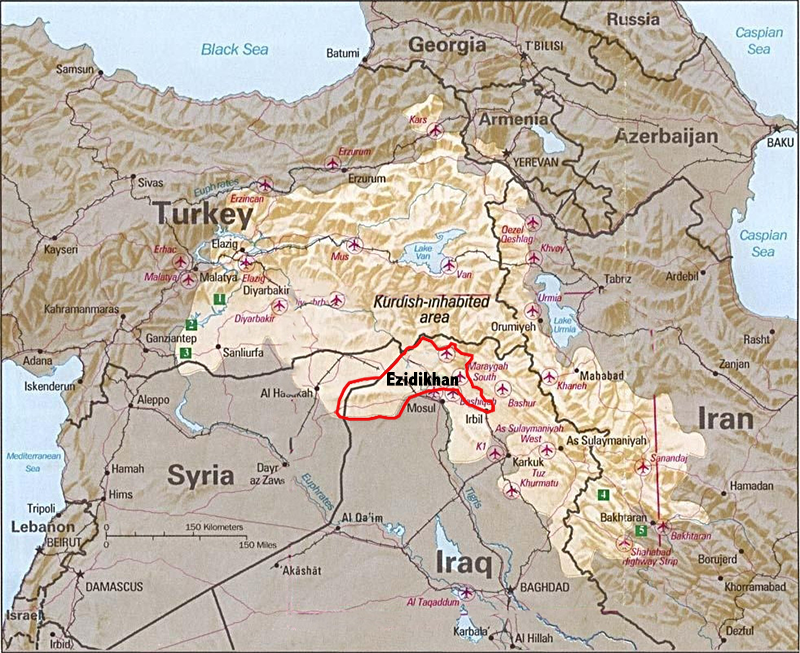
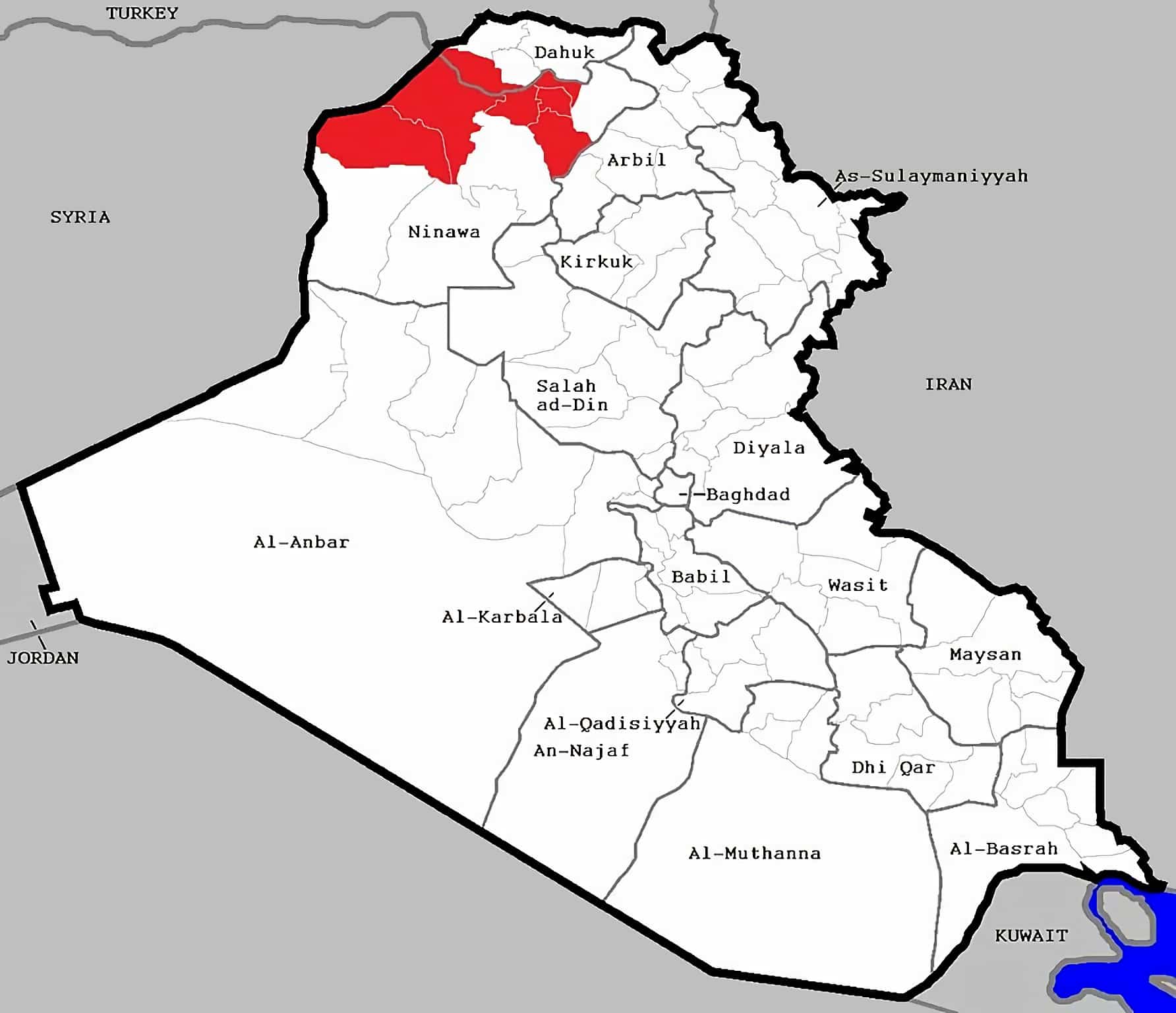 Location of Ezidikhan within the borders of the Republic of Iraq
“This is the internationally agreed norm established by the United Nations at its High Level General Assembly when the United Nations affirmed this principle in September 2014. Obtaining the “free, prior and informed consent” of indigenous nations before any state action affecting their rights or interests is the burden that Iraq agreed to at the High Level General Assembly in 2014.”
“It is my Government’s decision to enforce the principle of free, prior and informed consent as affirmed by the United Nations in our relations with Iraq and all nations and states. No policy or action by Iraq or any other state’s government that affects the interests of the Nation of Ezidikhan will be legitimate without my Government’s freely given consent and without having been fully and satisfactorily informed.”
Prime Minister Waheed Mandoo has also stressed that “Ezidikhan will not deal with the Iraqi government unless and until it conducts new elections since it is obviously an illegitimate government lacking any authority to govern.”
Across the world right now, Indigenous peoples are facing a renewed assault on their lands, rights, and ways of life.
From extractive industries pushing deeper into ancestral territories, to governments rolling back hard-won protections,
the threat is global—and it is growing.
What makes this moment especially dangerous is how little attention it receives.
Stories like this are disappearing in real time. Mainstream media
barely covers it and the coverage is fragmented. The public is left without the context
needed to understand what is truly at stake.
That is exactly why IC Magazine exists..
For more than 20 years, IC has reported on Indigenous struggles worldwide — consistently, independently, and without compromise.
We don’t follow news cycles; we trace patterns. We don’t sensationalize; we provide context.
And when the world looks away, we stay focused.
But this work is increasingly difficult to sustain.
We refuse to lock our reporting behind a paywall. We don’t sell access through subscriptions.
And we don’t answer to advertisers. IC Magazine survives solely because readers like you choose to
support independent Indigenous journalism.
Please donate today if you can. Every contribution helps us to continue this crucial work.
Thank you,
John Ahni Schertow
Founder and Editor in Chief