Last Updated on January 19, 2014
Guatemala and Honduras – a Global Investors “Oasis”
from Rights Action, www.rightsaction.org
It has been said that “the problems of the South are the demands of the North,” and Central America is rife with poverty and exploitation and environmental destruction due in (large) part to “development” economic policies imposed by and beneficial to the global north.
On-going militarism in Central America – including the physical presence of American soldiers – facilitates mainly North American efforts to secure access to resources for North American investors and business interests, in
particular minerals, petroleum, land, water, coffee and cheap labour.
“Free” trade agreements, including DR-CAFTA (Dominican Republic – Central American “Free” Trade Agreement), with the US and the CA4TA (Central America Four “Free” Trade Agreement) with Canada, are further “liberalizing” the region in the same way that NAFTA “liberalized” Mexico.
MINING – “DEVELOPMENT” FOR WHOM?
Mining mega-projects offer clear examples of the top-down, environmentally and socially destructive model of ‘development’ promoted by U.S. and Canadian governments, global companies and International Financial
Institutions like the World Bank and the International Monetary Fund.
The scale of damage and destruction experienced by people who live in communities affected by multinational mining interests have caused some to label these activities as “Terrorismo Minero” (“Mining Terrorism”).
The World Bank, which invests directly in mining companies and insures their investments, along with help from Northern governments, have pressured mineral rich states around the world to do away with their existing mining
legislation, and funded them to come up with new legislation that creates a suitable environment for multinational mining companies, regardless of the needs of local people.
Guatemala and Honduras are both examples of countries where mining legislation was changed to favour (primarily Canadian) multinational mining companies. Today, in both countries, the royalty tax rate for mining is calculated as 1% of the value of total production.
GOLDCORP/GLAMIS in HONDURAS & GUATEMALA
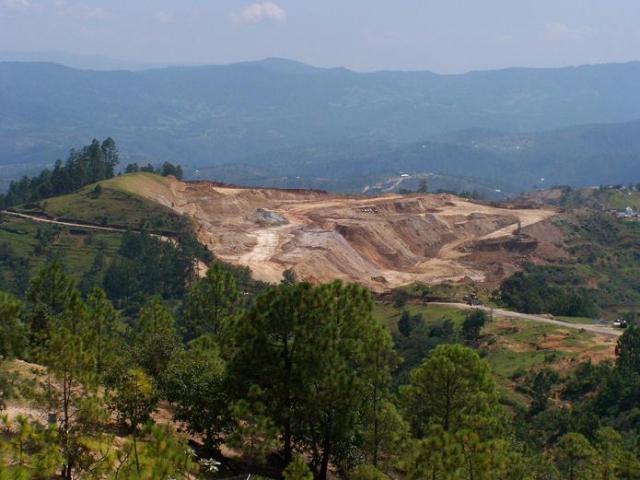
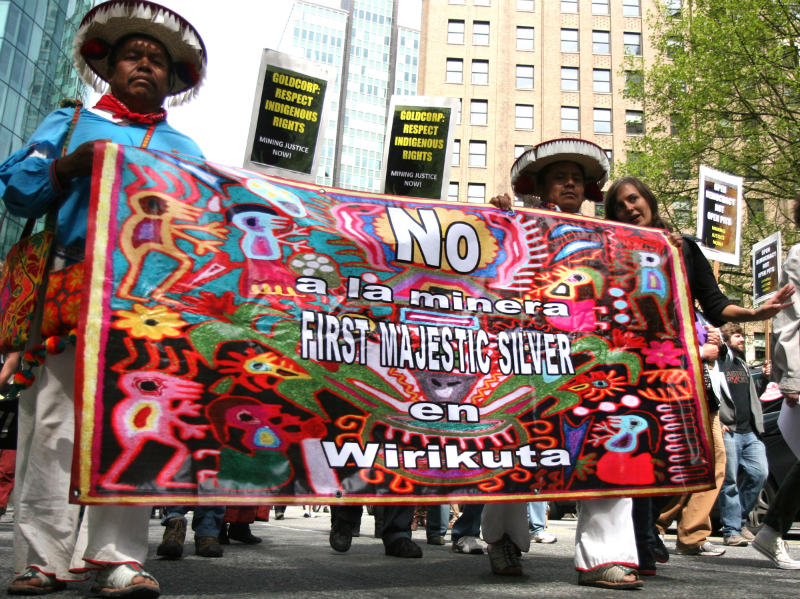
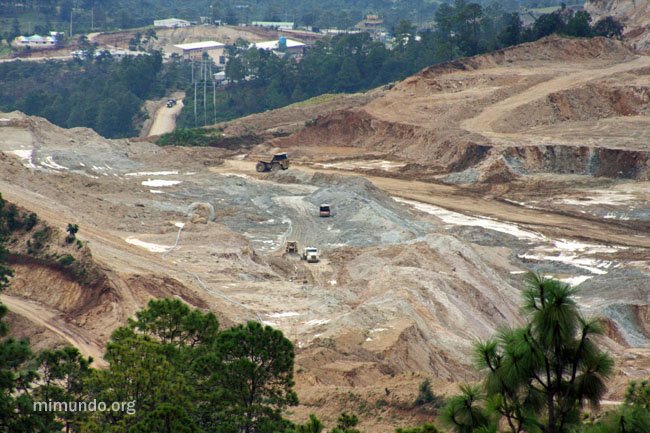
Specific examples of devastating and highly contested mining projects are the “Marlin project” in Guatemala and the disastrous “San Martin” mine in Honduras, both owned by the Vancouver based Canadian company Goldcorp inc,
formerly Glamis Gold.
In addition to destroying large tracts of land, major issues have arisen at the “Marlin project” and the “San Martin” mine around the contamination and drying up of rivers and sources of drinking water, illness without compensation among workers, the displacement of communities and the fracturing of their leadership, and threats, violence, and even murder of local people who take a stance against the company.
Many of these concessions – hidden from the public eye and granted without consultation – fall within indigenous territories, in direct violation of the national legislations and ILO Convention 169 that indigenous groups in
Honduras and Guatemala fought successfully to have ratified.
Across the world right now, Indigenous peoples are facing a renewed assault on their lands, rights, and ways of life.
From extractive industries pushing deeper into ancestral territories, to governments rolling back hard-won protections,
the threat is global—and it is growing.
What makes this moment especially dangerous is how little attention it receives.
Stories like this are disappearing in real time. Mainstream media
barely covers it and the coverage is fragmented. The public is left without the context
needed to understand what is truly at stake.
That is exactly why IC Magazine exists..
For more than 20 years, IC has reported on Indigenous struggles worldwide — consistently, independently, and without compromise.
We don’t follow news cycles; we trace patterns. We don’t sensationalize; we provide context.
And when the world looks away, we stay focused.
But this work is increasingly difficult to sustain.
We refuse to lock our reporting behind a paywall. We don’t sell access through subscriptions.
And we don’t answer to advertisers. IC Magazine survives solely because readers like you choose to
support independent Indigenous journalism.
Please donate today if you can. Every contribution helps us to continue this crucial work.
Thank you,
John Ahni Schertow
Founder and Editor in Chief