
Last Updated on April 8, 2025
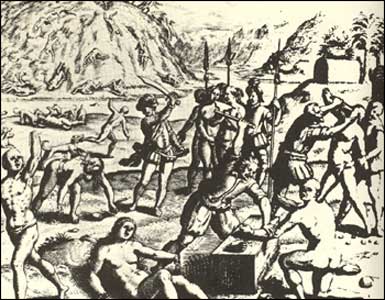
The powerful and hard-hitting documentary, American Holocaust, is quite possibly the only film that reveals the link between the Nazi holocaust, which claimed at least 6 million Jews, and the American Holocaust which claimed, according to conservative estimates, 19 million Indigenous People.
It is seldom noted anywhere in fact, be it in textbooks or on the internet, that Hitler studied America’s “Indian policy”, and used it as a model for what he termed “the final solution.”
He wasn’t the only one either. It’s not explicitly mentioned in the film, but it’s well known that members of the National Party government in South Africa studied “the American approach” before they introduced the system of racial apartheid, which lasted from 1948 to 1994. Other fascist regimes, for instance, in South and Central America, studied the same policy.
Noted even less frequently, Canada’s “Aboriginal policy” was also closely examined for its psychological properties. America always took the more ‘wide-open’ approach, for example, by decimating the Buffalo to get rid of a primary food source, by introducing pox blankets, and by giving $1 rewards to settlers in return for scalps of Indigenous Men, women, and children, among many, many other horrendous acts. Canada, on the other hand, was more bureaucratic about it. They used what I like to call “the gentleman’s touch”, because instead of extinguishment, Canada sought to “remove the Indian from the Man” and the Women and the Child, through a long-term, and very specific program of internal breakdown and replacement – call it “assimilation”. America had it’s own assimilation program, but Canada was far more technical about it.
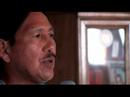
Perhaps these points would have been more closely examined in American Holocaust if the film had been completed. The film’s director, Joanelle Romero, says she’s been turned down from all sources of funding since she began putting it together in 1995.
Perhaps it’s just not “good business” to invest in something that tells so much truth? In any event, Romero produced a shortened, 29-minute version of the film in 2001, with the hope of encouraging new funders so she could complete American Holocaust. Eight years on, Romero is still looking for funds.
American Holocaust may never become the 90-minute documentary Romero hoped to create, to help expose the most substantial act of genocide that the world has ever seen… one that continues even as you read these words.
Across the world right now, Indigenous peoples are facing a renewed assault on their lands, rights, and ways of life.
From extractive industries pushing deeper into ancestral territories, to governments rolling back hard-won protections,
the threat is global—and it is growing.
What makes this moment especially dangerous is how little attention it receives.
Stories like this are disappearing in real time. Mainstream media
barely covers it and the coverage is fragmented. The public is left without the context
needed to understand what is truly at stake.
That is exactly why IC Magazine exists..
For more than 20 years, IC has reported on Indigenous struggles worldwide — consistently, independently, and without compromise.
We don’t follow news cycles; we trace patterns. We don’t sensationalize; we provide context.
And when the world looks away, we stay focused.
But this work is increasingly difficult to sustain.
We refuse to lock our reporting behind a paywall. We don’t sell access through subscriptions.
And we don’t answer to advertisers. IC Magazine survives solely because readers like you choose to
support independent Indigenous journalism.
Please donate today if you can. Every contribution helps us to continue this crucial work.
Thank you,
John Ahni Schertow
Founder and Editor in Chief