
Last Updated on September 18, 2025
In a time when “green tech” comes with high-cost startups and extractive industries dressed in eco-branding, a quieter revolution is taking root. Drawing on generations of ecological intelligence, Indigenous innovators are building new tools that speak not only for survival, but for the sovereignty and well-being of future generations.
From solar-powered water purifiers to permaculture designs that restore degraded landscapes, Indigenous technologies are blossoming all over the world. But these are not temporary fixes or market-driven products built to appease investors. They are systems of care that are deeply embedded in relationships with land, water, and kin.
For many Indigenous communities, solar energy is more than a renewable resource; it’s a pathway to energy sovereignty and environmental stewardship. Organizations like Native Renewables, co-founded by Diné mechanical engineer Suzanne Singer, are at the forefront of this movement. Their initiatives provide off-grid solar photovoltaic (PV) systems to Navajo and Hopi families, many of whom lack access to electricity.
But they don’t just install it and forget it. Native Renewables emphasizes community empowerment through education and workforce training which helps to ensure self-reliance and long-term sustainability.
In Canada, there are over 1,700 Indigenous-led renewable energy projects transforming the energy landscape. By integrating traditional knowledge with modern technology, these initiatives not only address energy needs. They also reinforce cultural values.
One notable Indigenous-led project is the Three Nations Energy Solar Farm in northern Alberta. Developed by Three Nations Energy LP—a partnership between the Athabasca Chipewyan First Nation, Mikisew Cree First Nation, and Fort Chipewyan Métis Local 125—this project exemplifies Indigenous leadership in clean energy. The solar farm, completed in 2020, is the largest in a remote Canadian community, with a capacity of 2.2 megawatts. It effectively replaces 25% of the community’s diesel-generated electricity, reducing reliance on fossil fuels and lowering greenhouse gas emissions.
The T’Sou-ke Nation in British Columbia has implemented a comprehensive energy strategy of its own. They have installed a 400-panel solar photovoltaic system and solar hot water systems on numerous buildings. They are also exploring wind and wave energy projects.
Access to clean water is a particularly pressing challenge for hundreds of Indigenous communities worldwide. Many reserves in Canada continue to live under long-term boil-water advisories, while rural and remote nations across the globe struggle with scarcity and contamination. Indigenous innovators are addressing this as well—not by importing expensive solutions, but by designing context-specific systems grounded in reciprocity.
In Alaska, the Yukon River Inter-Tribal Watershed Council has developed a community-driven water monitoring program that combines traditional knowledge with advanced testing technologies. By training local youth in both Western science and Indigenous observation methods, they are safeguarding the Yukon River while cultivating the next generation of caretakers.
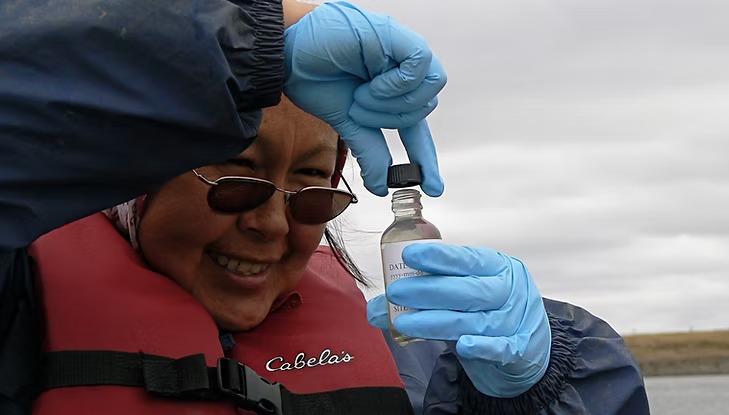
Photo: yritwc.org
In the Andean community of Canrey Chico, residents face a different water crisis: glacial meltwater that is contaminated with sulfur and heavy metals like aluminum, cadmium and arsenic. Working with the Instituto de Montaña, they created stone channels called “totorillas”. By lining the channels with native reeds full of anaerobic bacteria, they have been able to naturally filter the toxins out of the water.
In Nipissing First Nation, Ontario, an initiative called One Water is helping communities become more resilient by harvesting rainwater as a supplementary source of clean water. The project is Indigenous-led, with strong participation from the community in designing and managing rainwater harvesting systems. It’s intended not only to reduce dependence on vulnerable water infrastructure but also to build local capacity, engage youth, and integrate traditional ecological knowledge with engineering solutions.
Food sovereignty is another frontier of Indigenous technology. The Oglala Sioux Tribe on Pine Ridge has built aquaponics systems that blend fish farming with hydroponic vegetable production, creating local food sources in an area long dependent on outside supply chains.
In Australia, Yolŋu women are developing bush food enterprises that combine traditional ecological knowledge with sustainable packaging and distribution, ensuring that ancestral crops like Kakadu plum are protected from over-exploitation while generating community-led income.
Over in Hawaii, Hui Mālama Loko Iʻa is restoring fishpond aquaculture systems that date back hundreds of years. These loko iʻa provide not only sustainable food but also storm protection, acting as natural buffers against rising seas. By reviving them, Native Hawaiians are demonstrating how Indigenous infrastructure is often more climate-resilient than concrete seawalls or industrial fisheries.
And in Mexico, the Zapatista communities of Chiapas continue to practice collective maize farming using agroecological methods. Their seed banks protect native corn varieties from genetic erosion, while their cooperatives ensure that profits flow back into community infrastructure rather than leaving for outside corporations.

Photo: schoolsforchiapas.org
Perhaps the most visible before-and-after stories come from land itself. Where extractive industries leave behind scars, Indigenous nations are leading efforts to restore balance.
In Ecuador, the Sápara Nation has developed agroforestry projects that replace monocrop plantations with biodiverse food forests. These systems simultaneously provide fruit, medicine, and timber while creating carbon sinks that outpace conventional “carbon offset” projects.
Closer to home, the Tłı̨chǫ Government in the Northwest Territories is integrating satellite mapping with traditional caribou monitoring practices to protect herds under immense pressure from climate change and mining. This fusion of tools—digital and ancestral—creates adaptive management strategies that safeguard both food security and cultural identity.
Meanwhile, the Haida Nation has transformed Gwaii Haanas National Park Reserve into a model of co-governance. Once logged to near ruin, vast tracts of old-growth forest and marine ecosystems are now protected under an agreement between the Haida Nation and the Canadian government. Through the Archipelago Management Board, the Haida exercise decision-making power rooted in their laws and knowledge systems. The result is not just ecological recovery but a profound rebalancing of governance—proving that when Indigenous nations lead, ecosystems thrive.
In Australia, Aboriginal fire practitioners are bringing back “cool burning” techniques—sometimes called firestick farming—that reduce the risk of catastrophic bushfires while rejuvenating the land. These cultural burns, carried out with precision and care, restore biodiversity by encouraging the growth of native grasses and creating habitats for endangered species. Governments are slowly beginning to recognize that these ancient practices are essential to managing a warming climate.
And in Mexico, Chinampas, also known as floating gardens, are making a comeback. Chinampas are crops that are grown on small, rectangular plots built on shallow lake beds, creating a closed-loop system that prevents soil erosion and naturally filters water.
Many other grounded technologies are emerging: Māori engineers in Aotearoa (New Zealand) are developing tidal energy systems modeled after eel migration paths and water (whakapapa). The Inuk in northern Canada are re-imagining ice monitoring technologies using traditional indicators—like the sound of cracks and the behavior of Arctic char—alongside satellite data. Across the Pacific, Indigenous nations are reviving voyaging canoes that offer a low-carbon alternative for island nations facing fuel insecurity.
While governments and corporations chase after expensive climate “solutions,” Indigenous homelands are alive with examples that are proven, local, and enduring. Solar farms built through kinship, rainwater harvested with care—these are not quick-fix gadgets or speculative startups. They are living systems designed to match the ecologies they serve.
They also stand as a counterpoint to so-called “green” mega-projects like nuclear plants and hydro dams that disfigure landscapes and displace entire communities. Indigenous technologies move in the opposite direction: they restore balance rather than extract it, strengthen relationships rather than sever them, and build resilience by honoring place instead of erasing it.
If policymakers, scientists, and industry leaders are serious about addressing climate change, they must recognize this difference. Real solutions will not come from imposing one-size-fits-all schemes but from supporting Indigenous nations who are already shaping durable, regenerative futures.
Indeed, the “future” everyone is chasing has never been out of reach. It has been here all along, patiently waiting for the world to listen.
Across the world right now, Indigenous peoples are facing a renewed assault on their lands, rights, and ways of life.
From extractive industries pushing deeper into ancestral territories, to governments rolling back hard-won protections,
the threat is global—and it is growing.
What makes this moment especially dangerous is how little attention it receives.
Stories like this are disappearing in real time. Mainstream media
barely covers it and the coverage is fragmented. The public is left without the context
needed to understand what is truly at stake.
That is exactly why IC Magazine exists..
For more than 20 years, IC has reported on Indigenous struggles worldwide — consistently, independently, and without compromise.
We don’t follow news cycles; we trace patterns. We don’t sensationalize; we provide context.
And when the world looks away, we stay focused.
But this work is increasingly difficult to sustain.
We refuse to lock our reporting behind a paywall. We don’t sell access through subscriptions.
And we don’t answer to advertisers. IC Magazine survives solely because readers like you choose to
support independent Indigenous journalism.
Please donate today if you can. Every contribution helps us to continue this crucial work.
Thank you,
John Ahni Schertow
Founder and Editor in Chief

