
Last Updated on October 1, 2025
Artificial intelligence is often framed as a frontier that belongs to Silicon Valley, Beijing, or the halls of elite universities. Yet across the globe, Indigenous peoples are shaping AI in ways that reflect their own histories, values, and aspirations. These efforts are not simply about catching up with the latest technological wave—they are about protecting languages, reclaiming data sovereignty, and aligning computation with responsibilities to land and community.
From India’s tribal regions to the Māori homelands of Aotearoa New Zealand, Indigenous-led AI initiatives are emerging as powerful acts of cultural resilience and political assertion. They remind us that intelligence—whether artificial or human—must be grounded in relationship, reciprocity, and respect.
Just this week, researchers at IIIT Hyderabad, alongside IIT Delhi, BITS Pilani, and IIIT Naya Raipur, launched Adi Vaani, a suite of AI-powered tools designed for tribal languages such as Santali, Mundari, and Bhili.
At the heart of the project is a simple premise that technology should serve the people who need it most. Adi Vaani offers text-to-speech, translation, and optical character recognition (OCR) systems that allow speakers of marginalized languages to access education, healthcare, and public services in their mother tongues.
One of the project’s most promising outputs is a Gondi translator app that enables real-time communication between Gondi, Hindi, and English. For the nearly three million Gondi speakers who have long been excluded from India’s digital ecosystem, this tool is nothing less than transformative.
Speaking about the value of the app, research scholar Gopesh Kumar Bharti commented, “Like many tribal languages, Gondi faces several challenges due to its lack of representation in the official schedule, which hampers its preservation and development. The aim is to preserve and restore the Gondi language so that the next generation understands its cultural and historical significance.”
In Latin America, a similar wave of innovation is underway. Earlier this year, researchers at the Chilean National Center for Artificial Intelligence (CENIA) unveiled Latam-GPT, a free and open-source large language model trained not only on Spanish and Portuguese, but also incorporating Indigenous languages such as Mapuche, Rapanui, Guaraní, Nahuatl, and Quechua.
Unlike commercial AI systems that extract and commodify, Latam-GPT was designed with sovereignty and accessibility in mind.
To be successful, Latam-GPT needs to ensure the participation of “Indigenous peoples, migrant communities, and other historically marginalized groups in the model’s validation,” said Varinka Farren, chief executive officer of Hub APTA.
But as with most good things, it’s going to take time. Rodrigo Durán, CENIA’s general manager, told Rest of World that it will likely take at least a decade.
Half a world away, the Māori broadcasting collective Te Hiku Media has become a global leader in Indigenous AI. In 2021, the organization released an automatic speech recognition (ASR) model for Te Reo Māori with an accuracy rate of 92%—outperforming international tech giants.
Their achievement was not the result of corporate investment or vast computing power, but of decades of community-led language revitalization. By combining archival recordings with new contributions from fluent speakers, Te Hiku demonstrated that Indigenous peoples can own not only their languages but also the algorithms that process them.
As co-director Peter-Lucas Jones explained, “In the digital world, data is like land,” he says. “If we do not have control, governance, and ongoing guardianship of our data as indigenous people, we will be landless in the digital world, too.”
On the global policy front, leadership is also shifting. Earlier this year, UNESCO appointed Dr. Sonjharia Minz, an Oraon computer scientist from India’s Jharkhand state, as co-chair of the Indigenous Knowledge Research Governance and Rematriation program.
Her mandate is ambitious: to guide the development of AI-based systems that can securely store, share, and repatriate Indigenous cultural heritage. For communities who have seen their songs, rituals, and even sacred objects stolen and digitized without consent, this initiative signals a long-overdue turn toward justice.
As Dr. Minz told The Times of India, “We are on the brink of losing indigenous languages around the world. Indigenous languages are more than mere communication tools. They are repository of culture, knowledge and knowledge system. They are awaiting urgent attention for revitalization.”
Artificial intelligence is also being harnessed to care for the land and waters that sustain Indigenous peoples. In the Arctic, communities are blending traditional ecological knowledge with AI-driven satellite monitoring to guide adaptive mariculture practices—helping to ensure that changing seas still provide food for generations to come.
In the Pacific Northwest, Indigenous nations are deploying AI-powered sonar and video systems to monitor salmon runs, an effort vital not only to ecosystems but to cultural survival. Unlike conventional “black box” AI, these systems are validated by Indigenous experts, ensuring that machine predictions remain accountable to local governance and ecological ethics.
Such projects remind us that AI need not be extractive. It can be used to strengthen stewardship practices that have protected biodiversity for millennia.
As Indigenous communities lead the charge toward ethical and ecologically grounded AI, we must also confront the environmental realities underpinning the technology—especially the vast energy and water demands of large language models.
In Chile, the rapid proliferation of data centers—driven partly by AI demands—has sparked fierce opposition. Activists argue that facilities run by tech giants like Amazon, Google, and Microsoft exacerbate water scarcity in drought-stricken regions. As one local put it, “It’s turned into extractivism … We end up being everybody’s backyard.”
The energy hunger of LLMs compounds this strain further. According to researchers at MIT, training clusters for generative AI consume seven to eight times more energy than typical computing workloads, accelerating energy demands just as renewable capacity lags behind.
Globally, by 2022, data centers had consumed a staggering 460 terawatt-hours—a scale comparable to the electricity use of entire states such as France—and are projected to reach 1,050 TWh by 2026, which would place data centers among the top five global electricity users.
LLMs aren’t just energy-intensive; their environmental footprint also extends across their whole lifecycle. New modeling shows that inference—the use of pre-trained models—now contributes to more than half of total emissions. Meanwhile, Google’s own reporting suggests that AI operations have increased greenhouse gas emissions by roughly 48% over five years.
Communities hosting data centers often face additional challenges, including:
This environmental reckoning matters deeply to Indigenous-led AI initiatives—because AI should not replicate colonial patterns of extraction and dispossession. Instead, it must align with ecological reciprocity, sustainability, and respect for all forms of life.
Together, these Indigenous-led initiatives compel us to rethink both what counts as intelligence and where AI should be heading—
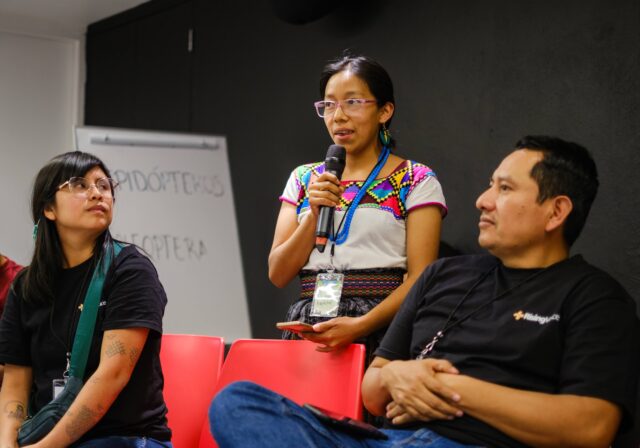
a topic that was discussed to some degree at the first AI+Indigenous Languages Forum, held on March 13 and 14 in Mexico City. In the mainstream tech industry, intelligence is measured by processing power, speed, and predictive accuracy. But for Indigenous nations, intelligence is relational: it lives in languages that carry ancestral memory, guiding communities toward balance and responsibility.
When these values shape artificial intelligence, the results look radically different from today’s extractive systems. AI becomes a tool for reciprocity instead of extraction. In other words, it becomes less about dominating the future and more about sustaining the conditions for life itself.
This vision matters because the current trajectory of AI as an arms race of ever-larger models, resource-hungry data centers, and escalating ecological costs—cannot be sustained.
The challenge is not technical but political and ethical. Will governments, institutions, and corporations make space for Indigenous leadership to shape AI’s future? Or will they repeat the same old colonial logics of extraction and exclusion? Time will tell.
Across the world right now, Indigenous peoples are facing a renewed assault on their lands, rights, and ways of life.
From extractive industries pushing deeper into ancestral territories, to governments rolling back hard-won protections,
the threat is global—and it is growing.
What makes this moment especially dangerous is how little attention it receives.
Stories like this are disappearing in real time. Mainstream media
barely covers it and the coverage is fragmented. The public is left without the context
needed to understand what is truly at stake.
That is exactly why IC Magazine exists..
For more than 20 years, IC has reported on Indigenous struggles worldwide — consistently, independently, and without compromise.
We don’t follow news cycles; we trace patterns. We don’t sensationalize; we provide context.
And when the world looks away, we stay focused.
But this work is increasingly difficult to sustain.
We refuse to lock our reporting behind a paywall. We don’t sell access through subscriptions.
And we don’t answer to advertisers. IC Magazine survives solely because readers like you choose to
support independent Indigenous journalism.
Please donate today if you can. Every contribution helps us to continue this crucial work.
Thank you,
John Ahni Schertow
Founder and Editor in Chief