Last Updated on March 13, 2013
On June 19, Peru’s Congress overwhelmingly revoked two of the controvesial land laws that triggered this month’s violent confrontation in northern Peru, which left 34 people dead and hundreds more injured and still missing.
The laws were an obvious violation of ILO Convention 169 and the United Nations Declaration on the Rights of Indigenous Peoples. They would have granted mining, oil & gas, logging, and hydro companies free access to Indigenous territories.
Declaring the laws ‘necessary’ for the future of Peru, President Garcia brought them in late last year, without consulting or acknowledging the rights of Indigenous People.
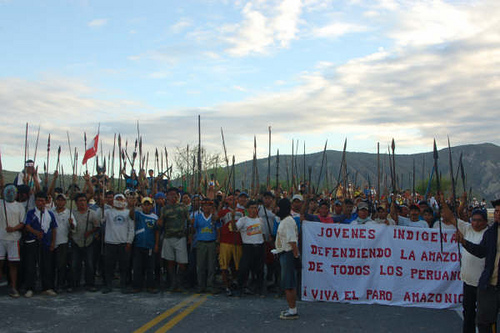
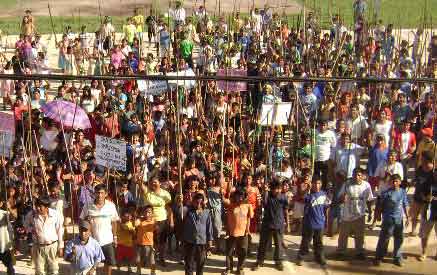
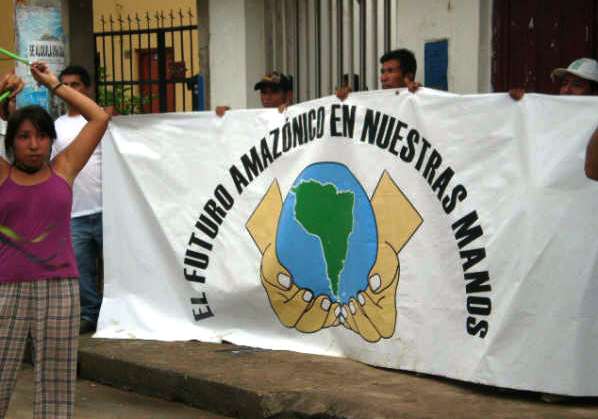
In response to the laws, on April 9, 2009, more than 1250 indigenous communities began a National campaign to have the laws overturned. They protested every single day, setting up more than two dozen blockades and holding countless protests in nine Provinces.
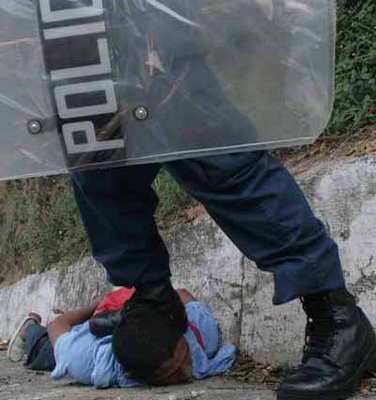
The mobilization came to a brutal peak on June 5, when police forces were sent in to break up one of those blockades—on the Fernando Belaunde Terry Road in Bagua.
The events that followed have been widely reported and repudiated, with Indigenous People labeling Bagua a “massacre, ” while various government officials claiming it was a “conspiracy” led by “murders” and “foreigners”, including Venezuela President Hugo Chavez and Bolivia President Evo Morales — to undermine the state.
All told, the violent confrontation in Bagua left 34 dead according to government figures, both Police and Indigenous People. Hundreds more have been reported injured and up to 250 people are still missing.
Following Congress’ vote, Daysi Zapata, vice president of the Interethnic Association for Development of the Peruvian Jungle (AIDESEP), the organization that started the mobilization, officially called for an end to all protests), stating, “Today is an historic day, we are grateful that the will of indigenous peoples has been heard, and only hope that in future, governments meet and listen to the people, and not legislate the laws back in.”
As needed and as welcomed as this recent victory may be, we must’t forget there are more laws of equal concern to the Indigenous Population—all of which remain perfectly intact. It means we have not seen the end of protests.
But more to the point, the vote hasn’t done anything to solve “the essential conflict” as one blogger aptly noted this morning.
That conflict is one we find on every continent, involving every major industry and Nation State, and more than half of the world’s Indigenous Population.
In simplest terms, it’s about modernization, profit, the exercise of power, and the needs and rights of separate and distinct peoples like the Awajun, Wampis and Ashaninka in Peru, the Wayuu and Bari in Venezuela, the Mohawk and Lubicon in Canada, the Ogiek in Kenya and hundreds of others around the world.
The conflict go on forever unless governments like the Garcia administration stop thinking in polarized terms, and stop endorsing a barbaric policy of repression against those who only want to live in peace.
Instead, reason and equanimity must be allowed to reign — alongside dignity and international law.
If this happens then every govenrment in thew world can be sure that there will be no more protests, and no more loss of life.
If instead the continue on the path of barbarism, leaving indigenous people with no choice but to forfeit their culture and sacrifice their history “or the so-called “greater good” then all we can do is struggle. Even if it costs us our own lives.
Photo: © REUTERS. June 15, 2008
Across the world right now, Indigenous peoples are facing a renewed assault on their lands, rights, and ways of life.
From extractive industries pushing deeper into ancestral territories, to governments rolling back hard-won protections,
the threat is global—and it is growing.
What makes this moment especially dangerous is how little attention it receives.
Stories like this are disappearing in real time. Mainstream media
barely covers it and the coverage is fragmented. The public is left without the context
needed to understand what is truly at stake.
That is exactly why IC Magazine exists..
For more than 20 years, IC has reported on Indigenous struggles worldwide — consistently, independently, and without compromise.
We don’t follow news cycles; we trace patterns. We don’t sensationalize; we provide context.
And when the world looks away, we stay focused.
But this work is increasingly difficult to sustain.
We refuse to lock our reporting behind a paywall. We don’t sell access through subscriptions.
And we don’t answer to advertisers. IC Magazine survives solely because readers like you choose to
support independent Indigenous journalism.
Please donate today if you can. Every contribution helps us to continue this crucial work.
Thank you,
John Ahni Schertow
Founder and Editor in Chief