Last Updated on March 13, 2013
I’m putting this up reluctantly, because the AFN get’s an F too; also for the hypocritical irony of what Prentice says…
Native group to give Ottawa failing grade for treaties
Royal commission’s recommendations still being ignored 10 years later, AFN says
BILL CURRY
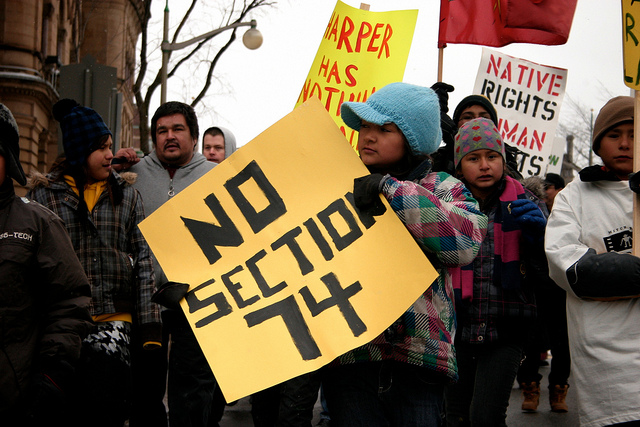
OTTAWA — Native leaders will mark the 10th anniversary of the Royal Commission on Aboriginal Peoples today, with the release of a report card that shows Ottawa has failed to act on the vast majority of its recommendations.
The Assembly of First Nations gives Ottawa an F in all areas dealing with the respect of treaties, which the commission argues are key to giving natives enough power and land to lift most out of poverty.
The federal government signed hundreds of treaties with natives as Canada was settled by Europeans, and they form the basis of continuing negotiations over land rights for traditional hunting and fishing. But treaties can also produce significant financial benefits for native communities that obtain rights to natural-resource revenues in areas such as mining and forestry.
The royal commission was launched in 1991 by prime minister Brian Mulroney’s government. By 1996, it produced five volumes of detailed recommendations based on extensive consultations with aboriginals.
The main recommendations called for a royal proclamation affirming aboriginal and treaty rights, and the regrouping of natives as self-governing nations that would manage a larger land base.
Phil Fontaine, the national chief of the AFN, will play host at a reception this evening marking the anniversary at the Museum of Civilization in Gatineau. According to a draft version of his speech, Mr. Fontaine will argue that building these nations will give natives the critical mass to govern themselves. He will also criticize the current Conservative government, saying, “We are concerned there is no activity to advance the agenda.”
After 10 years of federal inaction on the commission’s recommendations, Mr. Fontaine will argue that it is now a key moment for the country. “Canada is at a crossroads between the paths of co-operation and conflict,” the text of his speech states. “We can move forward or we can move backward.”
The AFN report card grades the federal government’s response to 62 of the royal commission’s recommendations, giving an F to 37 of them. The AFN grants only one A, two Bs, 12 Cs and 13 Ds.
The lone A was for the 1996 decision to designate June 21 of each year as National Aboriginal Day.
Indian Affairs Minister Jim Prentice seized on the AFN’s report card yesterday, answering a planted question from a Tory MP on the subject.
“Frankly I agree with the AFN, the Auditor-General and virtually every other independent commentator who has remarked on the terrible Liberal F for their failure and their disgraceful, shameful abandonment of aboriginal Canadians,” he said. “Aboriginal Canadians now know they have a government that delivers. No more ducking, dodging, dithering and delaying.”
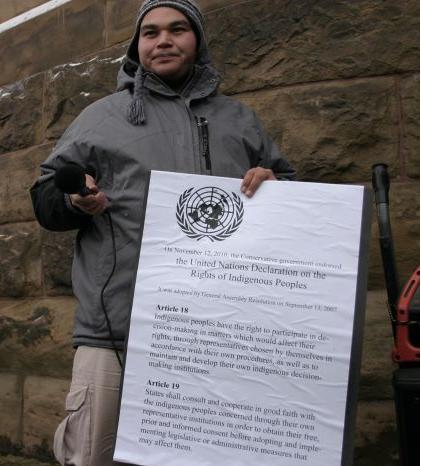
Liberal MP Anita Neville countered with an attack on the Conservatives’ record, criticizing the government’s decision not to honour the $5.1-billion Kelowna accord, signed at a first ministers meeting last November, and for opposing a United Nations declaration on the rights of indigenous peoples.
“How can the Prime Minister pretend to be a voice for human rights, as he declared over the weekend, while at the same time actively working to destroy the declaration on the rights of indigenous peoples?” she asked.
Mr. Prentice said his government is committed to honouring treaties.
“This government does not support this declaration because that particular declaration jeopardizes those treaties, the enforceability and the meaning of them,” he said.
From www.theglobeandmail.com
Across the world right now, Indigenous peoples are facing a renewed assault on their lands, rights, and ways of life.
From extractive industries pushing deeper into ancestral territories, to governments rolling back hard-won protections,
the threat is global—and it is growing.
What makes this moment especially dangerous is how little attention it receives.
Stories like this are disappearing in real time. Mainstream media
barely covers it and the coverage is fragmented. The public is left without the context
needed to understand what is truly at stake.
That is exactly why IC Magazine exists..
For more than 20 years, IC has reported on Indigenous struggles worldwide — consistently, independently, and without compromise.
We don’t follow news cycles; we trace patterns. We don’t sensationalize; we provide context.
And when the world looks away, we stay focused.
But this work is increasingly difficult to sustain.
We refuse to lock our reporting behind a paywall. We don’t sell access through subscriptions.
And we don’t answer to advertisers. IC Magazine survives solely because readers like you choose to
support independent Indigenous journalism.
Please donate today if you can. Every contribution helps us to continue this crucial work.
Thank you,
John Ahni Schertow
Founder and Editor in Chief