
Last Updated on July 28, 2014
http://www.youtube.com/watch?v=QLnMWZ_VQ5M
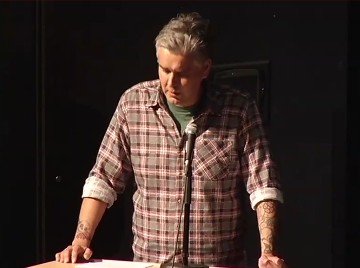
The now-legendary presentation given by Arundhati Roy in New York City at The Riverside Church, May 13, 2003:Instant-Mix Imperial Democracy (Buy One, Get One Free).
In these times, when we have to race to keep abreast of the speed at which our freedoms are being snatched from us, and when few can afford the luxury of retreating from the streets for a while in order to return with an exquisite, fully formed political thesis replete with footnotes and references, what profound gift can I offer you tonight?
As we lurch from crisis to crisis, beamed directly into our brains by satellite TV, we have to think on our feet. On the move. We enter histories through the rubble of war. Ruined cities, parched fields, shrinking forests, and dying rivers are our archives. Craters left by daisy cutters, our libraries.
So what can I offer you tonight? Some uncomfortable thoughts about money, war, empire, racism, and democracy. Some worries that flit around my brain like a family of persistent moths that keep me awake at night.
Some of you will think it bad manners for a person like me, officially entered in the Big Book of Modern Nations as an “Indian citizen,” to come here and criticize the U.S. government. Speaking for myself, I’m no flag-waver, no patriot, and am fully aware that venality, brutality, and hypocrisy are imprinted on the leaden soul of every state. But when a country ceases to be merely a country and becomes an empire, then the scale of operations changes dramatically. So may I clarify that tonight I speak as a subject of the American Empire? I speak as a slave who presumes to criticize her king.
Since lectures must be called something, mine tonight is called: Instant-Mix Imperial Democracy (Buy One, Get One Free).
Across the world right now, Indigenous peoples are facing a renewed assault on their lands, rights, and ways of life.
From extractive industries pushing deeper into ancestral territories, to governments rolling back hard-won protections,
the threat is global—and it is growing.
What makes this moment especially dangerous is how little attention it receives.
Stories like this are disappearing in real time. Mainstream media
barely covers it and the coverage is fragmented. The public is left without the context
needed to understand what is truly at stake.
That is exactly why IC Magazine exists..
For more than 20 years, IC has reported on Indigenous struggles worldwide — consistently, independently, and without compromise.
We don’t follow news cycles; we trace patterns. We don’t sensationalize; we provide context.
And when the world looks away, we stay focused.
But this work is increasingly difficult to sustain.
We refuse to lock our reporting behind a paywall. We don’t sell access through subscriptions.
And we don’t answer to advertisers. IC Magazine survives solely because readers like you choose to
support independent Indigenous journalism.
Please donate today if you can. Every contribution helps us to continue this crucial work.
Thank you,
John Ahni Schertow
Founder and Editor in Chief