
Last Updated on May 20, 2019
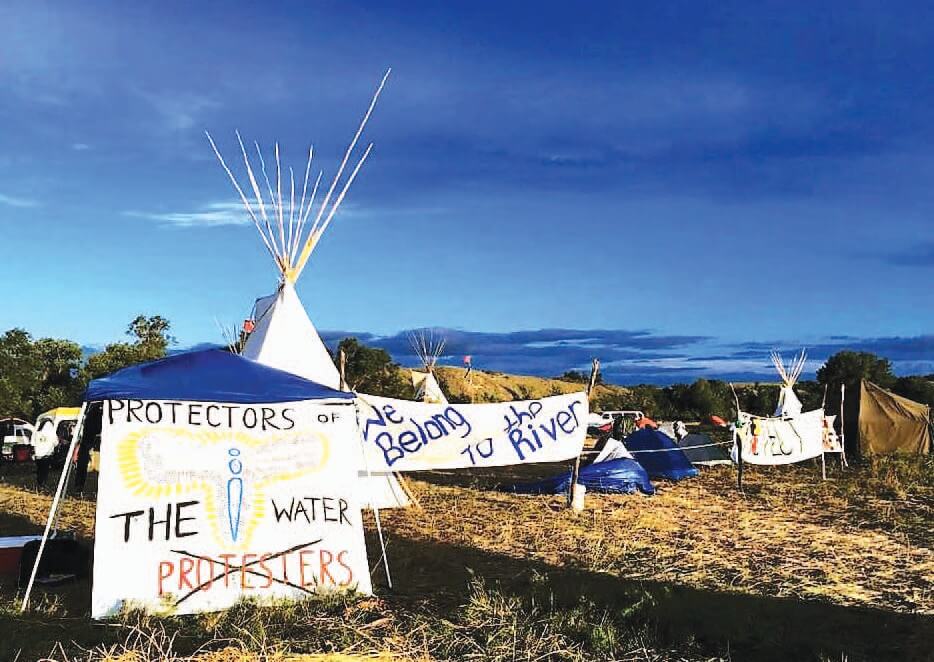
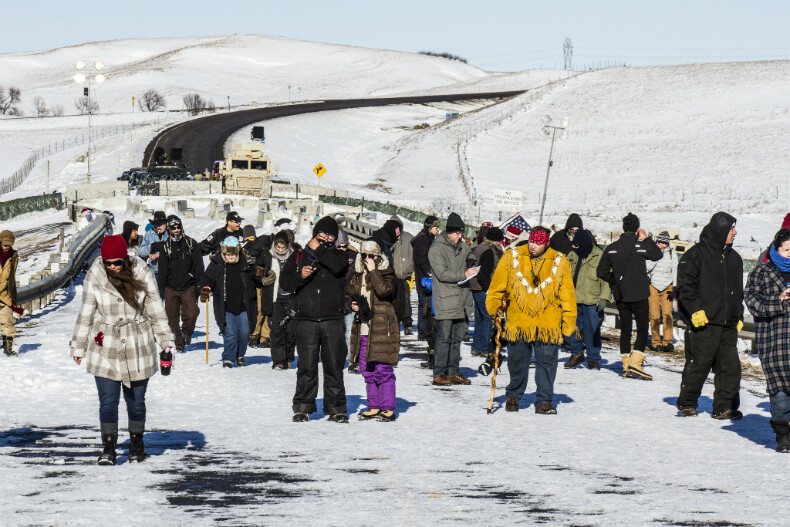
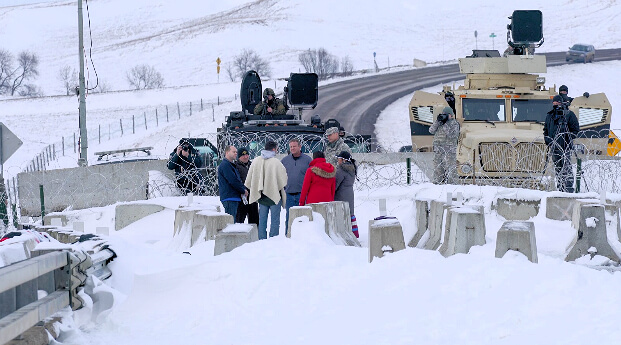
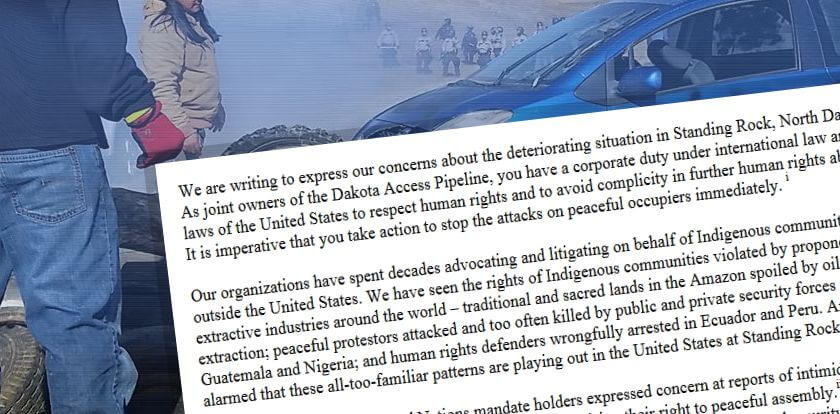
Six prominent legal and advocacy organizations warned the joint owners Dakota Access Pipeline of their legal responsibility amidst the escalating violence in Standing Rock, North Dakota. The letter highlights the corporate duty of project proponents Energy Transfer and Phillips 66 under international law and the laws of the United States to respect human rights and to avoid complicity in further human rights abuses.
The signatory organizations have spent decades advocating and litigating on behalf of indigenous communities when their rights have been violated by proponents of extractive industries around the world, from the Amazon to Nigeria, Guatemala to Peru and Ecuador. All-too-familiar patterns are now playing out in the United States at Standing Rock.
The letter cautions Energy Transfer, Phillips66 and lender Wells Fargo that, as a matter of international law, companies have an affirmative responsibility to protect human rights. It warns that the active involvement of state or local law enforcement does not absolve companies of these duties. To the extent that human rights abuses occur, business enterprises have an affirmative duty to avoid complicity in those abuses. The joint owners Dakota Access Pipeline may be responsible for injuries or losses suffered by the protestors, including those caused by private security forces or police working in concert with them or at their behest.
“The Indigenous peoples and the concerned citizens taking a peaceful stand at Standing Rock are protected not only by the Constitution, but by fundamental principles of human rights recognized the world over. The pipeline proponents have both a moral and legal duty to respect and protect those rights. Should they fail to do so, they can and should be held accountable,” says Carroll Muffett, President of the Center for International Environmental Law (CIEL).
“Unfortunately, we are used to seeing human rights abuses in our work outside the United States. It is deeply alarming to see these same abuses happening today in North Dakota,” says attorney Katie Redford, Director of EarthRights International. “EarthRights International has worked for decades to make sure all communities get justice for human rights abuses perpetrated by powerful corporations. The owners of DAPL should know that the world is watching them now and they too will be accountable to the communities and individuals they harm.”
The letter further warns that victims of human rights abuses occurring within the United States may seek redress not only through international human rights mechanisms but also in domestic courts. In this context, companies will not be absolved of responsibility or liability if their operations have aided and abetted the commission of tortious acts by third parties.
-//-
Contact:
Amanda Kistler, CIEL – akistler@ciel.org, 202.742.5832
Read full letter here.
Center for International Environmental Law (CIEL) – Founded in 1989, CIEL uses the power of law to protect the environment, promote human rights, and ensure a just and sustainable society.
Across the world right now, Indigenous peoples are facing a renewed assault on their lands, rights, and ways of life.
From extractive industries pushing deeper into ancestral territories, to governments rolling back hard-won protections,
the threat is global—and it is growing.
What makes this moment especially dangerous is how little attention it receives.
Stories like this are disappearing in real time. Mainstream media
barely covers it and the coverage is fragmented. The public is left without the context
needed to understand what is truly at stake.
That is exactly why IC Magazine exists..
For more than 20 years, IC has reported on Indigenous struggles worldwide — consistently, independently, and without compromise.
We don’t follow news cycles; we trace patterns. We don’t sensationalize; we provide context.
And when the world looks away, we stay focused.
But this work is increasingly difficult to sustain.
We refuse to lock our reporting behind a paywall. We don’t sell access through subscriptions.
And we don’t answer to advertisers. IC Magazine survives solely because readers like you choose to
support independent Indigenous journalism.
Please donate today if you can. Every contribution helps us to continue this crucial work.
Thank you,
John Ahni Schertow
Founder and Editor in Chief