Last Updated on November 13, 2011
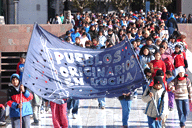
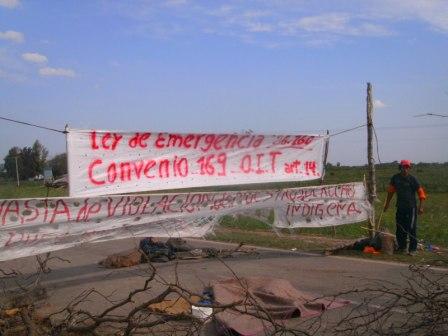
On Aug. 22, the government of Chaco province in northeastern Argentina signed a broad accord with representatives of the Chaco Indigenous Institute (IdACH) on land and budget issues in an effort to end a nearly three-month-old indigenous protest. Since June 6, some 500 indigenous people from rural areas of the province have been camped out in front of the provincial government building in the provincial capital, Resistencia, to demand land distribution, education and health care for Chaco’s indigenous communities, among other demands. Chaco, Argentina’s poorest province, is home to 60,000 indigenous people of the Toba, Mocovi and Wichi ethnic groups.
The accord was signed on behalf of the indigenous communities by IdACH president Orlando Charole, and on behalf of the provincial government by Minister of Government Hugo Matkovich and Minister of Economy Roberto DellOrto. Under its terms, the Chaco government is to provide titles for 140,000 hectares of land currently occupied by indigenous communities, and hand over new agriculturally viable lands. In addition, the government promised to review previous suspicious land sales to private parties, increase next year’s budget for the IdACH, continue licensing bilingual teachers and create new posts for bilingual and intercultural teachers. IdACH agreed to keep using the courts to pursue action against Lorenzo Heffner, mayor of Villa Rio Bermejito, for discrimination. A complaint against Heffner has been filed in federal court.
With the signing of the accord, the indigenous protesters agreed to abandon their encampment in Resistencia and return to their communities, though they said they will resume their protests if the government doesn’t fulfill its commitments. The accord also brought an end to a hunger strike by nine indigenous protesters who had been camped out on the floor in a windowless provincial government office in Resistencia for over a month. Twelve protesters began the fast on July 21, but three had to drop out over the subsequent weeks because of health problems. A group of indigenous protesters had also set up camp in front of the Chaco government’s offices in Buenos Aires the week of Aug. 14, to step up the pressure. (Agencia Informativa Pulsar, Aug. 23; Agencia Periodistica del Mercosur, Aug. 23; Ambito Financiero, Buenos Aires, Aug. 23; Pagina 12, Buenos Aires, Aug. 22; Article by Marie Trigona, Aug. 22 from Upsidedownworld.org)
According to the non-governmental Nelson Mandela Center for Research and Investigation, of 3.9 million hectares of public land that existed in Chaco in 1995, only 660,000 hectares remain. The indigenous communities, which under the law are supposed to be the main beneficiaries of land distribution, were shut out of the sell-off. (APM, Aug. 23)
From Weekly News Update on the Americas, Aug. 27
Across the world right now, Indigenous peoples are facing a renewed assault on their lands, rights, and ways of life.
From extractive industries pushing deeper into ancestral territories, to governments rolling back hard-won protections,
the threat is global—and it is growing.
What makes this moment especially dangerous is how little attention it receives.
Stories like this are disappearing in real time. Mainstream media
barely covers it and the coverage is fragmented. The public is left without the context
needed to understand what is truly at stake.
That is exactly why IC Magazine exists..
For more than 20 years, IC has reported on Indigenous struggles worldwide — consistently, independently, and without compromise.
We don’t follow news cycles; we trace patterns. We don’t sensationalize; we provide context.
And when the world looks away, we stay focused.
But this work is increasingly difficult to sustain.
We refuse to lock our reporting behind a paywall. We don’t sell access through subscriptions.
And we don’t answer to advertisers. IC Magazine survives solely because readers like you choose to
support independent Indigenous journalism.
Please donate today if you can. Every contribution helps us to continue this crucial work.
Thank you,
John Ahni Schertow
Founder and Editor in Chief