
Last Updated on November 9, 2010
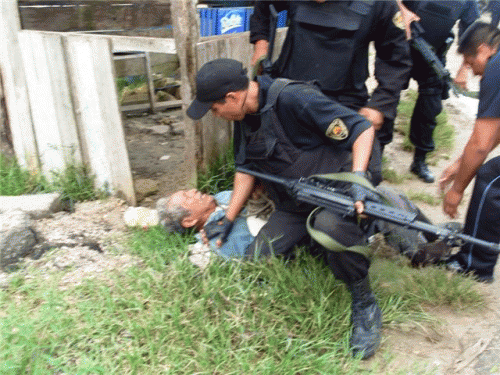
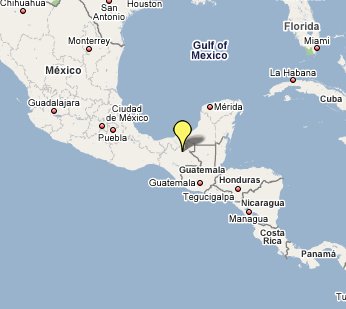
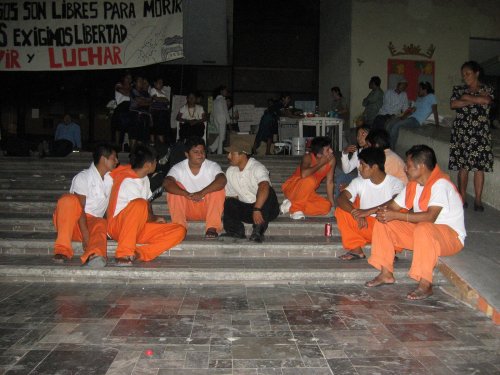
Kristin Bricker (mywordismyweapon.blogspot.com) reports that on Tuesday, April 1, “the Chiapas government freed thirty political prisoners in response to years of protests for their freedom, but not before giving some of them one last thorough beating.”
According to the recently released, while they were en route to a government press conference “the police beat them… until their heads and arms were purple and they were bleeding. Their wrists were bound tightly with tape, cutting off circulation to their hands. After the press conference, the police loaded them back into a government vehicle, beat some of them again, and told them they were going to be returned to jail, but then released them.”
Belonging to a variety of organizations,”including EZLN bases of support, adherents to the Zapatistas’ Other Campaign, an evangelical Christian organization, and the Party of the Democratic Revolution (PRD in its Spanish initials)” — at least two of the liberated spent the last twelve years in jail.
Seventeen more people are still incarcerated, however the government refuses to negotiate their release. As of April 1, thirteen of them have been on a hunger strike for 37 days. “Outside medical experts say that the symptoms the hunger strikers report and the amount of time they’ve gone without food has put their lives in danger, and that they may begin to die as early as Sunday [April 6]. ” Kristin explains.
The liberated have said “they will remain at the plantón (permanent protest encampment) outside the state government headquarters in Tuxtla until all of their compañeros are free,” she notes.
Please read the full article “Facing Escalating Protests, Chiapas Frees 30 Political Prisoners.” Kristin has also posted a letter you can send to support the political prisoners on hunger strike…
WE INVITE YOU TO SIGN THE FOLLOWING GLOBAL PUBLIC DECLARATION
For ethical, humanitarian, and just reasons, the people, organizations, and networks who sign this letter express our profound rejection of the deprivation of people’s liberty through the “fabrication” of crimes.
We are concerned because the criminalization of social movements is a strategy of the Mexican government to eliminate other ways of doing politics.
In this context, we demand the immediate and unconditional freedom of the political prisoners in Chiapas and Tabasco who have participated in a fast and hunger strike since February 25, and whose health condition is very grave. We declare our support for the freedom of all of the political prisoners of Chiapas and Mexico.
Life and respect for the dignity of all people are inalienable rights.
Signed,
[Please send your signature and country to laotrajovel@gmail.com with the message “Yo o mi organizacion quisiera firmar la carta por la libertad de los presos politicos”]
The original Spanish:
LES INVITAMOS A FIRMAR EL SIGUIENTE
PRONUNCIAMIENTO PUBLICO MUNDIAL
Por razones éticas, humanitarias y de justicia, las personas, organizaciones y redes abajo firmantes expresamos nuestro profundo rechazo a la privación de la libertad de personas mediante la “fabricación” de delitos .
Estamos preocupados porque la criminalización de los movimientos sociales es una estrategia del gobierno mexicano para eliminar otras formas de hacer política.
En este contexto, exigimos la liberación inmediata e incondicional de los presos políticos de Chiapas y Tabasco que se encuentran en ayuno y huelga de hambre desde el 25 de febrero cuyo estado de salud es sumamente grave. Nos pronunciamos por la liberación de todas las personas presas políticas de Chiapas y de México.
La vida y el respeto a la dignidad de todas las personas son derechos inalienables.
Firmas
Envien sus firmas con sus paises a laotrajovel@gmail.com
Across the world right now, Indigenous peoples are facing a renewed assault on their lands, rights, and ways of life.
From extractive industries pushing deeper into ancestral territories, to governments rolling back hard-won protections,
the threat is global—and it is growing.
What makes this moment especially dangerous is how little attention it receives.
Stories like this are disappearing in real time. Mainstream media
barely covers it and the coverage is fragmented. The public is left without the context
needed to understand what is truly at stake.
That is exactly why IC Magazine exists..
For more than 20 years, IC has reported on Indigenous struggles worldwide — consistently, independently, and without compromise.
We don’t follow news cycles; we trace patterns. We don’t sensationalize; we provide context.
And when the world looks away, we stay focused.
But this work is increasingly difficult to sustain.
We refuse to lock our reporting behind a paywall. We don’t sell access through subscriptions.
And we don’t answer to advertisers. IC Magazine survives solely because readers like you choose to
support independent Indigenous journalism.
Please donate today if you can. Every contribution helps us to continue this crucial work.
Thank you,
John Ahni Schertow
Founder and Editor in Chief