Last Updated on April 10, 2025
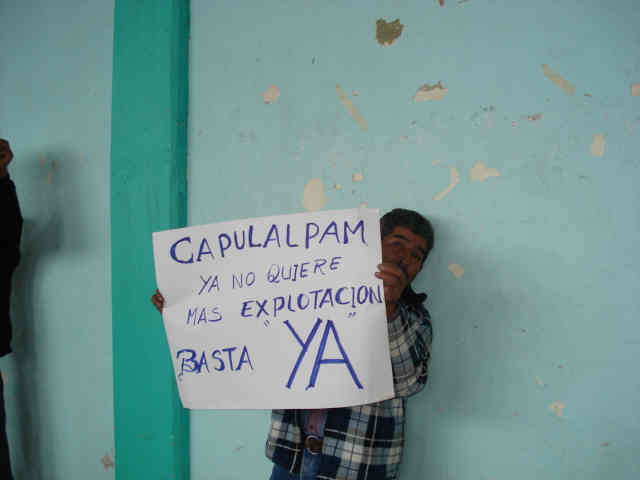
Following the standard now synonymous with Canadian mining, Vancouver-based Continuum Resources has reactivated the historic “Natividad” mine site, an area of Oaxaca that’s been looted since before the 17th Century. Largely on Zapotec land, the site is reported to be Oaxaca’s richest gold and silver mine.
Historically, thousands of Zapotec have worked the mine, but today the consequences of development are too well understood. Over the course of 230 years, more than a million ounces of gold and 23 million ounces of silver have been extracted from the site, but the only real ‘benefit’ to the community has been the death of their soil, the drying of their rivers, and the toxification of their land.
Today, Continuum holds more than 54,000 hectares of concessions at the Natividad site, extending that legacy of destruction for generations to come.
On Friday, the Dominion published Canada’s Mining Continuum, which details what’s been happening:
“The whole territory of Capulálpam is communally owned,” explains Francisco Garcia López, a member of Capulálpam’s Commission of Communal Goods, standing on a rock above a river valley and indicating with a sweep of his arm the forests, rivers and mountains that comprise the municipality.
He then points down to a series of white buildings, with mining carts on tracks leading to openings into the earth.
“For 230 years, gold and silver mining companies have been exploiting tunnels in the mountains,” he explains.
Thousands of people from Calpulálpam worked in the mine, until the union was broken in 1993. Only a few hundred people, mostly from the nearby town of Natividad, stayed on. In the last few years, there has been little activity at the mine.
[…] According to López, over the last few years, 13 streams have disappeared completely because of Continuum’s exploration activities. The National Water Commission (Conagua) has confirmed that during the course of their activities, Continuum Resources captured underground water, which resulted in the disappearance of springs. The company maintains that “the mine and the mining activity are not responsible for the disappearance of the springs.”
“People in Capulálpam know that mining isn’t sustainable” says Aldo Gonzales Rojas, a member of the Union of Organizations of the Sierra Juarez (UNOSJO), an organization devoted to popular education and farmer-to-farmer outreach. In addition to dried up springs and contaminated water, “people can’t use sand from the rivers anymore because it’s contaminated, nor can we capture the frogs that are part of our diet without leaving our traditional territory,” says Rojas.
[…]”All of our complaints to the government were falling on deaf ears,” says López, referring to the dozens of attempts by the municipal council and community organizations to have the federal or state government intervene in environmental conflicts with the company.
In October of 2007, the Federal Environmental Protection Agency (Profepa) ordered Continuum to halt all exploitation activities at Natividad due to environmental complaints. Locals were glad that the government stepped in, but remained concerned that the company would continue exploration work.
“We decided to take collective action,” says López, referring to the decision by members of the community, including the mayor, to block the main highway out of Oaxaca City.
“On October 16th, we blocked the highway with fifty pickup trucks for five hours, demanding the permanent closure of the Natividad mine.” They withdrew the roadblock once a working dialogue with the Secretary of Economy, the sub-Secretary of Government and Profepa was agreed upon.
You can You can read the full article at dominionpaper.ca. Threre’s also more information available (in Spanish) at www.defendamoslasierrajuarez.org
Considering:
I. That mining is not a source of development and progress for any people of the world.
ii Mining activity has a sharp impact on the environment, with particular effect on water and soil, creating effects such as desertification, deforestation and the destruction of ecosystems.
iii The start of mining projects put at serious risk the quantity and quality of water available to the nation for its people and their livelihood.
Iv The high seismicity of our land poses a serious risk to workers in the mine and also to the nearby communities.
v Mining was incompatible with agriculture and animal husbandry are the main sources of sustaining communities, threatening the country’s food security.
Vi It’s been verified that mining [heavy metals] puts at high risk the health of the population, being able to cause death, due to the use of injurious materials in great amounts.
Vii The activity generated by mining companies promotes the fragmentation of the social fabric.
Viii Government authorities are being corrupted with gifts and “benefits”, producing social decomposition and the purchase of a few to the damage of all.
Ix According to the ILO Convention 169, any project affecting communities must be consulted; not doing so, the government is violating community autonomy.
As the community of Capulalpam de Mendez requires:
1 . The final and immediate closure of the natividad mine.
2 . The cessation of pressure by the government and transnational corporations to the community for granting permission for mining.
3 . The return of the land occupied by the mining company to the community of Capulalpam de Mendez.
4 . The payment for environmental damage caused by mining community of Capulalpam de Mendez
Capulalpam de Mendez May 2007.
Across the world right now, Indigenous peoples are facing a renewed assault on their lands, rights, and ways of life.
From extractive industries pushing deeper into ancestral territories, to governments rolling back hard-won protections,
the threat is global—and it is growing.
What makes this moment especially dangerous is how little attention it receives.
Stories like this are disappearing in real time. Mainstream media
barely covers it and the coverage is fragmented. The public is left without the context
needed to understand what is truly at stake.
That is exactly why IC Magazine exists..
For more than 20 years, IC has reported on Indigenous struggles worldwide — consistently, independently, and without compromise.
We don’t follow news cycles; we trace patterns. We don’t sensationalize; we provide context.
And when the world looks away, we stay focused.
But this work is increasingly difficult to sustain.
We refuse to lock our reporting behind a paywall. We don’t sell access through subscriptions.
And we don’t answer to advertisers. IC Magazine survives solely because readers like you choose to
support independent Indigenous journalism.
Please donate today if you can. Every contribution helps us to continue this crucial work.
Thank you,
John Ahni Schertow
Founder and Editor in Chief